







Increasing conflict in Iran has sparked uneasiness among Persian and Iranian community members at San José State throughout the past few months.The ongoing conflict has resulted in some members of SJSU losing contact with their families in Iran.
On April 7, President Donald J. Trump threatened to kill a “whole civilization” (Iran) if Iranian authorities did not comply with his demands of reopening the Strait of Hormuz by 8 p.m. Eastern Standard Time, according to an April 7 New York Times article.
Nima Abrishamkar, a senior analyst at SJSU, said she was counting down every second on the clock until Trump’s proposed deadline. “It was very tough and asking my question every second, ‘Is it going to happen?’ ” Abrishamkar said. “Who’s gonna be alive (the) next morning?”
The United States and Iran agreed on a two-week ceasefire along with reopening the Strait of Hormuz, according to an April 7 AP News article.
Conflict in Iran increased because of an economic collapse in December 2025, which led to Iranian currency (rials) reaching a record low of 1.4 million per U.S. dollar, according to a Jan. 27 Stimson article.
The collapse sparked protests in January 2026 throughout Iran, according to the same article.
Iranian citizens lacking water, electricity, internet and other resources swarmed the streets of Tehran, the nation’s capital, to which the regime met them with a violent crackdown, according to a Jan. 26 Amnesty International article.
Avissa Abbaszadegan, a third-year advertising student, has family members currently living in Iran. This includes her dad, great-aunt, cousins and two younger brothers.
“It’s really hard to go about everyday life, knowing your family could be dead or not knowing if they’re dead or alive,” Abbaszadegan said.
The Iranian government reported that 3,117 people died during the protests, according to a Jan. 21 PBS article.
The lack of communication from inside Iran makes it difficult to narrow down how many people actually died; however, some reports estimated a death toll of 30,000 or more, according to a Jan. 27 The Guardian article.
When Abbaszadegan was 10 years old, she moved to the United States with her mother. She visited Iran last summer and came back to the U.S. the same day that Israel first struck Iran in June 2025.
“And it’s weird because I went over summer and I met this woman who was friends with a friend of mine, and she died,” Abbaszadegan said. “She was murdered. And it’s so heartbreaking to see that. It’s so heartbreaking to see people that I probably passed on the street dead now, like they’re all my age.”
Abbaszadegan said that most people killed are from her hometown of Mashhad.
“All of my friends have a friend that they have lost,” Abbaszadegan said.
On Feb. 28, the Ayatollah and Supreme Leader of Iran, Ali Khamenei, died in an air strike carried out by the U.S. and Israel, which also killed other top military generals, according to a Feb. 28 The New York Times article.
The joint strikes from Israel and the U.S. plunged the countries into a conflict with Iran, but the United States Congress has yet to declare an official state of war, according to a March 5 PBS article.
Abbaszadegan said that the people of Iran were begging for foreign intervention to try and change the regime.
“I understand when people are against the war, but it’s really hurtful to see people supporting the regime in Iran and the leader in Iran when that same leader has killed and tortured my friends,” Abbaszadegan said.
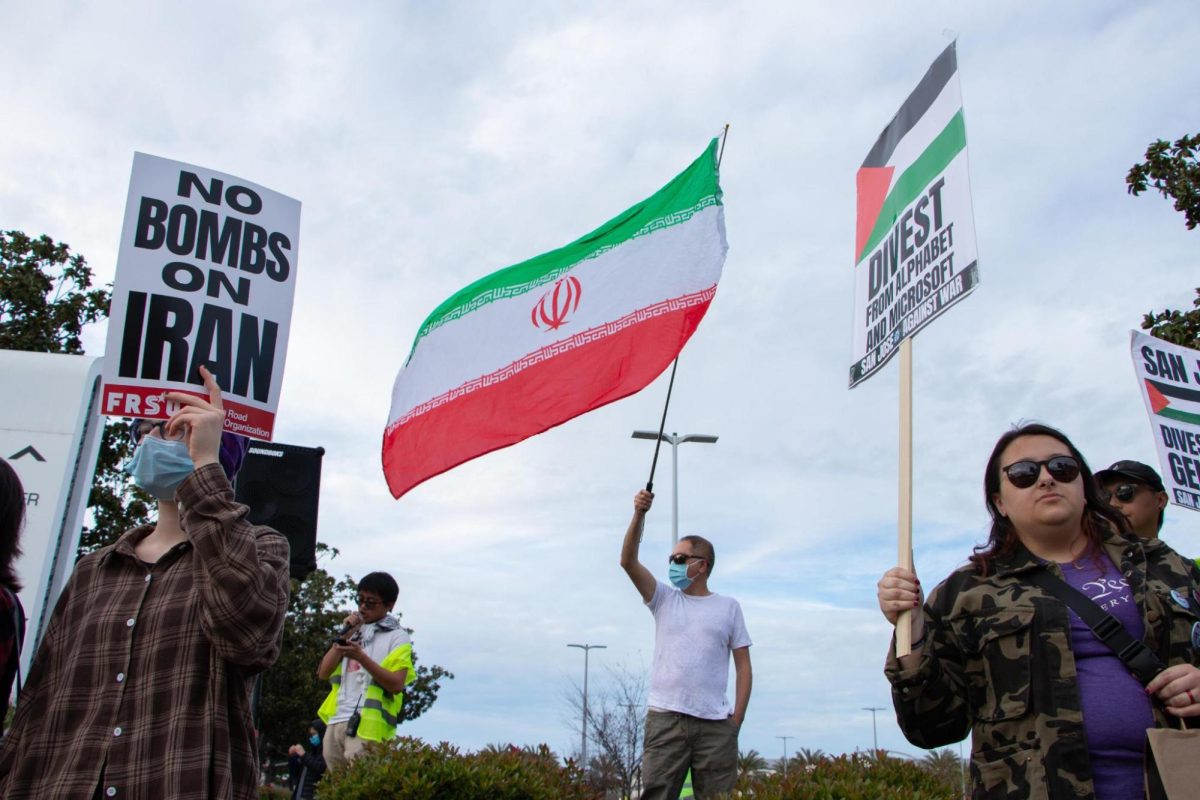
Since the conflict started, there has been a surge in protests throughout the Bay Area, either protesting the military action or supporting a change in regime in Iran, according to a March 3 NBC Bay Area article.
An anonymous community member who was born and raised in Iran, who spoke to the Spartan Daily on the condition of anonymity out of concern for their safety, said they have multiple family members living in Iran.
“We all have mixed feelings,” they said. “Of course, nobody likes war. Nobody wants to see their country being attacked. But things are just not good for so many years, and it gets worse and worse that actually most of Iranians are happy.”
Hundreds of Persians and Iranians in the U.S. took to the streets in support of Trump’s decision to strike Iran, according to a Feb. 28 KATV article.
The anonymous source said they understand why Americans don’t want the war, but for Persians and Iranians, they haven’t been able to make progress without outside help.
“I feel like Americans, they don’t want to be in war, like it’s not your problem,” they said. “… from our perspective, that anytime we try and do something, or we try to have a revolution, they massively killed the people.”
There have been major protests in Iran over the last few years, such as in 2019 in response to the government hiking gas prices up to 300% and the 2022 protests because of the death of Mahsa Amini, according to a May 30, 2023, United States Institute of Peace article.
Each protest led to civilian detainment and death, according to the same article.
The anonymous source said they have hope because of the military campaigns against Iran and how the regime sees its own people as enemies.
“They shut down the internet so people cannot, you know, communicate with each other,” the anonymous source said. “They cannot protest against them. So basically, they cut the internet on their enemies.”
In the past, Iran’s regime has used its power to suppress its citizens’ freedom of expression and assembly with punishments including torture, amputation and the death penalty, according to an Amnesty International webpage.
“The things that happened to the people that went to protest, like basically if they caught you, the best thing that can happen to you is just like they got killed,” the anonymous source said. “They torture people, people who got out like they’re not normal. They cannot go back to their normal life.”
Iranian authorities have committed mass detentions of protesters from the Jan. 8 and 9 protests while also forcibly disappearing people by denying them access to lawyers and family contact, according to a Feb. 24 Human Rights Watch article.
Along with mass detainments, Iranian authorities have coerced confessions from hundreds of detainees, including children, according to the same article.
Two children are currently facing the death penalty because of the January protests, according to a Feb. 20 Amnesty International article.
In 2022, Abbaszadegan’s friend was imprisoned for a week, returning with scars after being tortured by law enforcement.
“It’s so hurtful to see people here who have the freedom to speak and who have the right to speak their mind, support a regime who’s not allowing their people to have freedom of speech and freedom to protest,” Abbaszadegan said.
Other Iranians and Persians across the country, including Abbaszadegan, are grieving and mourning the deaths in Iran.
Students at colleges around America, such as Yale University and Tufts University, have held vigils for Iranians killed in the mass protests, according to student media at the universities.
Vigils remembering the Iranians who have died have also been organized in major cities throughout the U.S., such as Washington, D.C. and Seattle, Washington.
“A lot of my friends and family here have been getting sick because their bodies can’t handle all this stress,” Abbaszadegan said.
Nima Abrishamkar lived in southern Iran until Iraq invaded her hometown, causing her to move to Tehran in 1981. She moved to the U.S. in 1989 to study computer science and attended De Anza College and SJSU.
Abrishamkar said she focuses on her mental health by staying calm, doing meditation and deep breathing exercises.
“The first thing that I ask myself every morning is, ‘I’m alive so what can I do to help others?’ ” Abrishamkar said.
She emphasized it is very important to share hope when trying to manage the grief and worry of having a family living in Iran.
“I know the people of Iran are gonna be free one day, but is war the answer, or not? I’m not sure,” Abrishamkar said. “They have more economic problems now, a lot of civilians are dead, so many people have lost their jobs, but there is always hope, always.”