





The Vietnamese community holds great importance to the City of San José, with many families rebuilding their lives there after the Vietnam War.
Many adapted to living in California, fought for recognition to establish a community and continue to advocate for social and political change.
Immigrating from Vietnam to San José
Over 50 years ago, the fall of Saigon marked the end of the Vietnam War on April 30, 1975. The end of the war led to the mass exodus of Vietnamese refugees escaping to other countries.
Binh Danh, an associate professor in art at San José State, said he was born after the Vietnam War, with his family immigrating to the United States in 1979.
“We escaped Vietnam on a boat in 1978,” Danh said. “We left by getting on boats, going down to the South China Sea and getting rescued by other neighboring countries.”
From 1975 to 1992, many sought asylum and nearly two million Vietnamese people fled their native country, risking their lives by taking to the sea, according to a Vietnamese Boat People webpage.
Many Vietnamese people who were fortunate ended up in refugee camps in neighboring Southeast Asian countries; others were captured by pirates and many lost their lives during the voyage across the sea, according to the Vietnamese Heritage Museum website.
“Refugee camps were scattered throughout Asia, and then people started to apply for asylum,” Danh said. “So we got asylum in the U.S. We could have easily gone to France or Australia, but somehow the U.S. selected us.”
Danh said his family relocated to San José, where he grew up a part of the Vietnamese community.
Interested in studying photography, Danh said he attended SJSU to major in fine arts.
It was here that Danh would become interested in Asian American history and his own backstory.
“I took an Asian American study class,” Danh said. “When I took that class because I wanted to know more about Asian American history, I also was very interested in my history as a Vietnamese American coming to the U.S., born in Vietnam, but came here as a refugee.”
Passionate for photography and history, Danh said he produced his highly acclaimed series of chlorophyll prints titled “Immortality: The Remnants of the Vietnam War and American War,” which involved exposing images of the Vietnam War to leaf surfaces, printing images through photosynthesis.
“Growing up, the Vietnam War has always been on my mind,” Danh said. “It wasn’t until now that I can look back and sort of piece together, understand my journey as an artist.”
The Vietnamese American community is prominent in San José, with roughly 145,000 Vietnamese people living in the city, according to a May 1, 2025 Pew Research Center fact sheet.
John Dam, a San José local, first came to the U.S. in 1975 after leaving Saigon with his family when he was 16 years old.
“My brother was in the Navy and his station was in Saigon,” Dam said. “So we got on his warship and we sailed to the Philippines, then we went to Guam Island and we went to Camp Pendleton.”
The U.S. had several refugee camps such as Camp Pendleton in California, Fort Chaffee in Arkansas, Eglin Air Force base in Florida and Fort Indiantown Gap in Pennsylvania, according to a PBS article.
His family would be sponsored to move to Great Falls, Montana, where he would live for four years.
“We got there on the evening of Oct. 30, 1975,” Dam said. “And I remember clearly, because the next day, it started snowing. And I have never seen snow before that and it was beautiful, all white everywhere.”
In 1979, Dam moved to California, where he attended college at West Valley College and the University of California, Santa Cruz.
He got involved in helping the Vietnamese community by assisting Vietnamese immigrants with becoming citizens while recognizing the importance of voting.
“Many of us were becoming citizens, and in Vietnam, (the) government is seen as corrupt,” Dam said. “So most of all did not want to be involved in politics. Growing up, going to school, we realized that if you don’t vote, you had no voice, no power. You want to make changes in the community, you got to vote.”
Christina Vu, a third-year psychology and public health student and ACE Chair for the Vietnamese Student Association, said for many Vietnamese Americans there is a struggle to find identity and culture.
“It doesn’t matter if you’re half or full Vietnamese, or even if you’re from Vietnam, I think what all Vietnamese Americans do share is a story of our parents escaping Vietnam to provide us to get us here,” Vu said.
At SJSU, the Vietnamese Student Association (VSA) is a student organization founded in 1978 to encourage students to get involved in the Vietnamese community, according to its website.
“VSA is built upon Vietnamese Americans that are willing to partake in activism, policy, advocacy and anything to uplift the Vietnamese American community within San José,” Vu said. “A lot of Asian Americans I see partake in VSA to get closer to that sort of connection.”
Establishing a community in San José
Many refugees immigrated to California and Texas after the war, with San José becoming home to the largest Vietnamese community outside of Vietnam, according to the Visit San Jose website.
Trung Nguyen, an assistant professor in ethnic studies at SJSU, said in the late ’70s and early ’80s, there were few Vietnamese people living in San José.
In the 1980s, many Vietnamese moved to San José because the tech industry was booming with manufacturing jobs and opportunities to move upward into engineering fields, according to an article from Eater.
“When San José transitioned to tech manufacturing, because this area really was one of the first centers of tech manufacturing in the world, this created explosions of jobs and this is low-wage, working-class jobs in factories,” Nguyen said. “So with the promise of jobs for folks who were immigrants or refugees and didn’t need to know English, this became one of the sites where the first Vietnamese migrants were at that time.”
Early Vietnamese immigrants had access to pre-existing Asian businesses in San José, with many eventually opening their own businesses and restaurants, according to an April 30, 2025 article from Asian & Pacific Islander Americans in Historic Preservation.
“Once the first few Vietnamese folks came, they were able to open up some grocery stores or restaurants and that became the seeds of the first community,” Nguyen said.
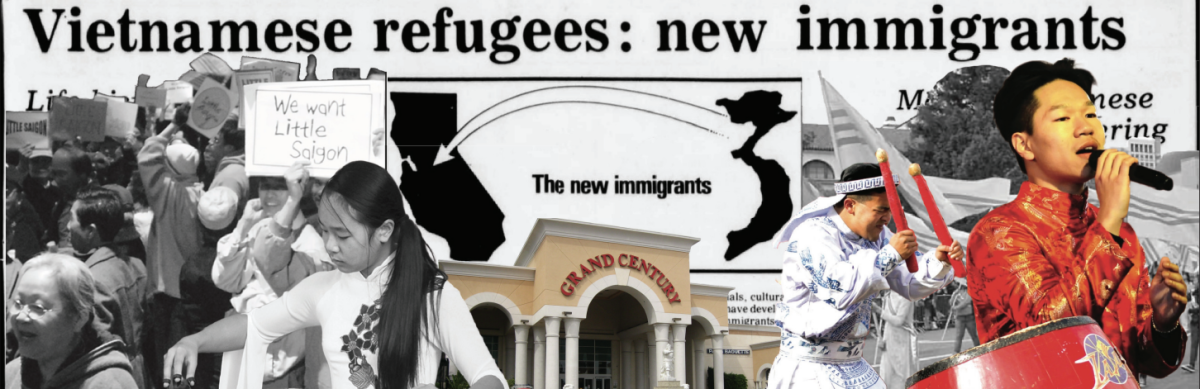
Many Vietnamese businesses center around Story Road in San José, including Grand Century Mall and Vietnam Town. The shopping plazas are about one-and-a-half miles southeast of SJSU.
In 2008, many Vietnamese Americans were split over the proposed district name for the one-mile stretch on Story Road to either be called “Little Saigon” or “Saigon Business District.”
Many wanted “Little Saigon” as it honored the fallen capital of Vietnam (now called Ho Chi Minh City), according to a Jan. 28, 2008 SFGate article.
Madison Nguyen, the first Vietnamese American elected to the San José City Council, compromised on dubbing it as the “Saigon Business District,” according to the same article.
Hien Do, a sociology professor at SJSU, said the controversy behind the name for Vietnamese Americans was because “Little Saigon” had a specific meaning.
“It was a sort of place of nostalgia,” Do said. “It was a place where all Vietnamese refugees can be together, can commemorate, can remember what their life was like before 1975.”
Many celebrated at City Hall when the district was officially named “Little Saigon,” while actively in the works to recall Madison Nguyen, according to a May 18, 2008 article from the Mercury News.
“Throughout all the United States, what you have is mostly called ‘Little Saigon,’ ” Do said. “You don’t have the ‘Saigon Business District,’ because that did not convey the sentimentality, the philosophy and also the historical importance of the development of that community.”
Madison Nguyen defeated the recall effort in 2009 and was appointed by the City Council to serve as San José’s first Vietnamese American vice mayor in 2011, according to an Aug. 12, 2012 article published by the East Bay Times.
Her efforts showed the beginning of political leadership in the Vietnamese American community in San José, with Councilmember Bien Doan currently representing District 7 and Supervisor Betty Duong representing District 2 on the Santa Clara County Board of Supervisors.
Doan worked in healthcare and as a firefighter for 27 years, serving as the first Vietnamese fire captain at the San José Fire Department, according to the San José District 7 webpage.
Doan said his experiences taught him how to serve the community and its people.
“Whether it is responding to a medical emergency or a fire call, the job teaches you that helping others is not just a profession, it is a responsibility,” Doan said. “Those experiences shaped my values. They taught me the importance of teamwork, compassion and being ready to serve the community whenever people need help.”
Doan said representing District 7 is very personal to him because his family’s journey is similar to many others immigrating to America from Vietnam.
“When you grow up here, you see how much sacrifice people made to create what we have today, the businesses, the temples, the churches and the cultural traditions that keep our community strong,” Doan said. “That experience absolutely influenced my decision to run for city council. I wanted to give back to the community that helped shape my life and represent the voices of the families who built Little Saigon into what it is today.”
Duong grew up in San José translating for her parents, guiding them through government and social agencies, according to the District 2 Santa Clara County website.
Prior to becoming supervisor for District 2, Duong said she was project manager for the development of the Vietnamese American Service Center and helped develop the Language Access Unit for Santa Clara County.
The Vietnamese American Service Center was created to help address the social and health disparities in the Vietnamese American community while the Language Access Unit was developed to bridge the gap between language barriers in county departments.
“Both of these highlights came out of that childhood experience that ‘What is the world I wish (my parents) had’ when we were growing up and being able to build that now and reenvision that now for recent immigrants,” Duong said.
Current Events
The Vietnamese community has been facing deportations from the United States Immigration and Customs Enforcement (ICE) with removal orders starting in 2017 during President Donald J. Trump’s first presidential term, according to the Asian Law Caucus.
Trung Nguyen said ICE is deporting Vietnamese people.
“We are one of the highest deportation rates under Asian and ethnic communities in the United States,” Nguyen said.
Fifty-eight people were deported from the U.S. to Vietnam between October 2023 and September 2024, along with 8,675 people considered Vietnamese citizens who have final removal orders as of November 2024, according to a March 28, 2025 Sahan Journal article.
Do said people are being deported because some may have committed a crime when they were children.
“Now (they) are sought after by ICE agents and being sent to Vietnam,” Do said.
Seventy-seven Vietnamese people were deported from the U.S. to Vietnam in the first three months of 2026, according to a March 24 article from VnExpress.
“I assume that the majority of them don’t know anything about Vietnam, probably left when they were young or were born here, and yet, there’s this assumption that they’re going to go back and now going be thrown into a country that they don’t know anything about and are expected to survive,” Do said.
A Vietnamese immigrant, Tuan Van Bui, died on April 1 in government custody at the Miami Correctional Center in Indiana and is the 46th person to die in federal custody this year after being detained by ICE, according to an April 7 ABC article.
The federal organization regards Bui as a “criminal illegal alien from Vietnam” in a news release, while an American Civil Liberties Union of Indiana news release reports Bui had “lived in the United States for 25 years.”
“We have people who died in ICE detention because of neglect, and these include Vietnamese Americans,” Nguyen said.
San José has multiple organizations that offer civic engagement, immigration resources and community organizing events for the Vietnamese community, such as the Vietnamese American Roundtable and the Vietnamese American Organization.
The Vietnamese American Roundtable provides information to report ICE activity, while the Vietnamese American Organization offers support to help individuals gain citizenship or fight against removal orders for deportation.
Nguyen said the reason why the Vietnamese community in San José has resources for refugees and immigrants is because many people fought for them.
“Vietnamese refugees and Vietnamese communities have been fighting for things like this for decades,” Nguyen said. “What we have today is because of the fight we put in already. So this does not mean the fight is over because things can be taken away in an instant.”