



Though there have been great strides in advancing LGBTQ+ rights since the early 1900s, some Filipino-Americans are looking to the past for inspiration.
Kailyn Altringer San José State’s MOSAIC Cross Cultural Center cultural programmer, said that before Spanish colonization, queerness in the Philippines was well-integrated into indigenous culture and concepts of gender and sexuality were diverse and spiritual.
Altringer led an educational presentation on the history of LGBTQ+ activism in the Philippines and the ideological shifts around gender and identity pre- and post-Spanish colonization.
They said they hoped that sharing the history of queer culture in the pre-colonial Philippines would help challenge colonial narratives about identity and queerness.
“When I was researching, I learned so many things that I didn’t even know and it’s not talked about among Filipinos, which was kind of crazy because it’s such a big history,” Altringer said. “Spanish colonization erased a lot of Filipino queer history, so people don’t really remember or talk about it anymore.”
They said that in pre-colonial Philippines, queer and non-binary individuals were recognized as spiritual leaders, healers and priests.
“In pre-colonial culture, queerness wasn’t something to hide or correct; it was normal and ingrained into their spirituality and many queer figures were praised as higher beings,” Altringer said.
Some of the Philippines’ most prominent deities were androgynous. Lakapati was a Tagalog deity of fertility, agriculture and prosperity who was often depicted as having both male and female traits, according to a ASWANG Project Nov. 29, 2018 article.
“She’s depicted as an androgynous transgender figure that embraced both masculine and feminine energies,” Altringer said. “That was seen as a symbol of harmony and balance in the interconnectedness of life – being able to prove that these different energies could all coexist.”
They said gender and sexuality were not strictly conceived in binary terms, and that terms existed for third genders and gender-crossing identities.
Babaylans were typically female healers but were sometimes male with feminine traits or had diverse sex characteristics, according to a March 2022 Alon: Journal for Filipinx American and Diasporic Studies article.
The terms asog or bayók described male-bodied, feminine-presenting babaylans whose embodiment of the feminine allowed them to fulfill powerful shamanistic roles, according to the same source.
The word bakla would later supplant these terms as an umbrella term for gays, in the absence of the word transgender, when English became the Philippines’ second language.
Altringer said that with the introduction of Catholicism and Western gender norms during the Spanish colonization of the Philippines from the 16th to 19th centuries, babaylans were demonized, executed and re-written as unclean, unholy and unbaptised devil worshippers.
Altringer said Lakapati’s androgyny was erased and vilified, with later retellings of her story replacing her divine fluidity with rigid gender binaries.
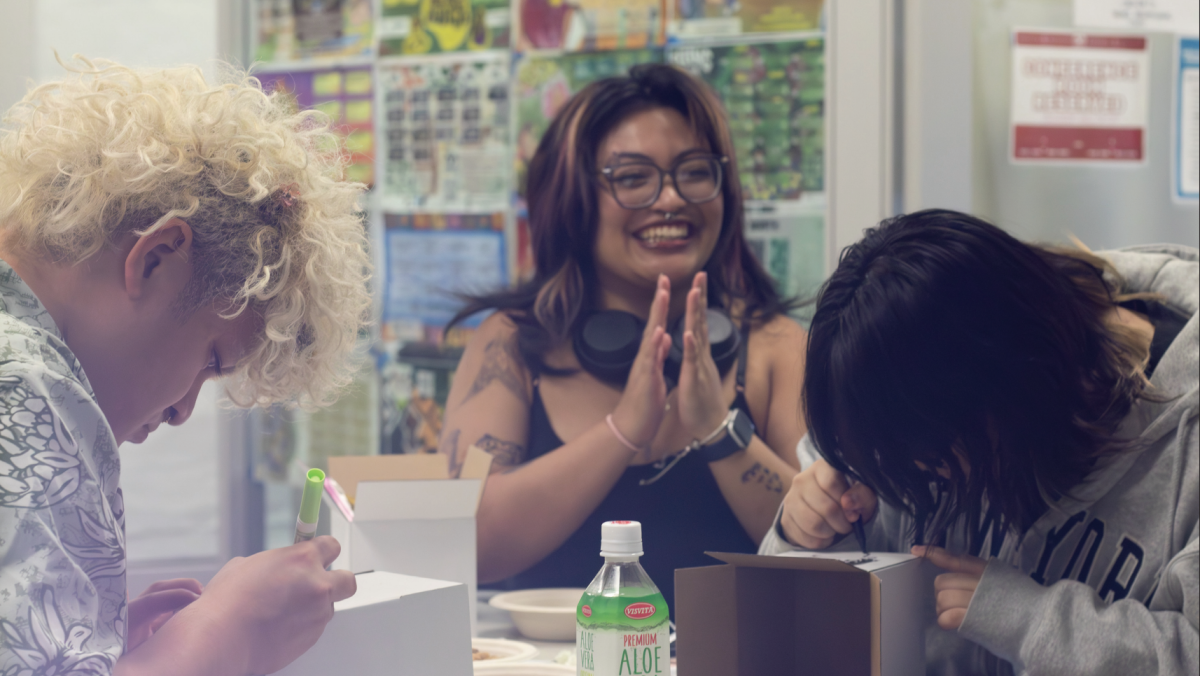
After their presentation, Altringer led participants in making balikbayan boxes, which are packages filled with goods such as food, household items and clothing that are sent to relatives in the Philippines from overseas.
A balikbayan is a member of the Filipino diaspora visiting or returning to the Philippines after a period of living in another country, according to the Oxford English dictionary.
Coined in the 1970s, the word is a combination of two Tagalog words: balik meaning to return and bayan meaning homeland, according to a 2006 article from Columbia University’s Department of Anthropology.
Altringer said they and their mother would pack balikbayan boxes for their relatives overseas almost every year.
“(The event) is unboxing the history,” Altringer said. “So (the balikbayan box) is kind of a metaphor for all of that.”
Among the materials provided to decorate the boxes were markers, stickers and memes related to being Filipino, such as “Born Filipino Raised Swagapino,” “I have two sides: Heaven / Filipino” or “Online I’m fine, but IRL I’m A FILIPINO.”
“I wanted to keep it light hearted and silly because it’s supposed to be fun,” Altringer said.
Participants snacked on popular Filipino snacks such as SkyFlakes crackers, Unisman King Choc Nut candy bars and Boy Bawang cornick as they crafted their balikbayan boxes.
Itzel Ramirez, a third-year political science and economics student, said the presentation gave historical context to news she would see about the Philippines on social media.
“I’ve seen on TikTok that there was this beauty pageant for transgenders and it was located in the Philippines,” Ramirez said. “Learning a bit about how the history of how sexuality wasn’t necessarily put in a category, but just left to how you felt, kind of made me make the connection between those two, and the significance of why the pageant was held in the Philippines.”
Hosted in Pattaya, Thailand the Miss International Queen is the world’s biggest and most prestigious beauty pageant for transgender women.
Lute Finau, a fourth-year public health student, said she enjoyed learning about and seeing parallels between Filipino culture and her own Tongan culture.
“I didn’t know that it was pretty similar to our culture too, because we didn’t have any binary labels or anything back then, pre-colonialism,” Finau said. “It was really cool to just kind of see the similarities that we have in both of our cultures.”
Though the island nation of Tonga was never formally colonized, much of contemporary Tongan society bears signs of Western influence, according to a Feb. 19, 2019 Vice News article.
“I feel like, definitely, with the spread of Christianity, it definitely made that change where it was deemed negative to be queer and be LGBTQ(+),” Finau said.
Modern activism, however, has encouraged Filipinos to reconnect with precolonial values of community, equality and respect.
In June of 1994, the Philippines held “Stonewall Manila,” the first Pride march in Asia, inspired by the 1969 Stonewall riots for gay liberation in New York City, according to a Global Voices June 11, 2021 article.
In June of 1969, patrons of the Stonewall Inn, a gay bar in Greenwich Village, resisted police harassment of LGBTQ+ people in a series of violent confrontations that came to be known as the Stonewall riots, according to Britannica.
In addition to opposing discriminatory policies, activists in the Philippines intertwined class and LGBTQ+ struggles, according to a March 12, 2023 Journal of Contemporary Asian Studies article.
Today, activists in the Philippines are still fighting for an anti-discrimination bill that would recognize the fundamental rights of everyone, regardless of gender identity or sexual orientation, according to a Amnesty Philippines webpage.
“Queerness has always been a part of Filipino culture and despite all the suppression, the Philippines is still a super queer place,” Altringer said. “And there’s a lot of people still continuing to fight for proper justice and recognition.”