









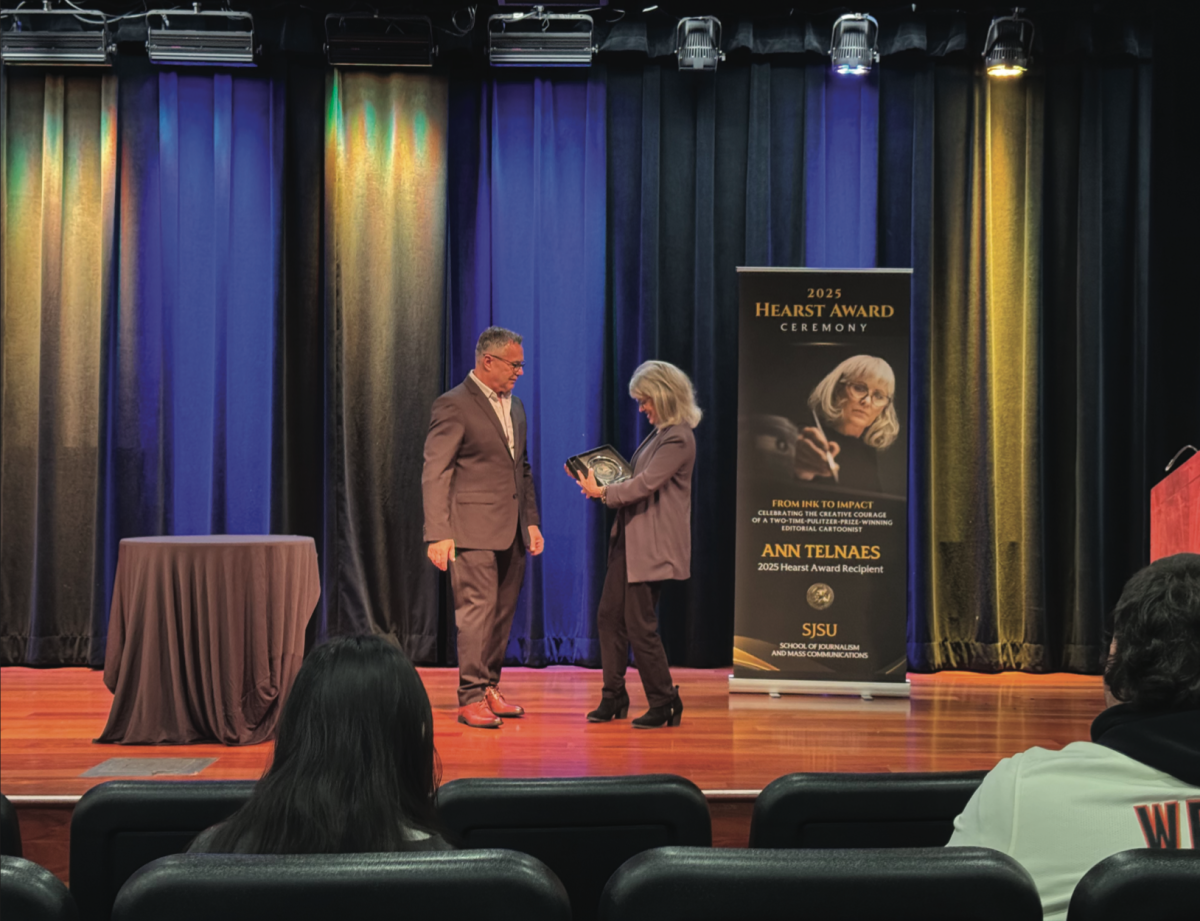
San José State hosted the William Randolph Hearst Awards on Wednesday, recognizing journalists whose work reflects the field’s public service mission. This year, SJSU welcomed editorial cartoonist Ann Telnaes as this year’s Hearst Award recipient.
Telnaes said how she found her way into cartooning after stepping away from her design career.
“Oh, I’ve always drawn as a kid. I’ve drawn ever since I can remember, but I didn’t get into editorial cartooning until my later 20s,” Telnaes said. “I decided I was more interested in current events and politics, so I decided to get into editorial cartooning.”
The William Randolph Hearst Foundation was created in 1948 by publisher William Randolph Hearst as a California nonprofit focused on educational and charitable work, according to the Hearst Journalism webpage.
Since then, the Hearst Foundation has distributed over a billion dollars to education, health care, social services and arts initiatives nationwide, according to the same source.
Another recipient of the award was Dr. Anthony S. Fauci in November 2020, according to an SJSU webpage.
Linda Zavoral, long-time editor and reporter at The Mercury News, said this event was significant for journalism students.
“I think it’s so important to let the journalists of tomorrow, the students of today, know what kind of a fight we’re in,” Zavoral said.
Telnaes resigned from The Washington Post because of their editorial page rejecting a cartoon she created, according to a Jan. 4 NPR news article.
In 2001, she became only the second woman ever to win the Pulitzer Prize for editorial cartooning – a field where women make up less than 5 percent of working cartoonists, according to the Library of Congress webpage.
The Pulitzer Prize committee honored her for work that showed originality, strong editorial impact, and high-quality drawing, according to the same source.
“I usually gravitate toward topics tied to free speech, freedom of expression and civil rights,” Telnaes said. “When I first started, I did a lot of cartoons about women’s rights.”
In 2023, she also earned the Herblock Prize for editorial cartooning, according to her website.
Melina Marin, a third-year public relations student, said she sees the event as important.
“For me, I feel like it is really kind of inspiring, I would say,” Marin said. “People like Ann are people who are in the field we all kind of want to go in.”
“The press is not as respected, not as read as much, not as listened to as much as it was in the past,” Zavoral said. “People are getting their information from too many places that may not be rooted in the foundations of journalism.”
When she left the newspaper earlier this year, Telnaes had never before had a sketch rejected because of the point of view behind its commentary, according to the same May 5 AP News article.
“I think it’s different when you hear it from a real person,” Marlin said. It’s one thing to read about something in a textbook, but meeting someone who’s actually been in the field gives you a lot more to think about. You learn so much more from that.”
In 1887, Hearst took over the San Francisco Examiner and later bought the New York Morning Journal, the second of many papers he would collect over the years, according to the Hearst Foundation webpage.
Hearst also produced movie newsreels and helped popularize the syndication model for comic strips.
Outside of media, he stepped into politics and won a seat in the U.S. House of Representatives in 1902, representing New York, according to the same source.
“It’s a lot of different steps. It’s a topic that you have an opinion upon, because for it to be an editorial cartoon, it has to have your point of view on it,” Telnaes said.