











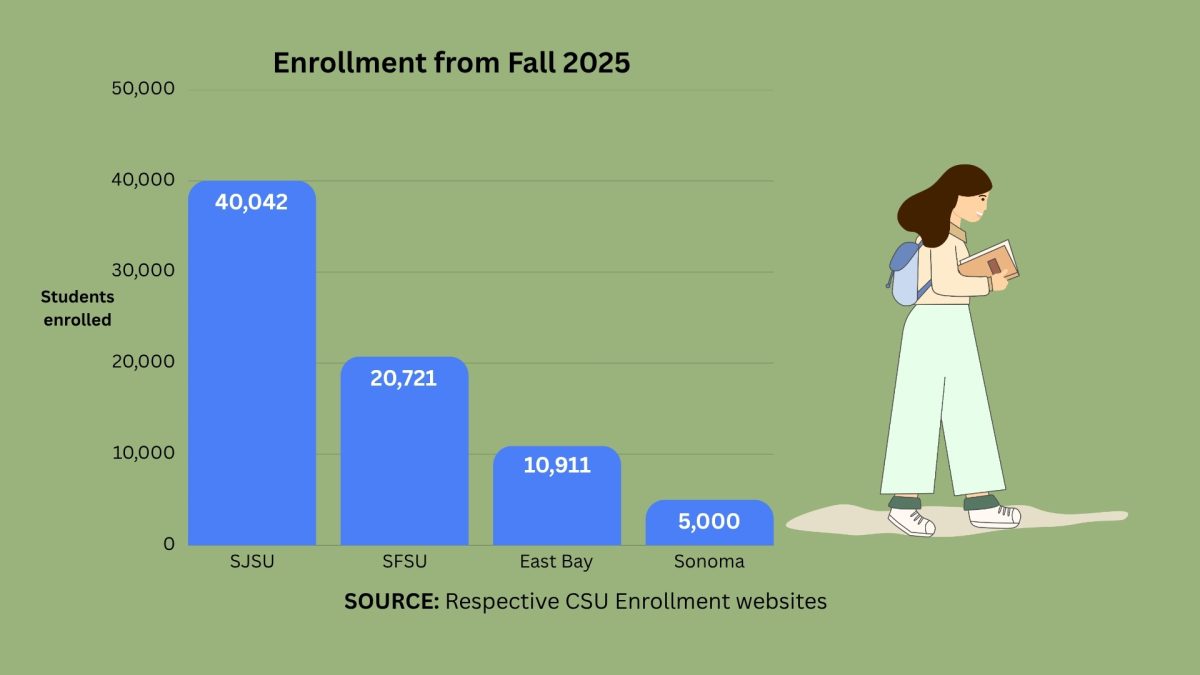
Enrollment has shifted for the California State University system, with some universities facing overcrowding and others having to recuperate from drops in enrollment.
Across the system’s 22 campuses lies a variety of different reasons for changes in enrollment, stemming mainly from each university’s response to the COVID-19 pandemic and other adaptations.
San José State University
In the heart of downtown San José and Silicon Valley is San José State, founded in 1857 and one of the oldest public higher education institutions in the western United States.
The university faces challenges in serving its large student population, with enrollment totaling over 40,000 students, according to an Aug, 25, 2025 SJSU NewsCenter article.
The high student population is causing challenges for SJSU, as 11 graduation commencements are scheduled to happen over the course of three days, according to a March 19 NBC Bay Area article.
Andrew Wright, senior associate vice president for enrollment at SJSU, said San José State is managing its current enrollment and leveraging systems to ensure students have access to the courses they need.
“This includes more efficient scheduling, better utilization of instructional space and continued expansion of online and hybrid offerings to increase flexibility and capacity,” Wright said.
The 2025-26 academic school year welcomed nearly 8,700 undergraduates and 3,800 students in the Professional and Continuing Education (PaCE) program, according to the same SJSU NewsCenter article.
The university had an 8% increase in students in Fall 2025 compared to Fall 2024. This academic year is the highest enrollment total in an academic term of SJSU’s history, according to the same source.
There were a total of 40,042 students enrolled in Fall 2025, according to the SJSU Institutional Research and Strategic Analytics website.
“Professional and Continuing Education has contributed significantly to recent enrollment growth, particularly through flexible and online programs,” Wright said. “At the same time, the university is also seeing growth within its state-supported programs. Together, these efforts reflect a balanced approach: expanding access to academic pathways for students while maintaining the strength of the overall student population.”
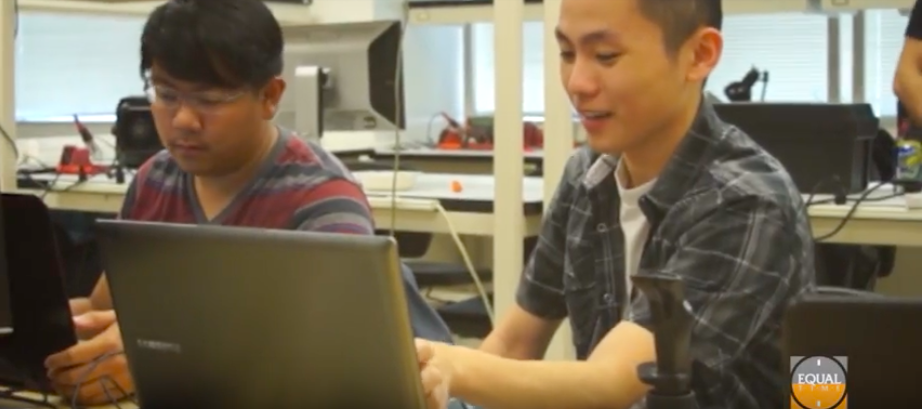
PaCE at SJSU offers online programs for master’s degrees, undergraduate degrees and credential programs to accommodate the needs of students and professionals , according to an SJSU Academic Affairs webpage.
Another online program provided at the university is SJSU Online, the university’s internet-based academic environment, which makes higher education more accessible by offering courses with flexible schedules to be completed wherever a student has a computer, according to the SJSU Online webpage.
Veronica Brooks, an SJSU third-year art history and visual culture student, chose to transfer to SJSU from San José City College because of the number of students being admitted into the animation program.
Despite this, she feels the university is overcrowded and noticed that despite the Student Union being big, it can’t support every student.
“I feel it’s just overcrowded and lines are getting bigger,” Brooks said. “People are not getting the food that they need for classes that start in their 30-minute gap window.”
Currently all majors are impacted at SJSU for transfer students, as applicants are accepted based on cumulative GPA and space in the major program, according to an SJSU Admissions webpage.
Impaction means admission at SJSU is competitive and meeting the CSU requirements does not guarantee admission into the university, according to an SJSU Admissions webpage.
A budget town hall meeting was held on April 7 in the Student Union Theater to discuss SJSU’s 2026-27 fiscal budget for faculty and staff.
Vincent J. Del Casino, Jr., the provost and senior vice president for Academic Affairs, said that with revenue generated from enrollment, PaCE has also increased enrollment for SJSU.
“We’ve grown quite dramatically in that space,” Del Casino said. “And that is in part an effort of a lot of people, including the work of SJSU Online, and the growth of online undergraduate education. This is resulting in a commensurate relationship to revenue.”
PaCE generated $60.9 million in the 2023-24 fiscal year and increased to $72.4 million in the 2024-25 fiscal year, according to the 2024-25 SJSU Academic Affairs Division Budget Allocations plan .
Del Casino said PaCE is a resource that allows students to finish their college degrees and helped 150 undergraduates graduate last year.
“We make up 25% of all the Professional and Continued Education enrollment in the California State University (program),” Del Casino said.
Wright said SJSU anticipates growth in PaCE and other programs.
“Overall enrollment appears to remain stable to maintain access and quality,” Wright said. “Currently, we do not anticipate needing to increase impaction levels as enrollment is managed to align student interest, workforce demand and available instructional resources.”
California State University, East Bay
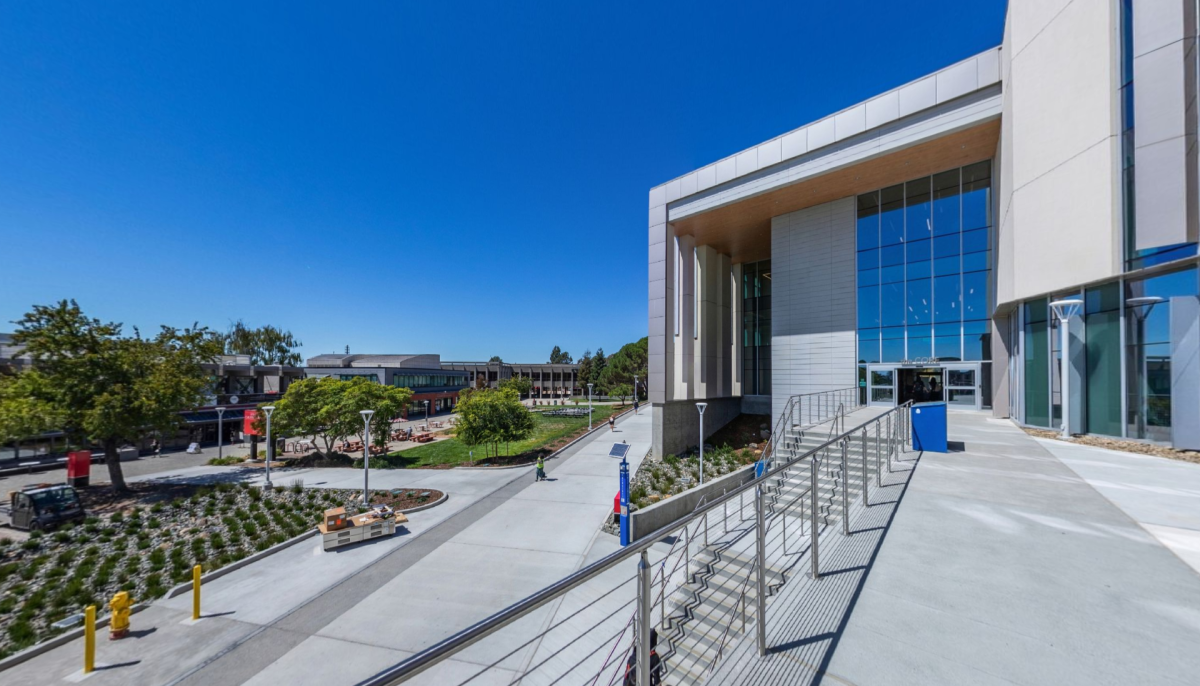
More than 25 miles northwest of San José, California State University, East Bay’s main campus lies in Hayward on a plateau overlooking the city.
East Bay’s enrollment peaked in 2016, with 15,855 students, and has since faced enrollment stagnatation, especially post COVID-19 shutdown.
With enrollment for Fall 2025 being at 10,911 students, the university is slowly increasing in student population, according to the East Bay enrollment webpage.
Brenda Amenson-Hill, the interim vice president for Enrollment Management & Student Affairs at East Bay, said many universities have been struggling with enrollment.
“Just across the United States, a lot of universities have struggled with enrollment, especially regional public universities,” Amenson-Hill said. “We did go up in enrollment this past year. … So we kind of feel like we’ve turned the corner after a five-year decline to bring us back up.”
Universities in the U.S. had experienced a downward trend of undergraduate student population, with a decrease of 15% from 2010-21, according to a May 2023 annual report by the National Center for Education Statistics.
East Bay has implemented partnerships with local Bay Area school districts to increase enrollment and retention rates through the Guaranteed Admissions Program.
The program supports high school students by offering them a direct pathway into colleges, according to the East Bay partnership webpage.
“We created automatic admissions programs and these memorandum of understanding last year pretty late in the cycle,” Amenson-Hill said. “And then this year, we continued and we continue to grow those partnerships,”
Violet Becerra, a second-year public history graduate student at East Bay, said she feels in-person enrollment is low at school.
“I feel like Cal State East Bay is very much an online school,” Becerra said. “I feel like in-person enrollment is really down.”
East Bay offers a number of undergraduate and graduate programs online, according to its official website.
About 18% of students exclusively took courses online, according to the CSUEB 2024 facts brochure.
With declining numbers of students, East Bay also faced a budget deficit of $14.2 million for the 2024-25 school year and a projected $13.2 million dollar deficit for the current fiscal year, according to a Cal State East Bay Budget Hub webpage.
Provost Anthony Muscat said the university addressed its budget deficit through a series of actions, including optimizing course schedules, improving operational efficiency and prioritizing classroom instruction.
“The university has also implemented a voluntary separation program for employees while continuing to add and fund full courses so students could stay on track to graduate,” Muscat said.
With a decline in budget, East Bay eliminated 11 positions from the operating budget for the 2024-25 school year while the university had layoffs in February 2025, according to a March 6, 2025 California Faculty Association article.
“The university has seen encouraging signs that it has turned a corner in enrollment, with overall stabilization and growth in areas, such as high school dual enrollment, transfer enrollment, and an expanding online presence that attracts students from across California,” Muscat said.
San Francisco State University
Across the bay, San Francisco State University was founded in 1899 and is around two miles east from the Pacific Ocean.
It was the first higher education institution to establish an ethnic studies college in 1969, growing from Black Student Union protests and Third World Student Strikes in 1968, according to the SFSU College of Ethnic Studies website.
SFSU proposed to discontinue its Italian, German and online Ethnic Studies bachelor’s degrees, citing low enrollment, according to a Feb. 17 Golden Gate Xpress article.
The university has faced declining student enrollment since Fall 2022, dropping from 25,046 to 22,357 students in Fall 2024, according to an SFSU student enrollment report.
In Fall 2025, there were 20,721 students enrolled at SFSU, according to the SFSU facts webpage.
Amanda Hill, an SFSU fourth-year child and adolescent major, said university administrators could provide more for students.
“I definitely do think that the university could do more because honestly, being on campus it kind of feels a little dead,” Hill said. “I think they need a lot more help for sure because it’s kind of like everybody is silently struggling from what I’ve heard even in my classes.”
The low student population decrease is one of the ongoing issues SFSU faces, along with budget deficits and faculty layoffs.
Brandon Nelson, an SFSU fourth-year broadcast and electronic communications arts and transfer student, said there weren’t a lot of classes offered once he began classes because of faculty members being laid off.
With the financial deficit having reduced funding and forcing professors to be laid off, students have a much harder time enrolling in classes they need to graduate because of fewer courses being offered, according to an Oct. 28, 2025 Golden Gate Xpress article.
“Getting into classes is maybe one of the hardest things around here. With as little classes that we have, everyone has to hit the same certain classes to complete their degree,” Nelson said.
Across many universities, students take longer to complete classes and graduate because of budget cuts and faculty layoffs, resulting in students not being able to get into their required courses, according to a Sept. 5, 2025 article from the Hechinger Report.
Katie Lynch, senior associate vice president for enrollment management at SFSU, said students graduating on time is a high priority and that the Academic Resources office works closely with Undergraduate Education and Academic Planning to offer necessary courses to students.
“What we encourage students to do, if they’re not able to find classes that fit what they need, is to visit the Undergraduate Advising Center and work with their academic advising team to identify if there is something that’s not available that they need,” Lynch said.
The Undergraduate Advising Center at SFSU assists undergraduates with academic advising, degree planning and academic success strategies, according to the center’s webpage.
Nelson said he believes things are getting better at SFSU, despite prevalent issues.
“I think our president gave positive budget news for the first time in a few years,” Nelson said. “I think things are on the up here.”
Sonoma State University
An hour north of San Francisco, Sonoma State University (SSU) sits on 269 acres of land surrounded by wine country. The small university is struggling with enrollment as the student population has declined.
In the fall semester of 2025, Sonoma State had 5,000 students enrolled, a 13% drop off from the previous year, according to a Nov. 20, 2025 ABC7 article.
As SSU faced a budget deficit of $23.9 million, the university laid off faculty, eliminated departments and degree programs and discontinued its intercollegiate athletics program in order to address the deficit, according to a Jan. 22, 2025 SSU News article.
Sonoma State’s enrollment peaked with 9,408 students in the 2015 fall semester, with the student population dropping over the past decade, according to a Nov. 3, 2025 Sonoma State article.
Paul Edwards, the interim vice president of strategic enrollment management for Sonoma State, said one of the reasons enrollment has been affected at SSU is because of key leadership changes over the last 10 years.
“I would add that there has been significant turnover of key leadership positions at Sonoma State,” Edwards said.
SSU has faced a turnover in leadership since the departure of Judy K. Sakaki, SSU president from 2016-22.
Michael E. Spagna became Sonoma State’s president in January, the university’s fifth leader in five years, inheriting a campus that was already struggling, according to a May 4 Edsource article.
Edwards said that the COVID-19 pandemic and the decline of high school seniors applying for colleges also affected enrollment at SSU.
“That’s what’s making that competition more fierce,” Edwards said. “All over the state of California and the U.S. for that matter. It’s also a declining population.”
The COVID-19 pandemic affected students from enrolling into colleges, with first-year enrollment declining from 2.5% after the 2020-21 school year, according to an April 8 Edsource article.
Edwards said the surrounding counties that Sonoma State provides service to are already small and declining in population.
“Some of the school districts, like many around the state, there are K-12 districts facing budget cuts, and that’s started to impact us in terms of the number of A-G eligibility to get into the CSU,” Edwards said. “There’s been a lower number of eligible students within our own region.”
Several school districts in Sonoma County and one school district in Napa County are facing a budget crisis because of declining enrollment and a lack of money to sustain districts among rising costs, according to a March 7 Press Democrat article.
Alexandra Miller Bordisso, an SSU associate professor in physics and astronomy, started at the college in 2019 and saw the shift in enrollment begin before the COVID-19 pandemic.
“We’re one of the smallest CSUs,” Miller Bordisso said. “So these sort of enrollment declines can hit us really hard because we’re really small to begin with.”
Miller Bordisso said in Spring 2025, with the athletics and certain academic programs cut, tenured professors and faculty were let go.
“It hit everyone very hard,” Miller Bordisso said.
A few degree programs that were identified for elimination include art history, geology, physics and public administration, according to the same Jan. 22, 2025 SSU news article.
Miller Bordisso said all of the programs offered by the Department of Physics & Astronomy were slated to be discontinued.
“The only reason they were selected was because they had sort of the lowest number of majors,” Miller Bordisso said. “And the stated reasoning there was then they affected the fewest number of students directly by making those cuts.”
SSU held a budget and planning forum on April 2, stating the physics program is reopening and history M.A. is returning as a blended program, according to an April 16 Sonoma State Star article.
Miller Bordisso said some programs, including physics and geology, are returning.
“I think a lot of people heard the news that we were cut, but then they need to hear the news that we’re coming back,” Miller Bordisso said.