







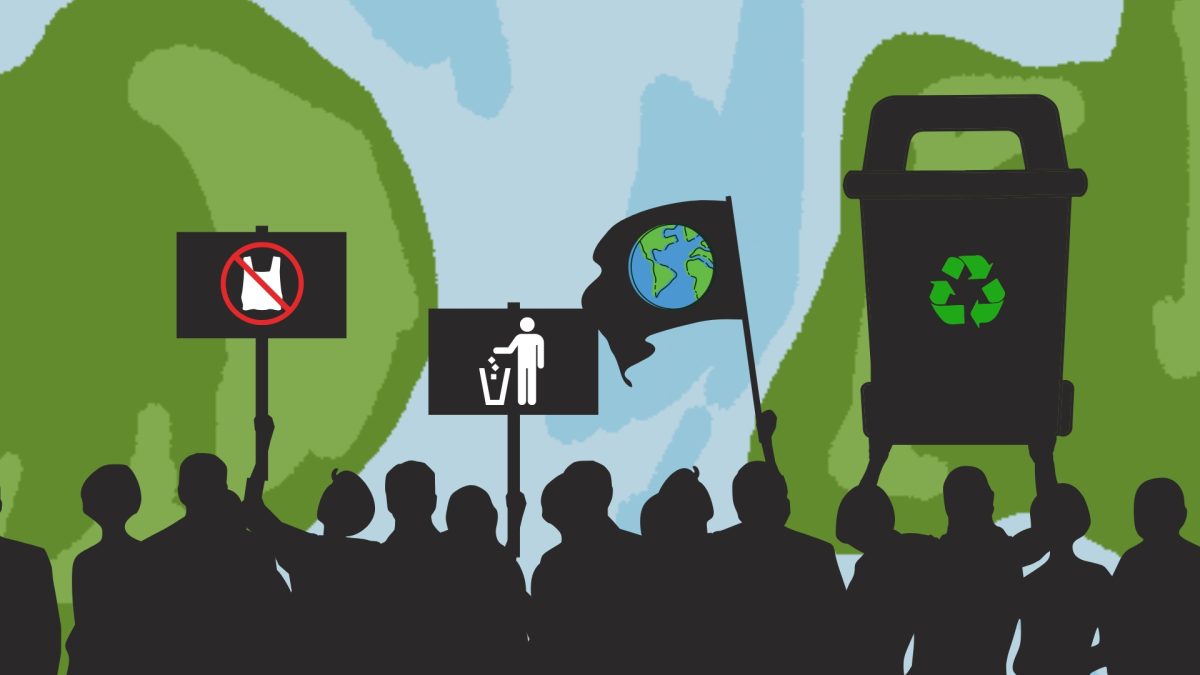
In recent decades, a majority of Americans have been more conscious of their effect on the environment, yet it is common to see people putting plastics in waste bins, or filthy containers in recycling bins.
In the United States, 87% of people believe that recycling is important, according to a Nov. 3, 2025 article by Keep America Beautiful.
Making a personal effort to keep garbage out of landfills, and ensuring that our waste is utilized in a sustainable and productive way, is vital to the future of the Earth.
Almost 1,800,000 acres of land in the U.S. are used for landfills, according to an April 15, 2021 report by University of Colorado, Boulder.
This is unacceptable, though it makes sense when only 32.1% of waste in the United States is recycled or composted, according to a May 30, 2023 California Review Management article.
Lack of consistent recycling practices and education on how to recycle has caused consumers to missort waste. This causes disruptions in processing recyclable materials and adds to waste flowing into our landfills, the same source reads.
Recycling is straightforward, especially in San José, though the lack of consistency on recycling standards can be disorienting for people in other cities.
For example, in Santa Cruz, putting cartons in the recycling is prohibited, according to a City of Santa Cruz webpage.
However, in San José, cartons can be recycled, though they should be rinsed and their caps be placed into the garbage, according to a San José Recycles webpage.
Creating a universal code for recycling would be a good start for making the system more accessible and effective.
A federal recycling program should be created to put cohesive rules and regulations in place for sorting waste.
However, with President Donald J. Trump withdrawing from the Paris Agreement in 2025, our current federal leadership has no interest in promoting ecological or sustainable practices on a national level.
The Paris Agreement is an international treaty with the goal of combatting climate change, according to a United Nations Framework Convention on Climate Change webpage.
This leaves residents to rely on their state or city government to support environmental sustainability.
Local policymakers could benefit from looking to Europe for guidance.
Germany achieved a recycling rate of 69% in 2022, with less than 1% of waste being landfilled, according to a March 2025 report by the European Environmental Agency.
Germany uses programs such as deposit refund schemes, which allows consumers to get refunds after purchasing bottles or cans, according to an April 18, 2022 article from Earth.Org.
California has a similar system, called the California Redemption Value fee, which allows consumers to recycle materials for refunds at certified recycling centers, according to a CalRecycle webpage.
Recycling is net-positive, meaning it contributes to the economy and protects the environment.
If we were to recycle 75% of our waste, we could create 1.1 million jobs, according to an Eco-cycle article.
This is an ambitious number, but if we follow Germany’s lead, this is feasible in the future.
In San José, our recycling system is highly effective, with a 74% waste diversion rate, according to a Jan. 15, 2026 study by the U.S. Environmental Protection Agency.
A waste diversion rate indicates how much garbage is diverted from incineration or landfills, according to a CleanRiver resource webpage.
However, as a state, we can do better. It’s important to educate consumers on how to recycle effectively.
In California, 95% of residents have recycling containers, but 37% of recyclables are actually recycled, according to a May 9, 2024 CBS News article.
European countries have proven that centralized and concerted efforts to force manufacturers into working with the government to recycle and compost are effective in reducing waste.
Banning single-use plastics and plastic bags would be a good start in leading the U.S. toward a more environmentally conscious future.