

Growing up bisexual in a rural town and the most conservative county in California was, at best, an interesting experience for me and caused me to grapple with internalized homophobia for years.
Being queer comes with many obstacles. Homophobia, self-acceptance and finding your community are among them, but being bisexual gets more hate than other sexualities.
Not only do we experience homophobia from classic hate-filled bigots, but we also experience rejection from our own LGBTQ+ community.
After moving to San José, I found myself in a much more liberal and diverse environment for the first time in my life.
I slowly started to embrace who I was and took the scariest leap of all: having a girlfriend.
It was easy for me to get over the few backhanded comments made by some family members, and I had never felt more socially accepted in my life.
Imagine my surprise when my relationship with my ex-girlfriend ended, and the same community that once accepted me was no longer willing to validate my identity.
In queer spaces I once was celebrated in, I was no longer welcome.
Splash Bar, a gay nightclub in San José, has always been a favorite spot of mine.
It makes me feel safe and validated as a member of the LGBTQ+ community.
I’ve always gone with girlfriends and been welcomed with open arms. However, when I brought my boyfriend in an attempt to share some of my culture with him, I was met with a very different response.
Walking up the stairs, we were stopped by a woman slowly clapping her hands in our faces saying, “Oh good, the straight couple is here.”
I immediately responded by telling her I was bisexual, to which she rolled her eyes.
It felt like I was no longer a valid queer person because I was there with my boyfriend.
I understand being protective over queer spaces, and I too get annoyed when groups of straight men show up to gay bars, but excluding members from the community based on who they’re with is blatant queerphobia.
I have also experienced people grouping me into whichever sexuality my current partner represents in both straight and lesbian relationships.
For example, my friends called me a lesbian when I was dating my ex-girlfriend, despite them knowing I’m bisexual.
Lesbian isn’t a dirty word nor an insult, but it’s just not me.
Referring to me as a lesbian is equally as damaging as referring to me as straight. It’s lumping me into a group in which I don’t belong.
Being feminine presenting also offers its own set of challenges.
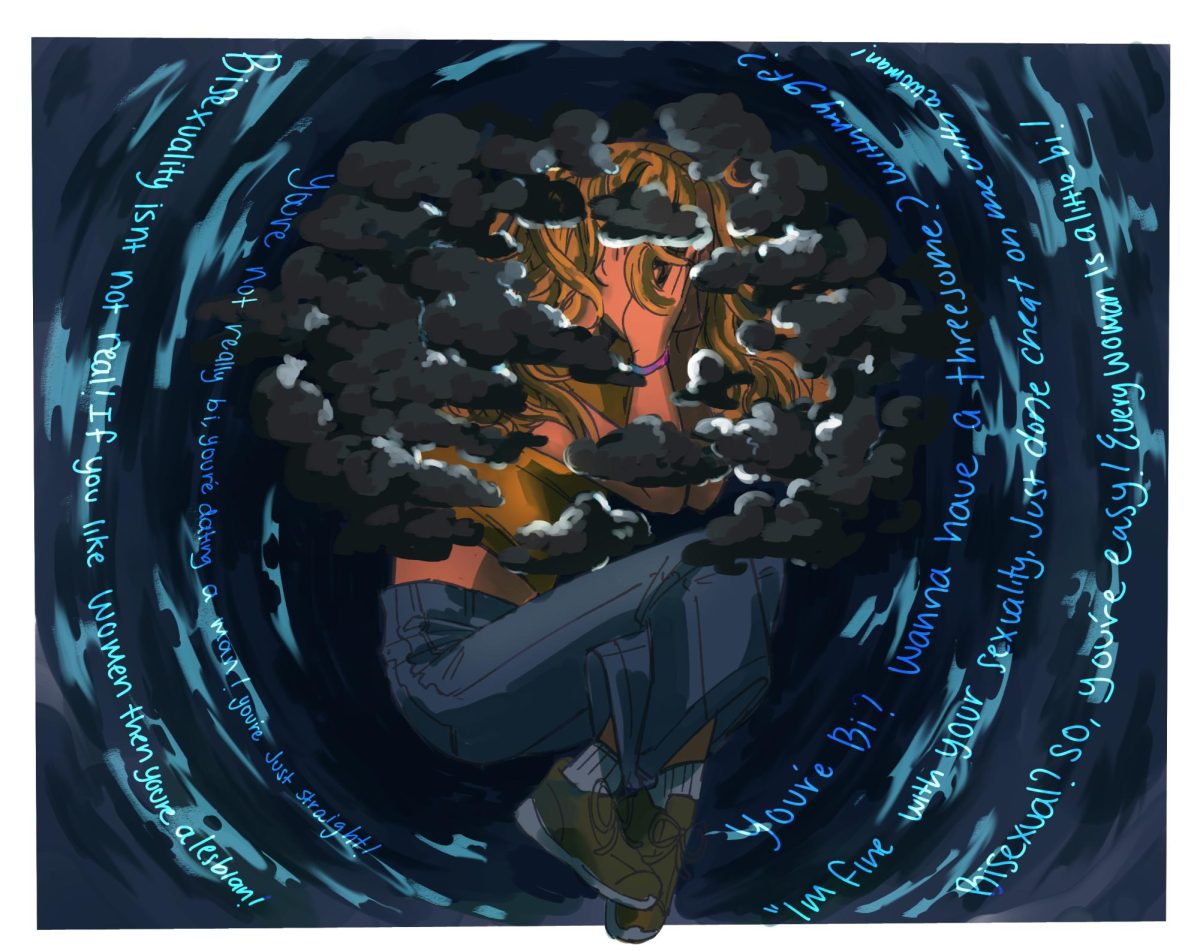
People are beyond shocked when I tell them I do, in fact, like girls, even to the point of making me promise I’m not lying.
These are usually men who can’t possibly imagine how such a feminine-presenting girl could also like girls.
I’ve even had men ask me for threesomes or respond with “that’s hot” when I tell them I’m bisexual.
I don’t feel any other sexuality receives the same fetishization that bisexuality does.
If that wasn’t enough, people love to remind me that they don’t believe I’m bisexual but rather just experimenting.
Previous partners have used my sexuality against me, throwing it in my face as a reason to question my loyalty and making me reassure them that I wouldn’t cheat on them due to my sexuality.
This creates the narrative that bisexuality is promiscuous, slutty even, and people blame their insecurities in a relationship on it.
A girl once unmatched me on Hinge because “bi chicks just cheat with dudes.”
I’ve felt frustrated over the biphobia from straight and queer people alike for a while now.
It feels as if bisexual people have to be all or nothing in order to receive validation.
Demanding equal rights, respect and justice from society just to treat members of your own community with rejection and shame is hypocritical.
So, to the queer community, I ask: What is your problem with bisexuals?
From one queer person to another, do better.