


















San José is facing legal challenges over its use of automated license plate reader cameras, as civil liberties advocates and residents argue the technology enables unconstitutional surveillance.
A federal lawsuit, filed April 15, alleges that San José’s deployment of Flock Safety cameras violates the Fourth Amendment by enabling warrantless tracking of residents’ movements, according to the Institute for Justice.
Dan King, assistant director of media relations at the Institute for Justice, said the institution has additional privacy concerns related to San José.
“Flock cameras are a key part of a growing network of police surveillance across the city,” King said. “The San José Police Department (SJPD) has access to a network of video cameras across the city, as well as numerous other information sources and surveillance tools. Over time, this mass police surveillance system will only grow unless ordinary San José residents push back.”
King said the City of San José has not formally been served and the city is sharing its data with hundreds of government agencies across California.
San José’s database was searched nearly 2.5 million times in the second half of 2025, averaging more than 15,000 searches every day, according to the Institute for Justice.
The Flock database creates detailed recordings of people’s lives by capturing vehicle location data that SJPD can store for at least 30 days, according to an April 15 Complaint for Declaratory and Injunctive Relief filed in the United States District Court.
Stacy Melillo, San José resident, spoke during public comment about her concerns with the emerging technologies in daily life at a San José City Council meeting on March 10.
“These cameras are often described as simple license plate readers, but they’re much more advanced … people shouldn’t have to feel like their daily lives are being quietly mapped just to live in their own neighborhood,” Melillo said. “San José is the capital of Silicon Valley. We should be leading with technology that protects people and civil liberties, not building systems that undermine privacy and trust.”
During the same meeting, city officials discussed limiting data retention and tightening access controls in response to public criticism, according to a recording of the meeting.
SJPD allowed other California police agencies to conduct federal searches of license plate data, potentially violating state law restrictions on data sharing, according to a Jan. 15 article by the Mercury News.
The searches allowed access to information beyond what state law permits for local agencies, according to the same source.
King said the “side-door” access that law enforcement gave United States Immigration and Customs Enforcement agents is an allegation based on The Mercury News article.
“Officers have shared their passwords with federal agents, in some cases,” King said. “In others, officers ran searches at the request of federal agents. Beyond that, despite repeated assurances that it had no federal contracts, Flock revealed last summer that it was running ‘pilot programs’ with federal agencies and that it had (it claims) inadvertently given them access to other customers’ data.”
The civil rights suit filed by San José residents argues that the cameras enable mass surveillance by tracking vehicles across the city without sufficient safeguards.
The three San José residents behind the lawsuit contend the system disproportionately affects ordinary residents who are not suspected of any crime, according to an April 16 KQED article.
“The Institute for Justice leads nationwide efforts to curtail unrestrained government surveillance, and we maintain websites to educate the public about automated license plate readers,” King said. “Our clients are three ordinary San José residents who find the city’s surveillance system creepy and overbearing.”
Additionally, San José moved forward with the surveillance technology despite warnings from its own advisory bodies, according to a May 27, 2022 article by Vice Media.
Marjorie Siegel, a San José resident who lives in District 8, spoke during public comment at the city council meeting urging the mayor to act, claiming Matt Mahan, mayor of San José, has received over $1 million in campaign contributions from Flock.
“I’m appalled to know that I’m being surveilled by Flock cameras virtually anywhere I go in San José, and I’m offended by Mayor Mahan’s gaslighting assurance that out safety is a top concern of his,” Siegel said.
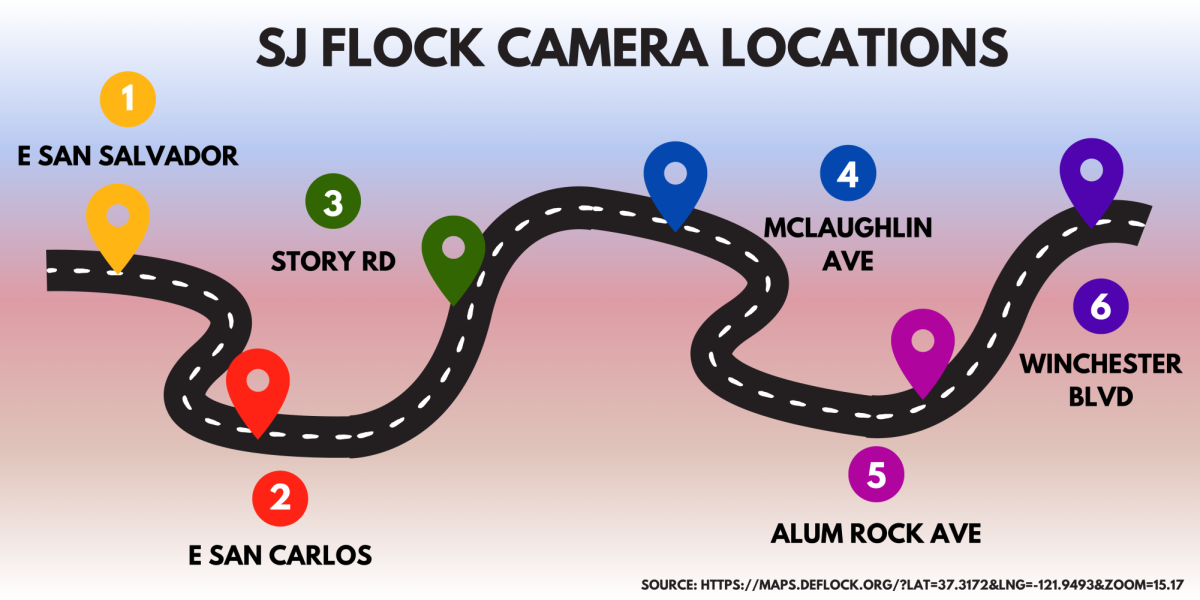
King said the city has stationed cameras around sensitive locations, such as healthcare facilities, immigration lawyer’s offices and people’s homes.
“Across the country police have been caught using Flock cameras to stalk their ex-partners, go after political opponents, and even track a woman who’d reportedly had an abortion,” King said. “San José’s efforts to limit this misuse because they ignore the root problem, which is indiscriminate surveillance of ordinary citizens who have done nothing wrong.”