






















Your college years are supposed to be a time of extreme socialization: riveting conversations with interesting people in classes and on campus, or spontaneous adventures with strangers from the local dive bar.
This is, at least, how I’ve heard older generations talk about their college years. Imagine my disappointment when I went into college for journalism and had experienced the exact opposite.
Sure, I’ve had my fun in the freshman dorms and met plenty of people through my sorority, Alpha Phi, but once those went away, so did my socialization.
This dropoff of a social life seemed abrupt and peculiar to me, especially being in such a social time of my life, and I wanted to find out why.
I started paying attention to how students behaved in class, and I have to say I was appalled.
Teachers would ask questions and nobody would raise their hand. We’d be assigned to work in groups, and students could barely get themselves to speak to one another.
Clearly, something is wrong.
Not only are young, supposedly eager to learn students incapable of basic classroom etiquette, these are journalism students.
I could understand this behavior in a STEM class where social skills may not be critical to performance, but sitting in a room of journalism, public relations and communication students with no social intelligence was jarring.
My observations expanded outside of the classroom as well.
Getting in an elevator in my primarily student-occupied apartment building, I noticed every person on the elevator was on their phone, every single time, without fail.
What have we come to as a society if we can’t ride in an elevator with other people for two minutes without the relief of a screen to free us from the potential awkwardness?
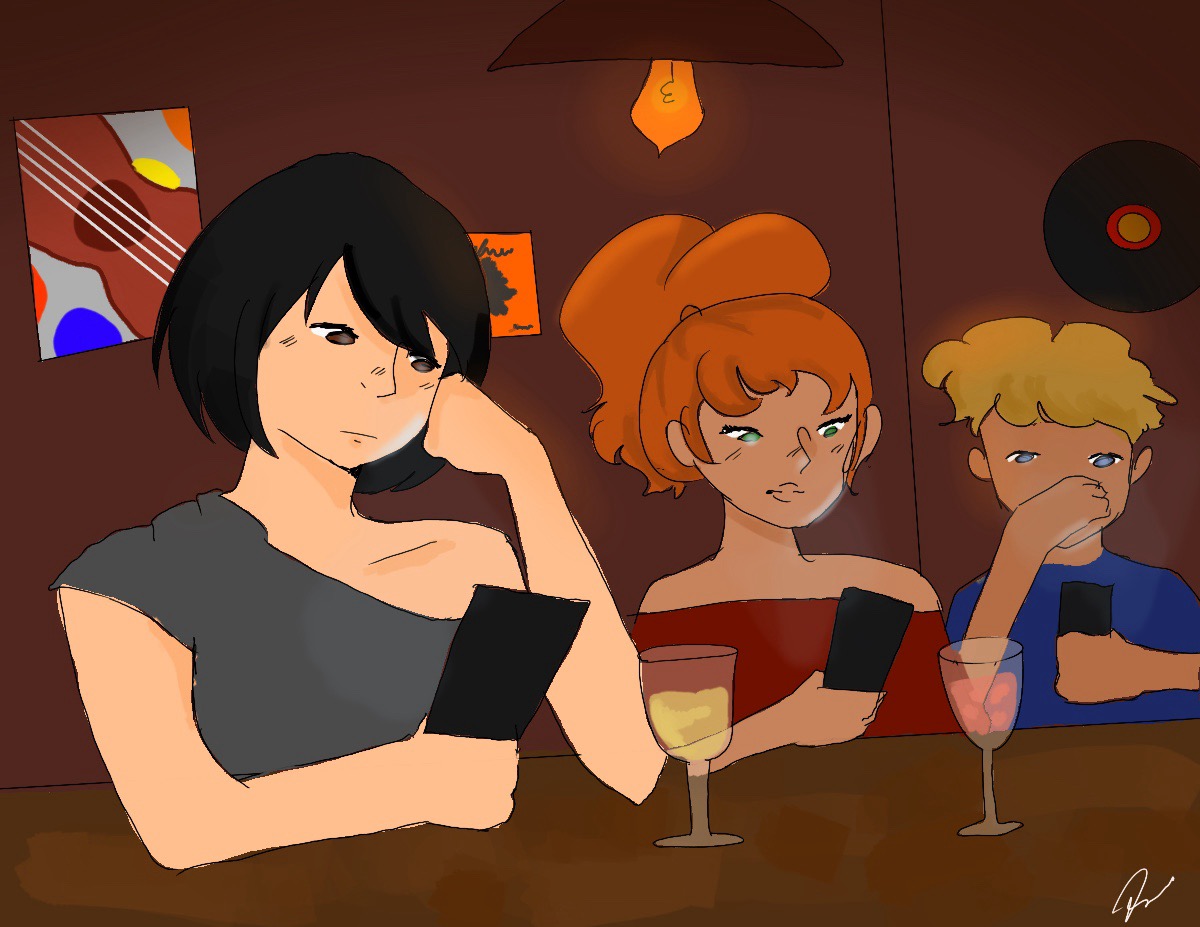
This led me to attribute the issue to phones. Everywhere I looked, people were on their phones.
On the dance floor at bars, nothing but phones. Why go out to do what you could sit at home and do?
In my classes I make an effort to connect with peers, but it never pans out. The person either gives very little interaction or can’t even make eye contact with me.
Struggling in a social setting, making friends or eye contact are symptoms often reminiscent of Autism Spectrum Disorder (ASD).
In the past 20 years, ASD diagnoses have risen over 300%, according to an article by Johns Hopkins University.
I remembered reading about how phone usage can be linked to ADHD symptoms, and wondered could it also be linked to autism symptoms?
So, I took to the internet with a very basic search: “Can phones cause autism?” which led me to a scholarly article from the National Library of Medicine.
After reading through the experiment’s findings, I saw my hypothesis had some merit.
The article linked children with excessive screen time to showing ASD symptoms more than those with little to no screen time.
Let me be clear, I am not saying that the rise in ASD diagnoses is because of phones, nor am I saying that phones cause ASD despite what researchers may suggest.
I am, however, saying that growing up with screens has socially stunted younger generations, so much so that they are showing symptoms of ASD.
Not only that, but I fear our ability to interact as a community is dwindling.
My mom recently visited me at my apartment, and used the gym. After working out, she asked, “How come nobody was talking to each other at the gym? It was so weird.”
After talking with her about her experience, I realized that I have fallen for the propaganda that humans do not need to interact with one another.
Medical professionals and researchers alike agree that social connection is a fundamental human need, and community is essential to our function, according to an article from The Harvard Gazette.
What is considered to be a basic human need is now being replaced with social media, causing people to feel like they have community and connections through the internet.
As someone with a complicated on-and-off relationship with Instagram, one of my biggest grievances with the app is that I notice myself getting sucked into a false sense of community.
I’ll see reels that agree with my beliefs or morals, usually content about outdoor living or feminism, and somehow feel that I’ve connected with the people liking and commenting that shared my enthusiasm for the content.
This is a very dangerous and slippery slope though, because it causes the consumer to feel that they don’t need human connection, while they’re lulled into a false sense of community with the online world.
But the fact of the matter is that social media cannot replace genuine human connection, and the more we allow ourselves to be fooled into thinking it can, the more we lose touch with our ability to connect.