



















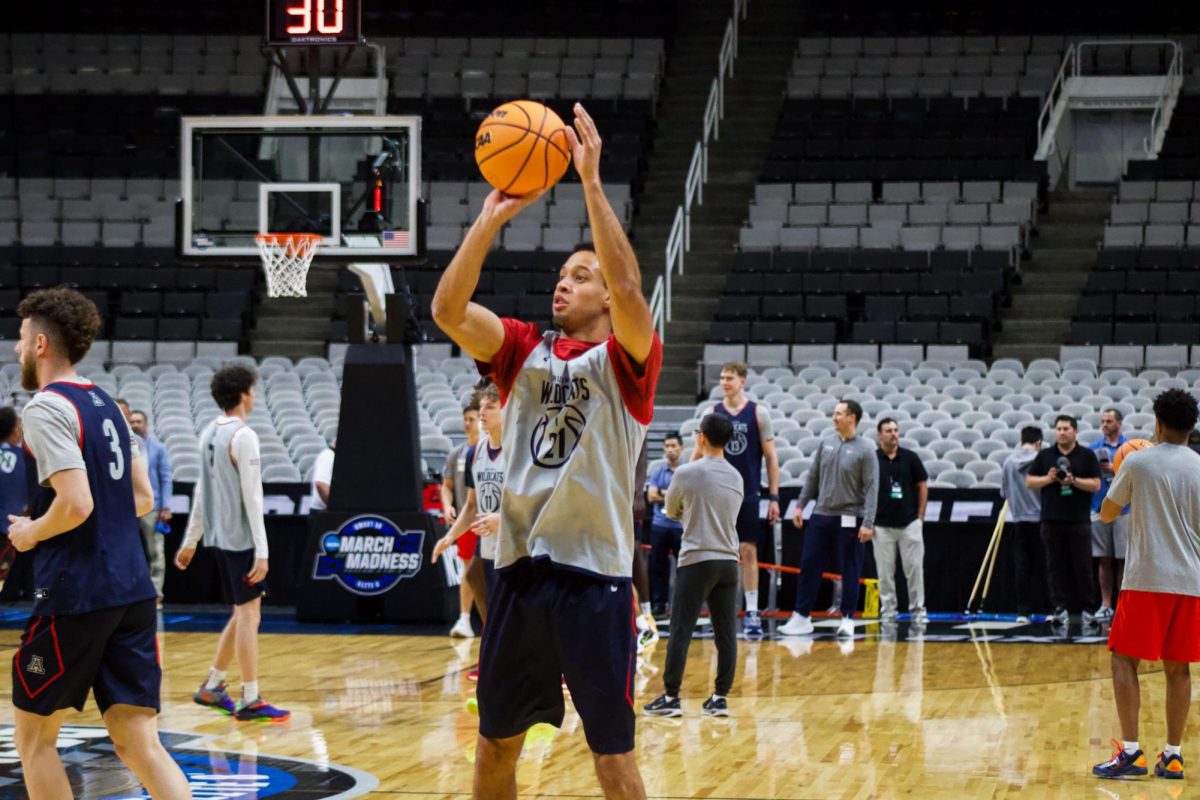
March Madness brings millions of college basketball fans from around the world together for its famous 64-team bracket.
With all the attention that comes with teams advancing in the tournament, an enormous amount of pressure is placed upon the shoulders of college athletes.
The opening round of the men’s NCAA Tournament drew an average of 9.8 million viewers across multiple programs, according to a Yahoo Sports article.
Purdue University senior forward Liam Murphy said there are many life lessons to be learned from playing in big games as a student-athlete.
“They are pressure-filled situations with a lot of eyes on you. All the preparation and hard work that you do is put on a pedestal,” Murphy said.
University of Arkansas graduate senior forward Nick Pringle said mental health is extremely important for athletes at the collegiate level.
“There is a lot of people who go through things that get overlooked,” Pringle said. “Athletes deal with things day in and day out, and everyone always thinks about basketball.”
Sports betting has contributed to people targeting players online based on their stat lines and bets.
According to an NCAA study from Nov. 11, 2025, 36% of Division I men’s basketball student-athletes reported experiencing social media abuse related to sports betting.
Pringle said he deleted X at the start of March after receiving messages from people connected to sports betting.
He said one important thing that he does is talk to people close to him to help him decompress and reset after big games and moments.
“A lot of people are avoiders. They don’t like talking to people, they don’t like talking about their problems or issues,” Pringle said.
Pringle said he has been affected by mental health struggles through a late family member.
One of his roles on the team is understanding his teammates, so he can check in on them and make sure they are in the best position to succeed.
“That’s one thing I kinda struggled with coming up, not talking to folks, just kinda staying to myself. That’s not always good for you because you start to create things in your own mind that’s not really good,” Pringle said.
Student-athletes have to balance studying for their education while also competing in their sport, which can place a heavy amount of stress on them, according to a study from the National Library of Medicine.
It was concluded that 22.3% of student-athletes reported symptoms of depression, according to the same study.
For University of Arizona freshman Koa Peat, mental health is crucial when competing at such a high level.
The projected NBA first-round pick and Big 12 All-Freshman Team selection said the mental state of the game is just as important as the physical.
“So you know, just try and stay out of the media. Try to really lock into the game, lock into the film,” Peat said.
March Madness is a win-or-go-home tournament, which leads to high-pressure matchups as teams fight to stay alive and win the national championship.
Arizona graduate student guard Evan Nelson said players deal with the pressure by focusing on what’s going on in their locker room and teammates.
“Some guys might confide with each other and spend time with each other, tune out a little bit and not really pay too much attention to media stuff,” Nelson said.
He said mental health is extremely important among college athletes and that it’s hard to perform well physically if they aren’t feeling good mentally.
“Taking the time to meditate, walk around, do whatever you have to do to get in your right headspace is absolutely super important,” Nelson said.