





















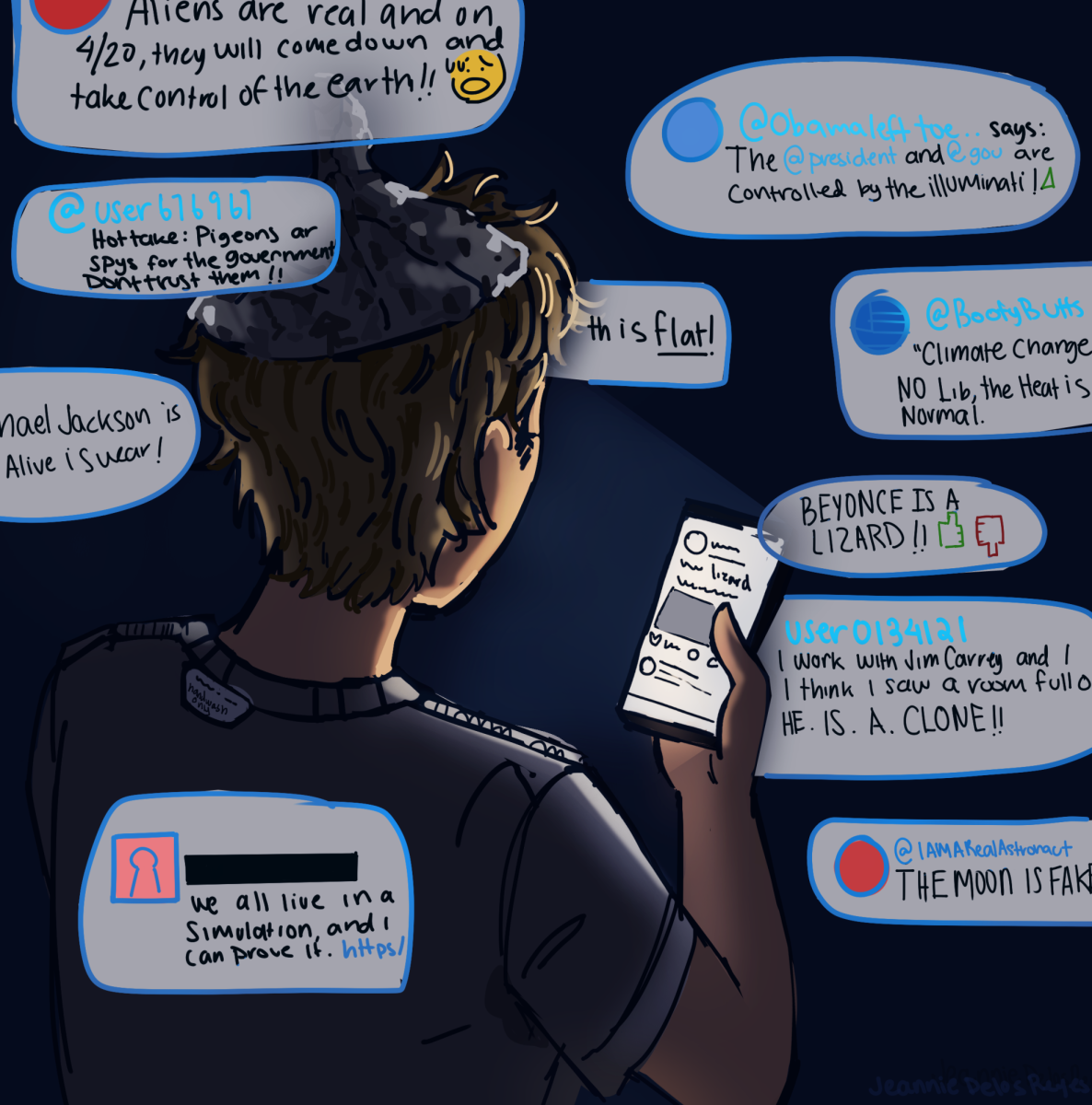
Anyone who has some form of social media such as Instagram, Snapchat, X, TikTok or Reddit, has unlimited access to the free-flowing ideas and opinions of anyone else on the internet.
What were once estranged musings of the stereotypical and out-of-touch-with-reality incel, have become trending hashtags across platforms that have wormed their way into sane-thinking people’s minds.
The most recent conspiracy theory I’ve seen come across my feed is that Jim Carrey was killed and replaced by a clone, and I have to admit I lost myself down the rabbit hole.
Conspiracy theory content creators have a talent for laying out information that can be very convincing, finding “evidence” to convince their perhaps more skeptical viewers.
A conspiracy theory is “a belief that some influential or controlling organization or group is secretly responsible for a notable event or phenomenon,” according to Oxford Languages.
Before you discount the effect these seemingly far-fetched musings have, in the case of the Jim Carrey clone fiasco, big name news outlets such as The Guardian even chimed in.
It’s safe to say this conspiracy theory was massively trending, capturing the attention of media consumers and convincing them that their beloved Jim Carrey was killed by the government.
Being one of the less harmful conspiracy theories I’ve heard, we still shouldn’t ignore how this shifted attention from what the government is actually doing, such as the U.S. and Israel going to war with Iran and using ICE to abduct and even kill innocent people, like Renée Good.
The scariest thing about conspiracy theories is that it can be difficult to determine what’s actually real, which can suck people into believing incredibly harmful narratives.
For example, roughly one in five Americans are QAnon believers, according to a 2022 article from the Public Religion Research Institute.
About 16% of the population believing that Satan-worshipping and cannibalistic liberals are secretly in control of the government is not only absurd, but incredibly dangerous.
It leads to things like a convicted felon, Donald Trump, getting elected as president.
The group has even been labeled as a domestic terrorism threat by the FBI, according to a 2021 article from the Center for Strategic & International Studies.
For those who haven’t seen the 2025 film Bugonia starring Emma Stone, I highly recommend taking a few hours to watch what I consider to be a brilliant take on conspiracy theorists.
The film does a wonderful job of depicting the lengths someone who is utterly convinced of a false reality will go to, and even how people with seemingly high intelligence use it to manipulate others into believing what they want them to.
The true beauty of Bugonia though is the ending, where it’s revealed that the lunatic who kidnaps and tortures Stone’s character because he believes she’s an alien, is in fact right.
This is where conspiracy theories can get tricky. The majority are shiny, exciting, attention-grabbing social media trends that are fun to binge before bed and then forget about, but some have elements of truth to them.
Take Jeffrey Epstein for example. He was prosecuted as early as 2005, yet the speculations about his connections and how he avoided serious consequences weren’t taken seriously, often dismissed as fringe ideas.
The Watergate Scandal also gave pause to the dismissal of outlandish claims, with journalists revealing that President Richard Nixon was involved in a break in and cover up of the Democratic National Committee’s headquarters.
That being said, both of these are examples of claims that were originally dismissed or silenced but turned out to be true, but are not evidence that all conspiracy theories have validity.
I have no doubt that there is information kept from the general public, and I have no doubt that my knowledge of “reality” is much smaller than I believe it to be.
However, I worry that conspiracy theories these days are too outlandish and harmful.
I am all for free thinking, questioning authority and speaking up when something doesn’t seem right, but there is a fine line between healthy skepticism and downright lunacy.