






















A proposed wealth tax in California has divided state leaders and faced fierce backlash from the Bay Area’s wealthiest residents.
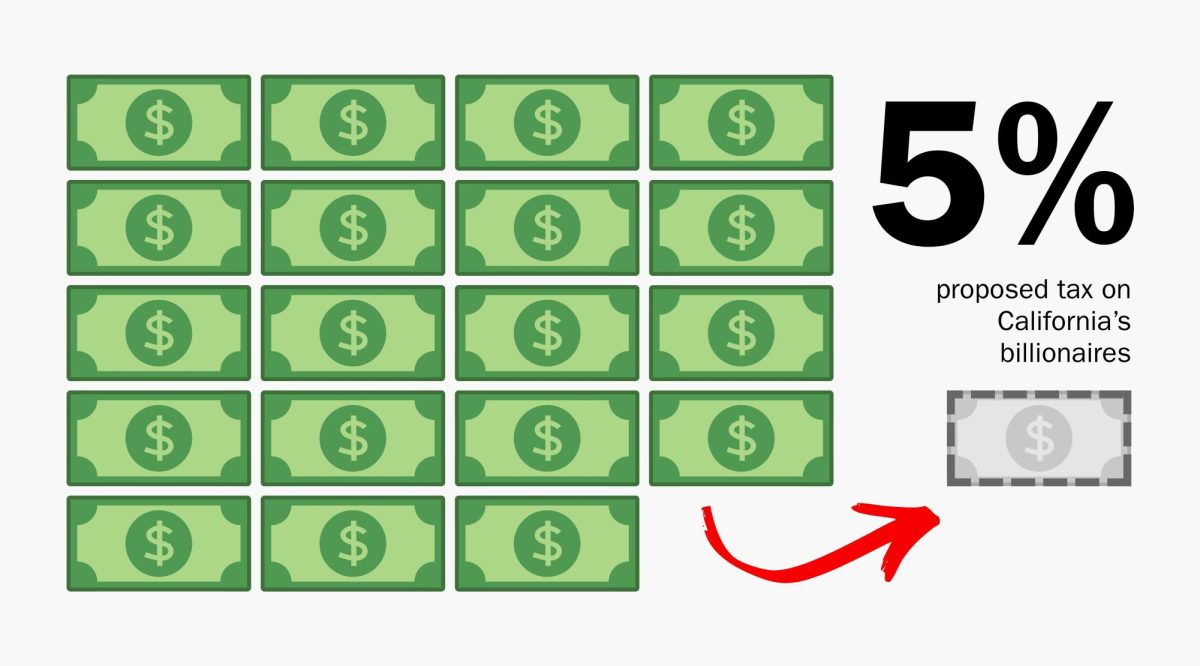
The proposed ballot initiative, called the 2026 Billionaire Tax Act, would impose a one-time 5% tax on the assets of California residents whose net worth exceeds $1 billion, according to a Jan. 22 article by The Mercury News.
Taxed assets would include billionaires’ publicly traded stock and private holdings.
It was introduced last year by the Service Employees International Union-United Healthcare Workers West in response to massive federal cuts to healthcare and food assistance programs, according to The Mercury News.
Kris Cuaresma-Primm, head of partnerships for the Billionaire Tax Now campaign, said the tax was a “common sense solution” to looming healthcare crises across California.
“If Dad is on a life-saving heart medication or Grandma needs diabetes shots or Mom needs her breast cancer treated – when you rip $100 billion out of the system and hospitals close, there’s just a tidal wave of pain that’s coming,” Cuaresma-Primm said. “So we can either do nothing or we can empower the people of California to (decide).”
Cuaresma-Primm said the tax was designed to be a dollar-for-dollar backfill for the federal cuts and would be payable over five years, or 1% every year.
Volunteers and paid canvassers have been tabling at college campuses across California, including San José State, to collect enough signatures to get the measure on the ballot.
The initiative will need roughly 875,000 valid signatures by mid-April to qualify for the November ballot, according to the California Constitution.
Cuaresma-Primm said the campaign is “absolutely on track” to meet that threshold.
Nicholai Rosoff, a campaign manager who works on grassroots political campaigns, has been canvassing for the tax proposal at SJSU’s campus since early January.
Rosoff said students have been more receptive to the idea than the general public has.
“A lot of older folks, especially in high-income areas, are averse to it and a lot of people are just pessimistic,” Rosoff said. “They say, ‘It’s a good idea, but it will never pass.’ Generally, that level of pessimism isn’t shared among the students.”
One of the proposal’s most vocal critics has been San José Mayor Matt Mahan, who called the wealth tax a “disastrous” idea that was, “driving out the entrepreneurs and innovators who have enriched California,” in a Jan. 8 op-ed in The San Francisco Standard.
Six of California’s 214 billionaires have left the state since the proposal was announced, according to a March 17 article by Fortune.
A group of Bay Area billionaires has thrown $35 million behind three counter-initiatives that would null or weaken the tax if it were to pass this November, according to a Sunday article by The Mercury News.
The counter-campaign’s largest donor is Google co-founder Sergey Brin, who has left California to live in Nevada.
Instead of taxing the richest Californians, Mahan suggested rooting out the “waste, fraud, and abuse” in government and spending state resources more efficiently.
John Duroyan, a graduate history student and president of SJSU’s chapter of Students for a Democratic Society, said Mahan’s rhetoric echoed that of Elon Musk’s Department of Government Efficiency.
“That was the language (Musk and Trump) were using: ‘We’re trying to cut out government waste, we’re trying to cut out frivolous spending,’ ” Duroyan said. “But in practice, that meant gutting education, gutting environmental protections, gutting health care … So if ‘being efficient’ means gutting spending for all the vital things that people need to survive, I would gladly say, ‘Let’s be inefficient.’ ”
Sen. Dave Cortese of California Senate District 15, which encompasses San José State, echoed Mahan’s concerns about billionaire flight.
“The problem is not that we’re going to miss the billionaire or that it’s going to break our heart,” Cortese said. “The problem is that the billionaire takes his income tax statement with him. So it defeats the purpose of having the billionaire tax in the first place.”
Instead of taxing individual billionaires, which Cortese called a “transient population,” the lawmaker suggested imposing a corporate tax or closing loopholes in the existing tax code.
“Corporations that are here are likely to stay here and do business – (California) is the fourth largest economy in the world,” Cortese said. “It’s pretty hard to walk away from it.”
Brian Holtz, secretary of the Libertarian Party of Santa Clara County, compared a potential billionaire exodus from California as a loss of the state’s “golden eggs.”
“Thank goodness they’re not yet killing the goose, but they’re scaring them out of the state and the golden eggs are going to land somewhere else,” Holtz said. “You can snatch one or two eggs but then your egg supply dries up.”
Rep. Zoe Lofgren, who represents California’s 18th congressional district, also expressed skepticism toward the state wealth tax.
“I’m not at all sympathetic to the billionaires whining about possible taxes, but it’s not at all clear to me that the proposed ballot measure would work,” Lofgren wrote in a statement to The Spartan Daily. “There are other reforms that can ensure everybody pays their fair share.”
At the federal level, Lofgren has cosponsored the Billionaires Income Tax Act, which would amend the U.S. tax code to eliminate loopholes that billionaires exploit to defer tax payments indefinitely.
Because wealthy individuals often generate earnings through capital gains and keep money invested in real estate and stocks, they can grow their wealth without paying taxes, according to an April 15, 2025 article by Yahoo Finance.
Kevin Chiu, an SJSU economics lecturer whose research focuses on health policy, said taxation is a “fickle matter” that requires balancing different incentives.
“The kind of cold-hearted economist standpoint is, you can’t regulate out bad behavior, you can’t tell people to stop being bad,” Chiu said. “Don’t tax just being a billionaire, tax whatever behavior got them there that is not desirable for the economy.”