











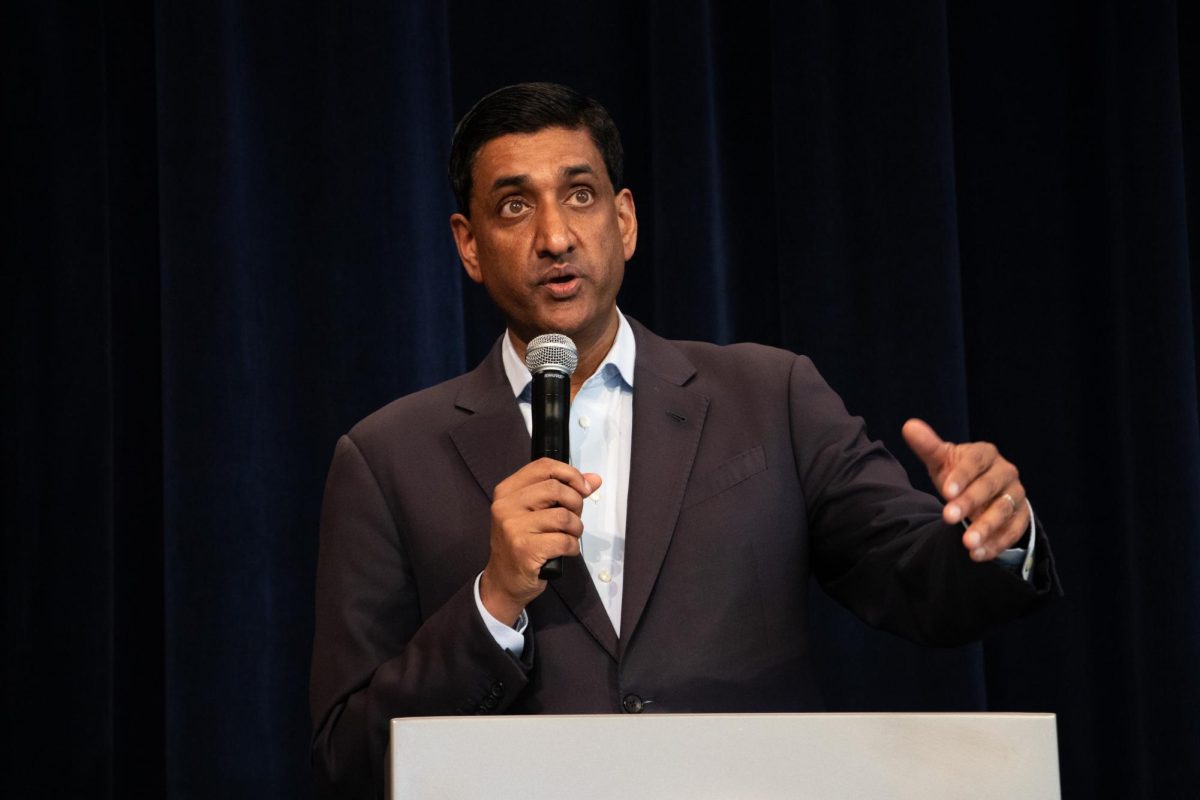
Rep. Ro Khanna discussed his latest work in Congress and answered constituents’ questions about topics ranging from the Iran war and the Epstein files to rising antisemitism and a proposed wealth tax at his March town hall on Saturday.
Khanna represents California’s 17th congressional district, which encompasses several cities in Silicon Valley, including San José, Cupertino, Sunnyvale, Santa Clara, Milpitas and Fremont, according to his website.
The forum was held at Abram Agnew Elementary School in North San José and attracted roughly 200 attendees.
Khanna said his highest priority when he returned to Washington, D.C. would be stopping the war on Iran and, “having us focus at home.”
Last summer, Khanna introduced a bipartisan War Powers Resolution alongside Republican congressman Thomas Massie that sought to prohibit the President from taking military action against Iran without congressional approval, according to a June 18, 2025 news release.
It was voted down by the House earlier this month, according to a March 5 article by The New York Times.
“We’ve replaced Khamenei, an 86-year-old, with his son, who’s an even bigger hardliner. It’s not like the regime has changed,” Khanna said. “And Donald Trump is now saying, ‘Well, I don’t know, the regime is going to continue to kill protesters.’ So we haven’t achieved anything. But we have cost Americans their lives and we have cost people their tax dollars.”
Khanna also introduced the bipartisan Epstein Files Transparency Act, which passed with near-unanimous support from both chambers of Congress last year. The law compelled the U.S. Department of Justice to release millions of documents from federal investigations into convicted sex offender Jeffrey Epstein, according to a Feb. 29 article by TIME.
Some of those files revealed ties between Epstein and top tech leaders in Silicon Valley, including Tesla CEO Elon Musk, Facebook CEO Mark Zuckerberg and Palantir founder Peter Thiel, according to a Feb. 8 article by The Mercury News.
Khanna said he would, “not rest until there is accountability.”
“It’s not just the abuse,” Khanna said. “It’s a sense that our government has been captured by a group of powerful people who think the rules don’t apply to them. We need to stand up to that elite impunity and start to have a government working for ordinary Americans again.”
Gila, a tech worker and Jewish resident of Sunnyvale who declined to provide her last name out of concern for her safety, thanked Khanna for condemning recent antisemitic incidents in San José.
“You are being accountable and you are realizing that the words you speak have a lot of impact in our district, and I appreciate that,” Gila said.
She also said she worried that taxing the wealthy would hurt those working in the tech industry.
“What we are experiencing is a lot of tech founders leaving the area, taking their wealth, and unfortunately for us, the workers, they’re also taking our jobs,” Gila said. “Because of your wealth bill, we are seeing founders saying, ‘We don’t want to build companies in this district anymore.’”
Earlier this month, Khanna and Vermont Sen. Bernie Sanders introduced legislation that would impose a 5% annual wealth tax on anyone in the U.S. whose net worth exceeds $1 billion dollars, according to a March 2 article by The Guardian.
The proposed federal tax, the Make Billionaires Pay Their Fair Share Act, is different from the state ballot initiative in California, the 2026 Billionaire Tax Act.
Khanna countered Gila’s suggestion that tech layoffs were happening because of a billionaire tax that hadn’t yet passed, let alone qualified for the state ballot.
Instead, he blamed President Donald Trump’s, “irrational restrictions on immigration,” and broad-based tariff policy as well as tech companies overhiring during the pandemic and use of AI, “in a way that’s eliminating jobs.”
Khanna initially embraced the state tax, but has since downplayed his support following backlash from billionaires in his district, according to a March 3 article by Bloomberg News.
“There should be a modest tax on billionaires at a federal level, so that we can have dental, vision and hearing for people who are elderly and on Medicare, so that we can have universal child care, so that we can have free public college,” Khanna said. “We need a new social contract so it doesn’t have to be done at a state by state level.”
The congressman rebuked claims that implementing a national wealth tax would trigger capital flight from the U.S.
“Give me a break,” Khanna said. “What are they going to do? Take up citizenship in China? I mean, that is a red herring. They’re not going to leave the United States and they’re going to have to pay an exit tax if they do.”
He said the government’s investment in public research institutions, such as San José State, is what has allowed tech entrepreneurs to thrive in America in the first place.
“I welcome their success. I welcome them building wealth, but they have an obligation,” Khanna said. “I’m tired of Silicon Valley saying that America should do things for Silicon Valley. Silicon Valley needs to ask what they can do for America.”
Lawrence Deng, an SJSU political science alumnus who lives in Berryessa, said he hoped to ask the congressman about the pressing needs of his district.
“I’m worried for the future,” Deng said. “How are we going to fund our hospitals? How are we going to fund our education programs? Because districts are now on the brink of having to close down schools … and by passing the H.R. 1 bill, the (federal government) is putting lives at risk.”
Last fall, voters in Santa Clara County approved a temporary sales tax measure to shore up local healthcare funds after President Trump made unprecedented cuts to the federal budget, according to a Nov. 4, 2025 article by KQED.
The San José Unified School District is considering closing five of its elementary schools because of declining enrollment, according to a March 11 article by NBC Bay Area.
Khanna said he had met with local education leaders earlier that morning at the Santa Clara County School Boards Association’s Annual Legislative Brunch, where they had brought up the issue of funding.
“We could fund the entire special needs education budget with the amount we’re spending 20 days in Iran,” Khanna said. “It’s a total waste of your tax dollars that should be going to building schools here, to building education here.”
Khanna’s next town hall is scheduled to take place from 10:30 a.m. to noon on April 25 at De Vargas Elementary School’s Guided Learning Center in San José, according to his email newsletter.