























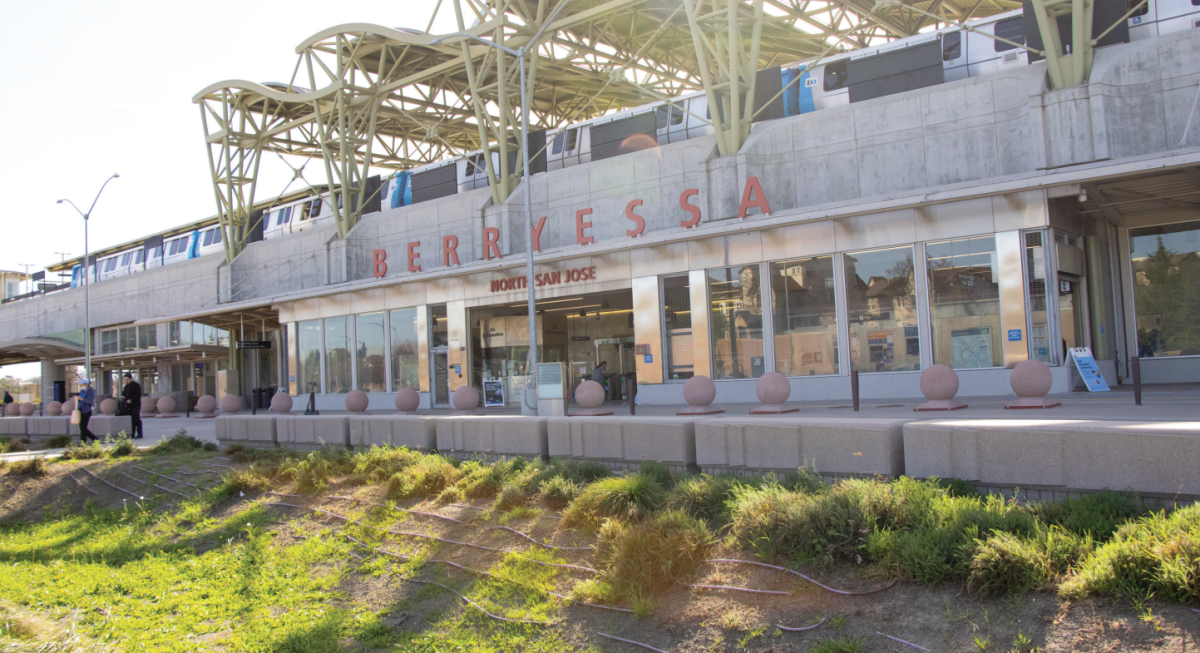
Bay Area Rapid Transit (BART) is facing a major financial crisis that could lead to reduced service, station closures and higher fares starting as early as 2027, and these changes could significantly impact thousands of commuters, including students at San José State.
On Feb. 26, the BART Board of Directors announced a projected plan to address a $376 million budget deficit if no new funds become available, according to a BART webpage.
The plan includes service cuts, layoffs, station closures, fare increases and a 63% reduction in train hours and could begin January 2027, according to the same source.
Nearly 90% of students at SJSU live in off-campus housing and 37.28% of students use public transportation to get to campus. Many students live five to 10 miles from campus or further, according to the SJSU Associated Students’ Transportation Solutions Fall 2024 Student Survey.
With SJSU being made up of primarily commuters, the potential closure of BART stations could affect SJSU students and faculty.
Manomay Dixit, a third-year finance student, said he was aware of the possible closures in South Hayward.
“I have one friend there who I know, the whole community is in kind of an uproar,” Dixit said. “It’s in a low-income community and it’s really marginalized, so that a BART station is kind of their only way of getting through the rest of the Bay Area.”
Dixit said losing the station could also increase transportation costs for students who already rely on multiple transit systems.
“If that BART station goes down, I can’t imagine,” Dixit said. “Having to use AC Transit already for a lot of stuff is kind of annoying, especially if our Clipper cards here don’t cover AC Transit or any of the other bus systems outside of San José. So if you’re a college student and you’re outside of the Bay, like me in Fremont, all AC Transit, Clipper cards don’t cover. So that’s out of my own pocket.”
The Alameda-Contra Costa Transit District (AC Transit) is a public bus-only system that operates in the East Bay and is the third-largest public bus-only transit agency in California.
For San José State students who depend on BART to commute to campus, jobs or home across the Bay Area, the potential cuts could make the transportation slower with students needing alternative means of transportation.
David Barraza, a third-year liberal studies teacher preparation student, said he was concerned about the potential closure of BART stations.
“The BART closures are a bit upsetting,” Barraza said. “It’ll just make it harder for San José students that do come from further locations and will have to drive further to another station.”
California Governor Gavin Newsom signed Assembly Bill/Senate Bill 117 on Feb.19. This will allow the California State Transportation Agency to lend $590 million to the Metropolitan Transportation Commission from the Transit and Intercity Rail Capital Program, according to a news release published by the Governor.
“Just this month the BART Board held its annual workshop,” BART’s communications department said. “Directors heard about an alternative service plan that could be implemented to balance BART’s budget if a November ballot measure fails and no new revenue becomes available.”
SJSU reacts to possible BART closuresThe financial challenges facing BART are largely caused by long-term changes in commuting patterns following the COVID-19 pandemic with more people working from home, according to the BART webpage.
Ridership has not returned to pre-pandemic levels, resulting in fewer trips and reduced revenue for the transit system, according to the BART webpage.
If voters don’t approve a 0.5% sales tax increase in Alameda, Contra Costa, San Mateo and Santa Clara Counties and a 1% increase in San Francisco during this year’s election to fund BART’s financial deficit, the agency plans to close 10 to 15 transit stations that experience low ridership and begin service cutbacks in 2027, according to a Feb. 6 KTVU Fox 2 article.
Some stations expected to close include the Oakland International Airport, South Hayward, South San Francisco, Warm Springs and West Dublin/Pleasanton stations, according to a KRON 4 article.
Barraza said it won’t change his hour-long commute to SJSU.
“I believe that my station might make it,” Barraza said. “Maybe it will take a little longer to go in between stations.”