


















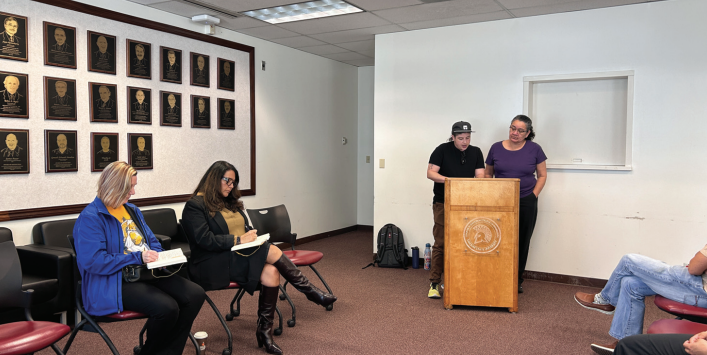
On Thursday, TransTalk held a town hall meeting regarding concerns and asking for transparency from the school after the recent Title IX investigation announcement at San José State.
A flyer was made by TransTalk encouraging students to hold SJSU’s admin accountable for protecting trans students, even including a QR code for attendees to easily access SJSU’s admin emails.
Initially, President Cynthia Teniente-Matson was scheduled to speak alongside other administrative members of the university, but could not attend.
Vice President for Student Affairs Mari Fuentes-Martin sent a message cancelling Teniente-Matson’s appearance three hours before the planned meeting time, on behalf of Teniente-Matson.
“Unfortunately, we must reschedule today’s TransTalk due to an unexpected scheduling conflict that now requires the President to be away from campus. We sincerely apologize for the short notice and for any inconvenience this last-minute change may cause,” Martin’s message read.
Oli Harter, a third-year animation and illustration student and member of TransTalk, addressed the audience at the start of the meeting and announced Teniente-Matson’s cancellation.
“It’s incredibly disrespectful that she isn’t here when so many of you put time and effort into making statements for her,” Harter said. “Her unexpected scheduling conflict matters more than trans students being federally targeted on our campus.”
The town hall meeting was intended to provide a space for transgender students, faculty and allies to speak directly with university leadership about the ongoing Title IX investigation and its potential implications.
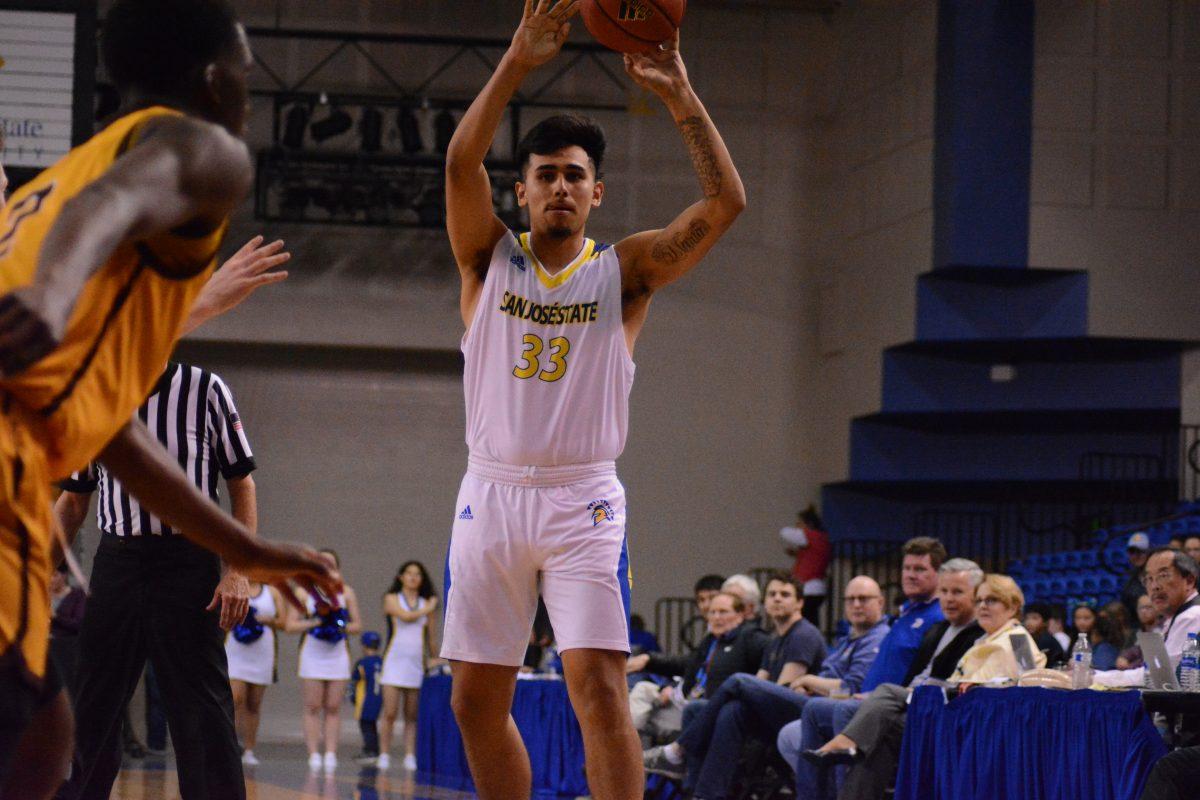
The United States Department of Education found that SJSU violated Title IX of the Education Amendments of 1972 for allowing a transgender athlete to compete in the women’s volleyball team, according to a Jan. 28 news release.
Despite Teniente-Matson’s canceled appearance, Heather French, the SJSU associate vice president and dean of students, as well as SJSU Associate Vice President for Student Equity and Belonging Rachel Camacho, were present.
French said members of TransTalk proposed a trans student wellness committee earlier in the week.
“Can I personally promise that this will have institutional support? I don’t know the answer to that yet,” French said. “I haven’t had a chance to talk with anyone, but in my role as dean of students, that’s also something that within my role I could do.”
Since the investigation was announced, transgender students and groups on campus such as TransTalk have been mobilizing through protests, according to a Feb. 19 Spartan Daily article.
Marissa Godoy, a fourth-year physics student and officer of SJSU’s oSTEM club, said the late cancellation changed how she viewed the university’s commitment.
“I was thinking that before, a town meeting was enough and then the cancellations happened,” Godoy said. “Now I’m feeling that they very much don’t care that they’re not providing enough.”
She also said that a better promotion of forums could increase participation.
Tammie Visintainer, an associate professor of science education at SJSU, said university administrators are doing the work, but need to be more transparent.
“I think just messages that are like, ‘Hey we’re working for you and we hear this and we’re here to listen’ … just something,” Visintainer said. “I know they’re doing the work, I think there just needs to be more communication.
Speakers took turns at the podium, many reading prepared statements that had been written with the expectation that Teniente-Matson would be present.
Tristan Tanner, an English student and member of TransTalk, said Teniente-Matson simply doesn’t want to face the heat.
“She will give an excuse that seems suitably polite and outside of her control, but we all know her real reasons,” Tanner said. “We know where her loyalties lie and we know they are not aligned with the needs and desires of the student body.”
She argued that legality does not necessarily equate to justice, referring to Teniente-Matson’s message that she will follow legal orders given to her by the Trump administration concerning Title IX.
“The history of this country clearly shows that morality and legality are two entirely separate things,” Tanner said. “Slavery was legal. The Salem witch trials were legal. McCarthyism was legal. Jim Crow was legal. Japanese internment was legal. Our concern is with their morality.”
Karin Jeffery, an SJSU lecturer in psychology and sociology, said the requirements of Title IX are unscientific and discriminating genderqueer campus members.
“My question Madam President … Are we going to repudiate all the scientific findings we stand for and if so, where does that leave us as a scientific institution?” Jeffery said. “How can we promote ourselves as a research institution of scientific integrity if we go along with these demands? I don’t think we can,” Jeffery said.
Sex refers to the physical differences between those who are male, female or intersex and gender refers to the different ways people identify, according to an article by Medical News Today.
People may identify with genders that are different from their natural-born sex or none at all. These identities include transgender, nonbinary or gender-neutral, but there are various other ways a person may define their own gender, according to the same source.
Jeffery questioned whether complying with federal directives that define sex strictly by birth assignment would undermine SJSU’s academic credibility.
Erik Johnson, a senior lecturer in the Humanities department and an elected officer with the California Faculty Association (CFA), said that any federal pronouncements redefining sex and gender would also affect employees.
“Our campus CFA chapter executive board has made a public statement that, if necessary, we will invoke California state law and the nondiscrimination provision in our contract – which do include protection for gender identity and gender expression – to protect our members’ rights,” Johnson said. “We should be doing work for (students) as the stewards of this community.”
CFA is a labor union of thousands of faculty who work for the California State University system, aiming to transform higher education into a more inclusive environment, according to their website.
Other speakers criticized the recognized pattern of silence from administration, as well as existing gaps in campus support.
Javier Ruiz, third-year information science and data analytics student and membership engagement director of TransTalk, described the treatment of trans students on campus as poor.
“There is a limited amount of gender inclusive housing on this campus,” Ruiz said. “There is a limited amount of health services available here. The cultural and identity centers are not sufficiently funded, as far as I can say.”
Some health services relative to the meeting’s topics include gender affirming care services, as well as sexual and reproductive health located in the Student Wellness Center, according to their official website.
“You’re not protecting transgender students on this campus who are being federally targeted,” Ruiz said. “So who are you protecting? Because as students, we do not feel protected.”
Iris Yip, president of TransTalk, asked French for commitments beyond discussion and whether administrators could guarantee Teniente-Matson’s attendance at a newly proposed March 17 meeting.
“I know that definitely in my capacity as the Dean of Students, that is something that I can work with you on,” French said. “I have not had a chance to address this with my supervisor working with the president.”
TransTalk members said they will continue organizing meetings and pressing for answers.