





















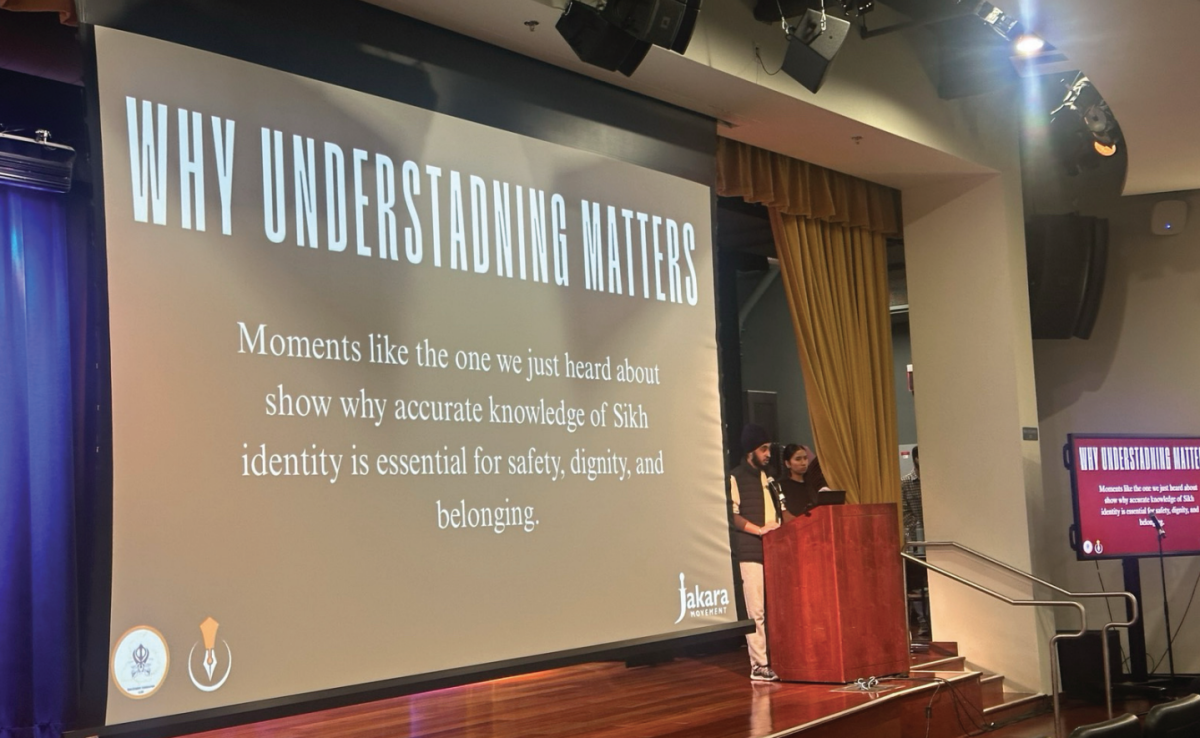
On Thursday, San José State community members gathered for a town hall meeting held by the Sikh Student Association and the SJSU chapter of the Sikh Collegiate Federation, demanding change and accountability after a Sikh SJSU student was assaulted on campus on Feb. 7.
Michael Carroll, chief of the University Police Department at SJSU, spoke at the town hall regarding the investigation process of finding the suspects of the attack.
“As a law enforcement department, we’re truly dedicated to investigating this as a hate crime,” Carroll said. “Even though we are still investigating the case, we’re still trying to identify the individuals, we really want to hold those individuals accountable.”
The Sikh student was assaulted by five people, misidentified as Hindu and forcibly had his turban removed, according to a Feb. 10 Spartan Daily article.
Initial statements from university personnel incorrectly referred to the student as Hindu, while condemning the act of violence, according to the same article.
Maheep Singh, president of the Sikh Student Association, said although SJSU has been responsive and apologetic, more must be done to prevent similar incidents from happening again.
“After we raised concern, the university listened, they corrected the misidentification and they worked with us. At the same time this moment calls for more than correction, it calls for prevention,” Singh said. “If one visible Sikh student can be targeted here, any visible minority can. This incident reflects a broader naturalization of hate in America and campuses are not immune to it.”
Other groups present at the town hall included local Sikh community members and SJSU Sikh alumni.
Cynthia Teniente-Matson, president of SJSU, sent a campus wide email on Monday providing insight on future initiatives and support for the Sikh community and other ethnic and religious groups on campus.
The Interfaith Task Force is an SJSU program under the Office of the President comprised of students and staff who support religious, secular and spiritual communities and currently plans to hold open campus presentations in March and April to spread cultural and religious awareness, according to the Monday email.
Mari Fuentes-Martin, vice president for student affairs, said SJSU housing is collaborating with UPD and the Information Technology Department to increase safety across campus.
“We’re installing additional cameras in both the interior and the exterior of our residential facilities,” Fuentes-Martin said. “We’re adding a blue light emergency phone at the international house on 11th street.”
Fuentes-Martin also said the administration has increased the number of housing security officers and are actively working with university police to hire additional officers.
Harshdeep Singh, the brother of the person attacked, also spoke at the town hall.
“The vice president here said we’re introducing 100 plus cameras, but what’s the point of those cameras if you don’t even have a guard or officer sitting in front of those cameras monitoring,” Singh said.
“I just expect that proper actions are taken, whether that’s the (UPD) or any of the Sikh students that go here, to protect one another because it just seems like it’s not happening from the police department here.”
The Sikh organizations presented a slideshow to educate attendees on Sikhism and the fundamental practices, beliefs and culture of Sikhs.
The organizations emphasised the importance of proper identification, explaining how Sikhs, Hindus, Muslims and Middle Easterns are often bunched into the same category by law enforcement and the general public.
The Federal Bureau of Investigation officially recognized anti-Sikh hate crimes as an individual category in 2015, following a 2012 mass shooting on a gurdwara in Oak Creek, Wisconsin, according to a webpage by the Sikh Coalition.
The Oak Creek mass shooting involved a white supremacist who shot 10 people and killed six, according to a National Public Radio (NPR) article.
The town hall floor opened for public comments, where Carroll mistakenly identified Sikh religious places of worship as a mosque.
“I’ve spoken to several of your community members, so that we can collaborate on having monthly meetings and come to your mosques, so once we know better we can do better,” Carroll said.
Gurdwaras are Sikh houses of worship, according to the same NPR article.
A mosque is a place of worship for Muslims, according to Merriam-Webster.
Kristin Dukes, chief diversity officer at SJSU, presented recommendations related to preventative and supportive action for religious, secular and spiritual communities.
“We are committed to looking at formal ongoing relationships between institutional leaders, advisors, chaplains, other spiritual and faith leaders, staff, student organizations and community partners,” Dukes said.
Dukes also said the Interfaith Task Force plans to have prayer rooms, inclusive dining options, a centralized online site for information distribution and routine faculty training to increase cultural awareness.
Dukes is leading sessions with the President’s Cabinet and campus leadership and open campus presentations will start in March, according to Monday’s email.
Hasmeet Kaur, the SJSU Sikh Collegiate Foundation president, said she is proud of the Sikh community for supporting one another.
“I feel like there was a very hard conversation that needed to be had and we did have them,” Kaur said. “These conversations are not stopping here.”