



















Sacramento Kings:
Having one of the worst records in the National Basketball Association (NBA) can be bad in the short term, but it usually means a team is headlined by young players who are developing.
A couple of expensive contracts that push a team to the salary cap can be limiting, but it usually means the team is winning games with high-level talent.
Now meet the Sacramento Kings, who entered the trade deadline as the third-oldest team in the NBA, with the worst record in the league while also carrying two of the highest salaries in the league.
The Kings are stuck in basketball purgatory with no clear route of escape.
The Kings had two clear objectives: get substantially younger and move off high-salary players in exchange for reduced salary and draft compensation.
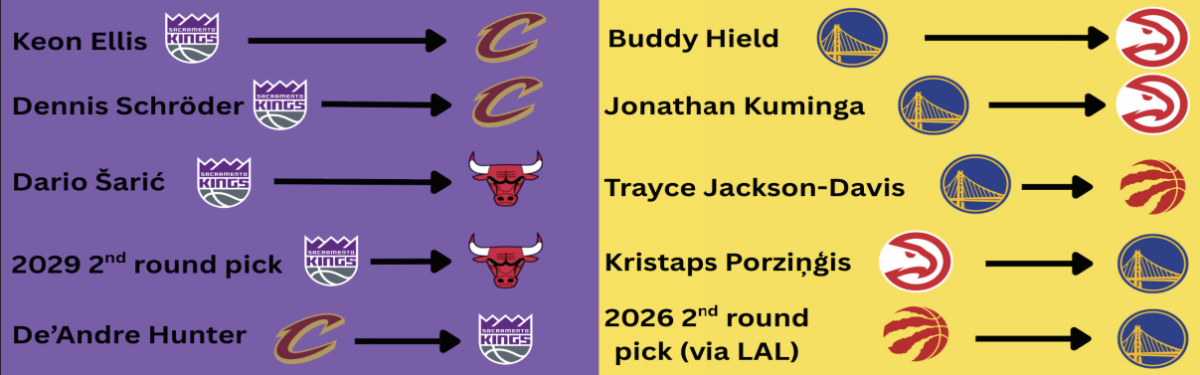
Not only were neither accomplished, but they traded their most valuable assets, including fan favorite Keon Ellis, as a sweetener to get the Cleveland Cavaliers to take on Dennis Schröder’s contract.
Sacramento sent Ellis and Schröder to Cleveland in exchange for forward De’Andre Hunter, with additional pieces routed to the Chicago Bulls, including Dario Šarić and a 2029 second-round pick, to make the deal work financially.
Ellis is widely regarded around the league as a key player with elite defensive traits and strong three-point shooting.
Last season, Ellis was one of just two qualified players in the NBA to shoot better than 40% from 3-point range while averaging at least 1.5 steals per game.
The other was three-time NBA MVP Nikola Jokić.
Ellis ranked fourth among qualified players in steal percentage and tied for first in block percentage among players under 6-foot-7, alongside multi-time Defensive Player of the Year Draymond Green. Among Kings’ lineups that played more than 40 minutes together last season, Ellis was part of five of the top lineups in net rating.
Over the offseason, new general manager Scott Perry signed Schröder to a lucrative three-year, $45 million contract to serve as the team’s starting point guard.
Schröder started the first 12 games before losing his starting job to Russell Westbrook, who is on a veteran minimum contract.
With a logjam in the backcourt, the addition of Hunter brings balance to the Kings’ roster as a 6-foot-7 wing.
Hunter carries a hefty two-year, $48 million left on his contract, while being a largely average player on both ends of the floor.
The 28-year-old has struggled to stay healthy since being drafted in 2019 and is having his worst offensive season since his rookie year.
The Kings earn a D for their trade deadline.
Golden State Warriors:
Effort and intent were never in question for the Golden State Warriors at the trade deadline, as the organization continued its desperate search for a competitive roster that could help Stephen Curry chase another championship in the final years of his career.
In their defense, Golden State reportedly put everything they had on the table for Bucks forward Giannis Antetokounmpo, who has made it clear that he is ready to move on from Milwaukee.
However, the two-time NBA MVP and multi-time All-NBA first-team selection was the hot topic of discussion going into the trade deadline. He ended up staying put, which left the Warriors to pivot in other directions.
The Warriors’ young wing Jonathan Kuminga was packaged with veteran guard Buddy Hield in a deal that landed them Atlanta Hawks Center Kristaps Porziņģis.
Following that, Golden State sent young center Trayce Jackson-Davis to the Toronto Raptors for a second-round pick.
Porziņģis, who stands 7-foot-2, brings elite shot-blocking abilities, averaging 1.8 blocks per game throughout his career.
What makes his game particularly intriguing for Golden State is his shooting. No player his height or taller has made more career 3-pointers.
In theory, Porziņģis is an ideal fit for the Warriors style of play, but his ability to stay on the court has been an issue.
Following a diagnosis of postural orthostatic tachycardia syndrome and a slew of lower-body injuries, Porziņģis has only played 59 out of the his teams last 134 games before being traded.
This deal also functions as a salary dump as Porziņģis’s $30 million contract expires this offseason.
Overall, this deal reflects the failure of the front office in the handling of young forward Jonathan Kuminga.
While Kuminga struggled to fully adapt to Golden States’ offensive system, he flashed offensive star potential, particularly during the playoffs against the Minnesota Timberwolves after Curry was injured.
In the four games following Curry’s injury in the playoffs last year, Kuminga averaged 24 points per game.
After a contract standoff last offseason in which the Warriors were unable to generate meaningful trade interest, both sides agreed to a two-year, $46 million deal with the expectation that Kuminga would be moved during the season.
Failing to extract strong value for Kuminga while banking on Porziņģis’ health earns the Warriors a C-minus grade for the deadline.