

















Zombie movies haven’t always appealed to me, which is why I was surprised that I enjoyed Nia DaCosta’s “28 Years Later: The Bone Temple,” a direct sequel to the 2025 film “28 Years Later.”
This new film is the most recent addition to the “28 Days Later” franchise, which originally debuted in 2002.
After seeing “28 Years Later” during summer of 2025, I was left disturbed and impressed by the artistic approach director Danny Boyle took to telling a gory and gut-wrenching story, leaving me excited for a potential follow-up.
There was a switch in directors from Boyle to DaCosta and it was apparent in the film’s style. Boyle was unable to direct both movies as they were shot back to back and wanted a fresh influence in “The Bone Temple,” according to a 2025 article in Dexerto.
I have to admit I miss Boyle’s flair.
I noticed a slower build up in Boyle’s film, dropping disturbing visuals seemingly out of nowhere combined with footage from old movies and distressing sound bites.
In moments of high intensity, the camera moves very quickly and uses a fish eye lens – a disorienting effect I didn’t see in DaCosta’s sequel.
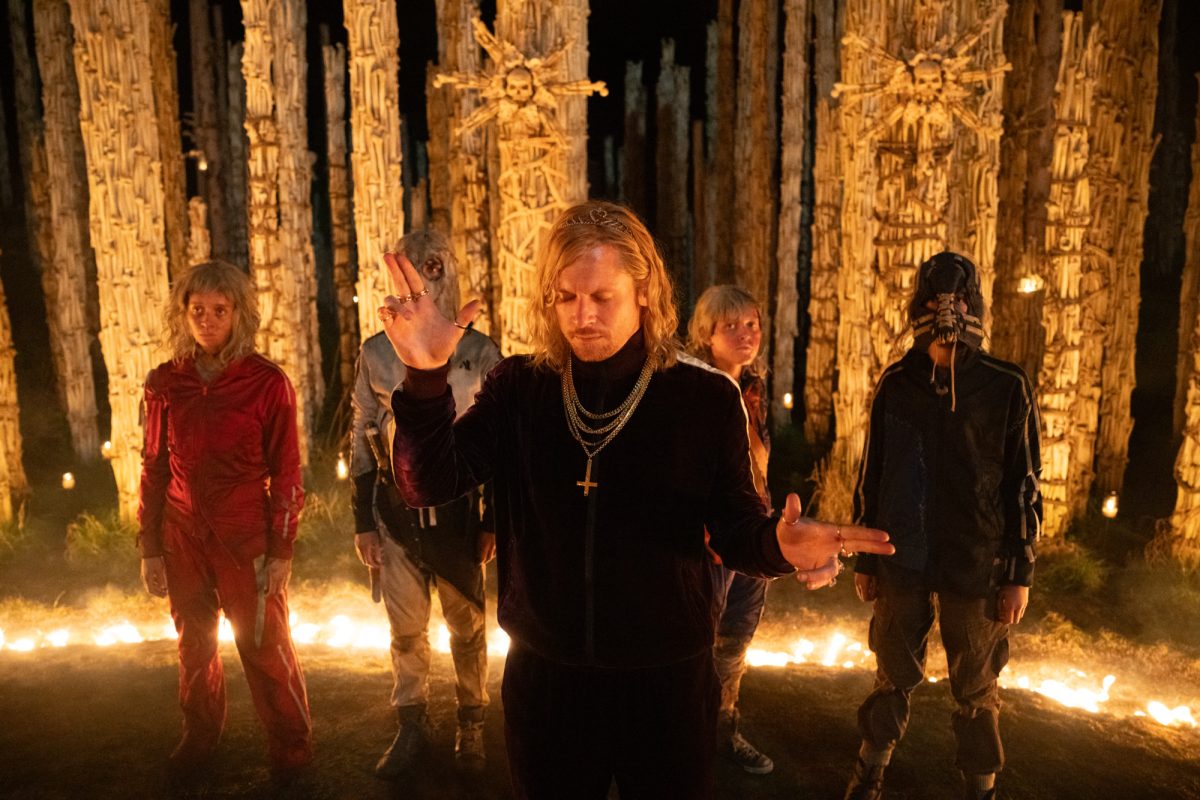
The film starts with little to no time gap between the end of the 2025 film, reintroducing the young protagonist, Spike, fighting for his place in a bizarre, tracksuit-wearing, satanist cult called The Jimmies.
The cult leader, Jimmy Crystal, was a child when the virus that created the zombies broke out.
Not only did he survive, but he also accumulated a small group of followers who believed him to be the son of Satan.
The existence and appearance of Jimmy Crystal and his followers was a somewhat controversial reference to former british media personality Jimmy Savile, who after his death was exposed for the sexual assault of hundreds of men, women and children, according to a 2026 article from IndieWire.
The similarities drawn between The Jimmies’ physical appearance to Savile, as well as Jimmy Crystal’s abuse of power adds another layer of unsettling non-zombie related content.
The Jimmies are explained to have traveled the countryside, seemingly unaffected by the zombies, intending to kill non-infected survivors in gruesome ways as an offering to the devil or “Old Nick.”
Crystal is shown in scenes to use fear and religious persuasion to manipulate members of his group, even having another character pretend to be “Old Nick” for the sake of fooling his followers into further submission.
The cult is an example of how religion can be used to manipulate and control people, especially when they are afraid and desperate.
In another scene, one of The Jimmies tells Spike that there aren’t any better options for survival when he’s caught trying to escape his murderous captors, illuminating how people may do terrible things to avoid terrible things being done to them.
The film has two plots it follows, one of which is the story of Spike and his imprisonment with The Jimmies cult, while the other follows former doctor Ian Kelson, who abandoned community living to study and potentially cure those infected by the rage virus.
Explained in earlier movies in the franchise, the rage virus is a man made pathogen causing all those it infects to lose their mind within seconds and succumb to a murderous rage.
The name of the film comes from a temple of bones that Kelson built out of those who perished from the virus as a way to honor them.
Kelson resided amongst the bones and began to form a relationship with an alpha variant of the zombies he named Samson.
Kelson can study Samson by making a drug to lull him into a state of harmlessness, where he’s able to find traces of an intact mind.
The film strays from a typical zombie movie as it focuses on the growth of a very fragile relationship and gives Samson humanity, something I don’t see often in the genre.
What I enjoyed most about the film was the examination of societies that emerge following a catastrophe, seen in The Jimmies.
The film primarily focused on the actions of The Jimmies and how in trying to survive they managed to instead create something equally as ugly and twisted as the zombies.
In terms of classic zombie movie gore, there’s plenty of that and arguably more disturbing due to its torturous nature.
A graphic, drawn-out scene of skinning a family alive as an act of “charity” was nearly impossible to watch without closing my eyes and the joy The Jimmies clearly took from it was nauseating.
This movie broke free of redundant zombie cliches and still managed to stay twisted and dark with layers I was hardly expecting to find.
Although I found it to have forsaken the artistic flare I was expecting, I thoroughly enjoyed the complexities it explored.