





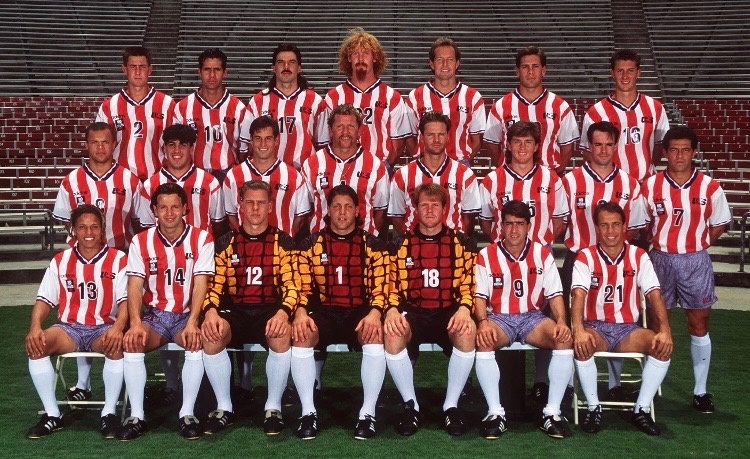
For the first time in over three decades, the 1994 United States Men’s National Team will be reuniting on Friday at the Soccer Legacy Gala in San José.
The event, held at the Signia by Hilton San Jose on Market Street and organized by America SCORES Bay Area, helps celebrate the legacy and influence of the U.S. soccer team.
America SCORES is a non-profit organization and an afterschool program that focuses on child development through soccer, according to the official America SCORES Bay Area webpage.
Randy Gordon, the partnerships lead for America SCORES, said the Bay Area chapter of the organization has made positive changes in low-income areas.
“They work with schools that are in underprivileged areas, and a lot of it is Latino and heavily urban,” Gordon said. “These are the kind of elementary schools that really need to have their soccer fields worked on.”
Gordon said America SCORES is focused on building and repairing soccer fields for the youth.
“There’s a project that I believe will happen in the Bayview-Hunters Point area to build up some new soccer fields,” Gordon said. “It’s in the works, it’s not finalized, but it’s seemingly going.”
The United States men’s national soccer team (USMNT) played their most notable games at Stanford Stadium.
During the 1994 World Cup, the USMNT reached the World Cup knockout stage for the first time since 1930 by defeating Colombia and drawing with Switzerland, according to an April 28 National Soccer Hall of Fame article.
The U.S. received worldwide recognition for their accomplishment, according to a U.S. Soccer History article.
Colin Schmidt, the executive director for America SCORES, said the event is the biggest the company has ever done.
“It’s an amazing opportunity to honor and celebrate the legacy that came out of 1994 and to pick up the momentum here for the 2026 event,” Schmidt said.
Two years after the 1994 World Cup, Major League Soccer launched in the United States, according to the same National Soccer Hall of Fame article.
The influence from the team and having their biggest games played in Stanford helped the San José Earthquakes and other soccer teams in the league gain lots of attention.
United States Olympic gold medal swimmer and Bay Area native, Anne Cribbs, was a member of the host committee in 1994 that helped bring the World Cup to the Bay Area.
Cribbs, who won the medal at the age of 15 in 1960, said because she was a big name in sports, a city council member in the Bay Area promoted her voice.
“A city councilman named Frank Patitucci, who was really instrumental in bringing the World Cup here, called my boss and said, ‘I need to have somebody serve on the host committee,’ ” Cribbs said. “So because I was an Olympian and people figure I knew about sports, they said ‘Oh, we’ll have Anne Cribbs do it.’ ”
Marcelo Balboa, a Hall of Fame defender who was on the 1994 USMNT, gave a personal experience as an example of how American soccer players became recognized after the 1994 World Cup.
“I remember going to Disneyland. People had no clue who we were before the World Cup,” Balboa said. “After the World Cup, we were getting security escorts … I’m not saying we were huge, but we took a huge step in making the sport popular in this country.”
Balboa said the launch of Major League Soccer helped enhance the recognition of soccer in the U.S.
“We set a good, solid foundation in MLS and in soccer, and every generation has had to do their part to keep elevating soccer in this country. And I think that’s where we’re at right now,” Balboa said.