




















On April 15, the City of San José started an encampment sweep of Coyote Creek, particularly an area often referred to as “the Jungle.”
The clearing of the area is expected to continue with the city’s forceful removal of people experiencing houselessness by taking their items in trash bags and relocating them, according to an April 16 San José Spotlight article.
Carlos, a resident of Coyote Creek for the last 15 years, said he understands why the city is clearing out the encampment.
“I have no plan, but I have to figure out something,” he said. “I have to get money and go somewhere.”
The encampment sweep is a part of San José Mayor Matt Mahan’s “BeautifySJ,” a program dedicated to cleaning up pollution and managing encampments in public spaces, according to its website.
The program also works to improve neighborhoods, engage local residents and keep public spaces cleaner and safer, according to the same source.
Carlos chose not to sign a lease to move into a tiny house, a sentiment that is not acknowledged by government officials.
“I didn’t want to sign a lease,” he said. “It feels like a jail.”
Before the sweep, people experiencing houselessness in Coyote Creek were offered leases to join a tiny house community located at Valley Transportation Authority’s Cerone Yard, according to a Feb. 17 KQED article.
Cerone Yard was transformed into a homeless shelter containing 162 private rooms, according to the article.
Advocates for the unhoused community have been voicing their concerns over the ethics of the removal, with some showing up to provide support to those being relocated.
Jim Clark-Moore, volunteer and pastor with Encompass Homeless Ministry, was present at the cleanup site on April 15 and passed out toiletries for the people.
“You have to restart. You’ve gotta find more clothes, toiletries … family heirlooms are lost … they’ve developed communities, and those communities are shattered,” Clark-Moore said.
Encompass Homeless Ministry is a ministry whose mission is “… to remove structural and cultural barriers that keep the marginalized on the margin,” according to its website.
Clark-Moore said during a previous cleanup of “the Jungle” in 2014 that he witnessed people in misery, covered in mud trying to drag their stuff out.
After attending multiple cleanups and supporting the people involved, Clark-Moore said he’s never met an unhoused person who was able to retrieve their items from the city after removal.
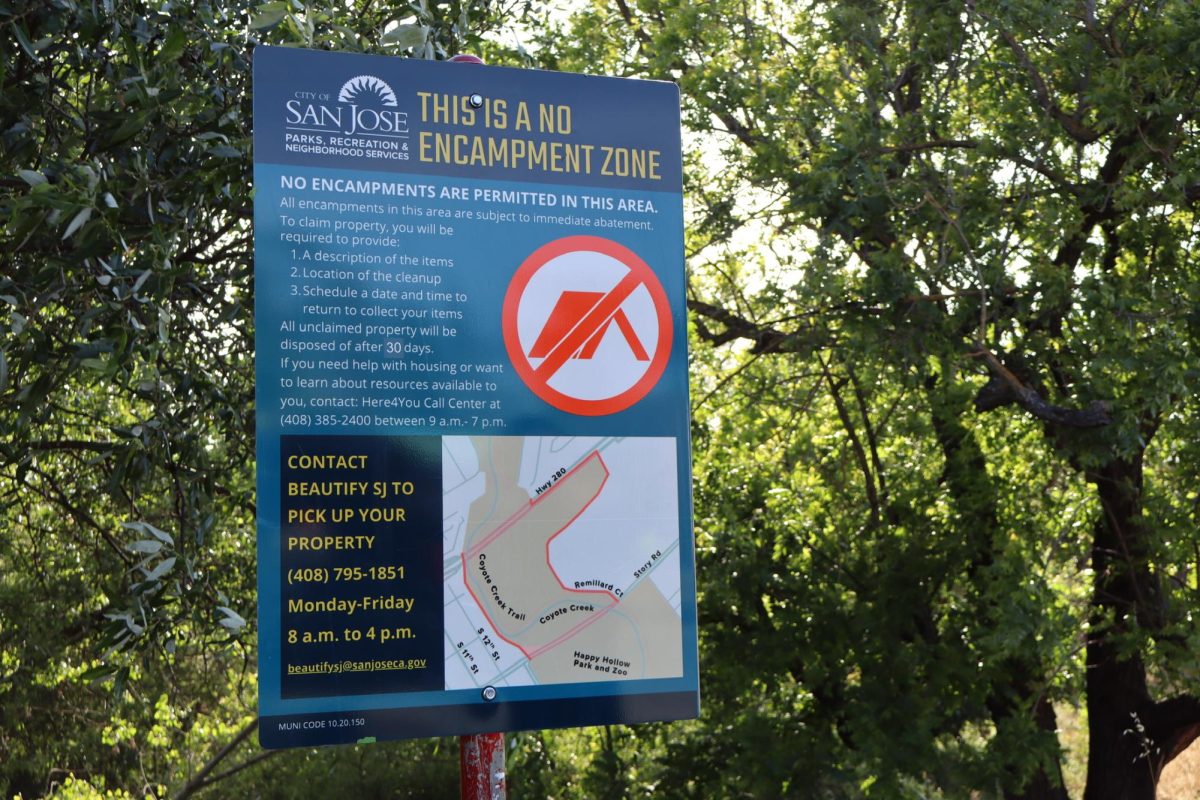
Signs and fliers are posted around the community that read, “this is a no encampment zone,” with instructions to contact BeautifySJ for the organization to pick up property seized by the city, as well as a number to call for housing assistance.
The encampment itself was quiet with abandoned campsites appearing beside few residents still clearing out their items.
Ernesto was one of those residents, and said he will take advantage of the city’s tiny homes after living in “the Jungle” for nearly five years.
“A lot of people had a lot of stuff, and they lost their stuff,” Ernesto said.
He said he is appreciative of the chance to have housing and a job, but that he doesn’t feel good about the removal.
He noted that he observed unfair treatment of people experiencing houselessness by city officials during the process.
A previous sweep of a houseless encampment at Columbus Park in August 2025 resulted in the deaths of two residents, according to a Sept. 16, 2025 article from the Spartan Daily.
When asked for a statement about ethical concerns of the removal of people from Coyote Creek, Mahan’s office provided the following statement to the Spartan Daily: “We’ve spent over two months at Coyote Meadows talking with people one on one and offering them housing.”
In regards to how many unhoused individuals took advantage of the services, the statement continued with, “Over 100 people said yes to coming indoors, with some moving in before the abatement even started.”
Although Carlos said he opted out of moving to interim housing, he was not in “the Jungle” on the day that the city arrived to sign leases for tiny homes.
He said he wasn’t the only one who was skipped over by the city.
San José city officials said that 109 residents agreed to move into transitional housing while also working to give everyone removed from Coyote Creek necessary resources, according to an April 15 NBC Bay Area article.
City officials also said they opened more than 1,000 beds in the last year and 22 locations across the city provide shelter to unhoused individuals, according to the same article.
Encampment sweeps have increased while Mahan runs for California governor, with the recent sweep of “the Jungle” being the first time in a decade it has been cleared out, according to an ABC article.
All while a large aspect of his campaign for governor is housing, according to his website.
Mahan’s campaign claims that a contributing cause of houselessness is a high cost of housing, which he plans to tackle by removing taxes from new housing and speeding up the process to build shelters, according to his website.
“We need to address the root cause and we’re not,” Clark-Moore said. “That is affordability.”