


















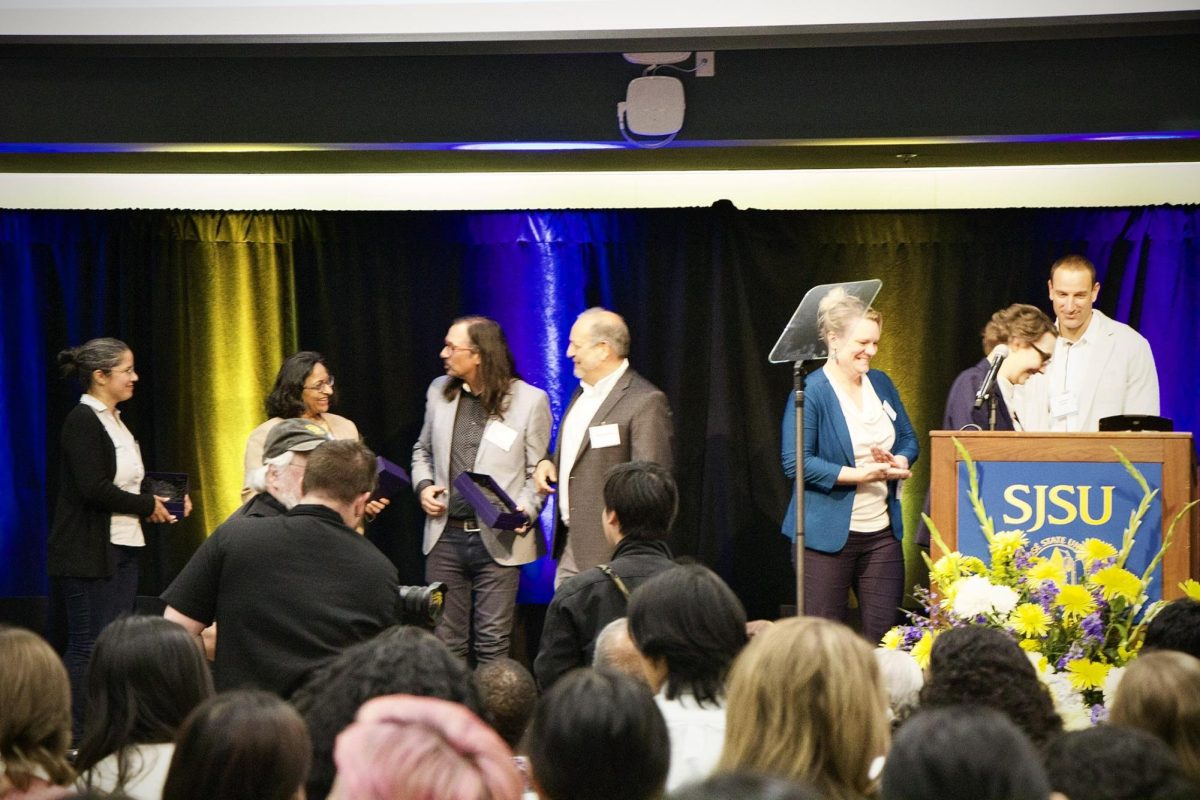
Students, faculty and families gathered in the Student Union on Thursday to honor three San José State faculty members for their research contributions at the annual Celebration of Research event.
The ceremony highlighted the 2025 SJSU Research Foundation awardees.
The three awardees were Sudha Krishnan, Jessica Castillo-Vardaro and Craig B. Clements. They were honored for their work in education, environmental science and wildfire behavior research.
Krishnan, an assistant professor in the Department of Special Education, received the Early Career Investigator Award for her detailed research on inclusive education.
Krishnan said her work details the experiences of students with extensive needs or those with the most significant disabilities.
“My research focuses on inclusive education and I am especially interested in how educators, families and systems can work together and what the barriers are in each case when it comes to creating meaningful inclusion for students with disabilities,” Krishnan said.
Inclusive education brings together all children – especially those who are often excluded – into shared learning environments where diversity strengthens everyone’s growth, according to a United Nations International Children’s Emergency Fund webpage.
The inclusive system requires sustained changes in schools, communities and policies to ensure equal access and meaningful participation for all students, according to the same source.
She said her research examines both the benefits and challenges of inclusive education, including how families navigate special education systems.
She emphasized the experiences of immigrant families and how their access, communication and cultural understanding are affected.
“This work matters because inclusion is often discussed as a goal, but not always implemented in ways that truly support students,” Krishnan said. “I aim to highlight what meaningful inclusion looks like and identify barriers that prevent it, so schools can better serve all learners.”
While Krishnan said her research focuses on equity in education, honorees including Craig B. Clements apply their expertise to environmental issues such as wildfires.
Clements, a professor in the College of Science, received the Industry-Sponsored Researcher Award for his work on wildfire behavior and fire-atmosphere interactions.
He said his research involves collecting data from active wildfires by using mobile Doppler radars and lidars that allow him to study fires in real time.
Doppler radar detects and measures both the location and movement of targets by tracking reflected radio waves and is a key tool in observing severe weather events, according to the National Weather Service.
“We study wildfire dynamics and fire weather by conducting fire experiments in the field,” Clements said. “This allows us to study how the fires spread and create their own weather.”
Clement said he has spent over 20 years studying wildfire science and became interested in the field after noticing the lack of data on how fires interact with the atmosphere.
He also said he is the founder and director of the Wildfire Interdisciplinary Research Center at SJSU, which brings researchers, industry partners and government agencies together to study fire behavior and expand solutions into wildfire-related challenges.
“With a better understanding of the fire environment, it will lead to improved predictions and help communities be more resilient,” Clements said.
Clements said his team will continue field research through a large-scale project this summer in collaboration with the National Aeronautics and Space Administration (NASA).
Castillo-Vardaro, an associate professor of ecology and evolution in the Department of Biological Sciences, said she focuses on how wildlife species respond to climate change through molecular ecology.
Molecular ecology uses genetic and molecular data to study population structure, gene flow and how ecological and demographic processes shape a species over time, according to a 2023 Science Direct review article.
“My primary research involves the American pika, which is a small mammal related to rabbits that lives in rocky areas, typically at high elevations where they can keep cool all year round,” Castillo-Vardaro said.
She said her work examines how different populations may be adapting to environmental conditions and how climate change has already affected some populations.
The effects of climate change alter species through shifts in migrational patterns, behavior and genetics, including the changes in breeding times, movements and survival rates across multiple species, according to an International Union for Conservation of Nature webpage.
She said her work uses genetic tools to understand how different populations may survive and adapt to different environments affected by climate change.
“This lack of information is a major motivation for my research,” Castillo-Vardaro said. “I want to determine whether the populations in the Great Basin of Nevada and Oregon, which are closely related to the populations in the Sierra Nevada in California, are adapted to differences in their environment.”
She also emphasized the role of species in public understanding of climate change and said that animals called pikas help connect people to environmental issues they might overlook and respond to better protection from extinction.
“Pikas can be a little ambassador for other less charismatic species,” Castillo-Vardaro said. “I am looking at how pikas have responded to the past century of climate change to predict how they might respond in the future to protect them from extinction.”
Because of climate change, pikas have lost one-third of their previous habitat in Oregon and Nevada and are at risk of extinction, according to the National Wildlife Federation.
She said that her lab is starting a new collaborative project with multiple California State University campuses to build a statewide biodiversity monitoring network.
“It’s an honor to be recognized for all the great work our faculty is doing, not just me but everyone that works collectively together supporting students and faculty to advance understanding and create solutions to address,” Clements said.