



























After the United States and Israel launched strikes on Iran in February, gas prices have been increasing nationwide, with Californians footing the bill with the highest prices.
President Donald J. Trump launched strikes on Iran in conjunction with Israel on Feb. 28 that killed Iran’s Supreme Leader Ayatollah Ali Khamenei, according to the New York Times.
Iran responded to these attacks by launching strikes, which have targeted energy facilities and civilian sites, according to the BBC.
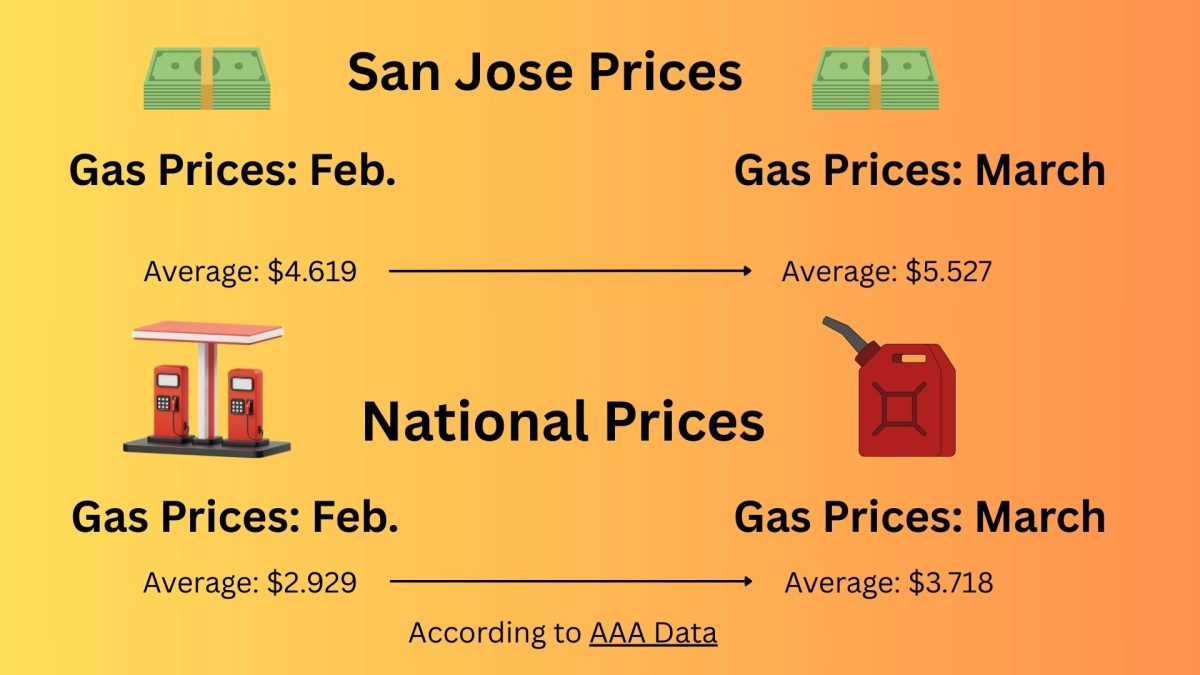
Gas prices have subsequently increased 78 cents nationwide in the last month, going from $2.929 to $3.718 per gallon, according to AAA’s website.
Matthew Tran, a criminology student at SJSU, said that Americans are feeling the consequences of the Iran war because of the increasing prices in gas.
“Gas here in California is already expensive compared to other states,” Tran said. “With a war happening in Iran right now (that) we realistically didn’t have to (be in), we are dealing with the consequences.”
In California, where gas prices are the highest average in the nation, San José is experiencing the same increase. Prices have risen from last month’s average of $4.619 to the current average of $5.527, according to the same website.
The Iran war has caused the Strait of Hormuz to periodically close, causing the largest oil supply disruption in history, according to a CNBC article.
The previous record for the largest disruption was the Suez Crisis in 1956, where around 20% of the global oil supply chain was disrupted for nine days, according to the same article.
Tran said he has to commute 200 miles in a week going to and from school and work.
“Since I have a hybrid, gas prices haven’t affected me that much,” Tran said. “It’s still more than how much I usually pay at the pump.”
Tran is concerned that rising gas prices are putting pressure on finances.
“It’s just a lot of money coming out of your pocket,” Tran said. “As a commuter and going to work, I’m not getting paid that much, it just takes more money.”
California has charged a per-gallon excise tax of around 61 cents since July 2025, and the tax affects all fuel that is moved or sold within the state and does not fluctuate with daily gas prices, according to the California Department of Tax and Fee Administration.
This is in conjunction with other fees that could increase gas prices in the state, according to the same source.
San José Mayor Matt Mahan suggested that state lawmakers should pause the state’s gas excise tax to keep prices from climbing during a debate in Monterey, according to a Monday SFGATE article.
“This is becoming an emergency for working families,” Mahan said in a video uploaded to his Instagram account. “I’m calling on Sacramento to temporarily suspend California’s gas tax, which is the highest in the nation.”
Mahan continued to state how it should be no different than if a natural disaster happened, and state lawmakers should act accordingly to the crisis of increased gas prices.
Santa Clara Valley Transportation Authority (VTA) urged residents to consider taking public transportation to help save money.
“For commuters, students and anyone running daily errands, VTA’s buses and light rail lines offer a way to get around without the rising cost of filling up the tank,” VTA said in a Monday news release. “Shifting a few trips each week from driving to transit can add up to meaningful savings.”
VTA announced that a single ride costs $2.50 for adults, $1.25 for students and $1.00 for seniors, according to the news release.
Joseph Gray, a fourth-year communication studies student, said it’s tough dealing with rising gas prices.
“It sucks, but you just try to save where you can,” Gray said. “There’s a couple gas stations that are a little bit farther out that are significantly cheaper.”
Trump has given conflicting answers to how long the Iran war will last, indicating that increased prices show no signs of letting up, according to an AP News article.
Trump said that the United States and Israel would continue the strikes for about a month, but General Dan Caine said the Pentagon’s military goals would, “take some time to achieve,” according to a March 10 New York Times article.
Gray said the rising gas prices have changed his commute to school.
“It’s tough, it’s one of those things where as an individual person, it’s hard to have control over,” Gray said. “It’s up to people that are much higher than us.”