










San José State’s Vietnamese Student Association put together a lion dance performance on Thursday in the Student Union to bring in good luck and fortune for the Lunar New Year.
The Lion Dance Club, a subgroup of the association, began their march near the entrance closest to the Spartan Bookstore and ended in front of the Information Center next to Subway.
The dance featured a drummer and two cymbal players providing percussion music, while two lions danced. Each lion was made up of two dancers, one controlling the lion’s head and the other in charge of the rear.
Yuti Laturkar, an engineering management graduate student and student assistant at the Information Center, witnessed the entire dance as they performed right in front of her desk.
Laturkar said it was refreshing to see people showing off their culture on campus.
“It was pretty good, like it was kind of a break for everyone around the campus. They just stopped there, watching the lion dance,” Laturkar said.
Lunar New Year begins on Feb. 17 at the start of a new moon, marking the beginning of the new year on the lunar calendar, according to a Feb. 16 article from Newsweek.
Phillip Tran, a fourth-year electrical engineering student and is a drummer for the Lion Dance Club.
“The meaning behind the art is just to bring good luck to the Lunar New Year, so it’s really seen as while when we dance, we bring good luck and fortune and scare away the evil spirits to whoever we are performing for,” Tran said.
The lion dance is a Vietnamese tradition for the Lunar New Year to bring in good luck by banishing the bad spirits, according to a Jan. 28, 2024 Vinpearl article.
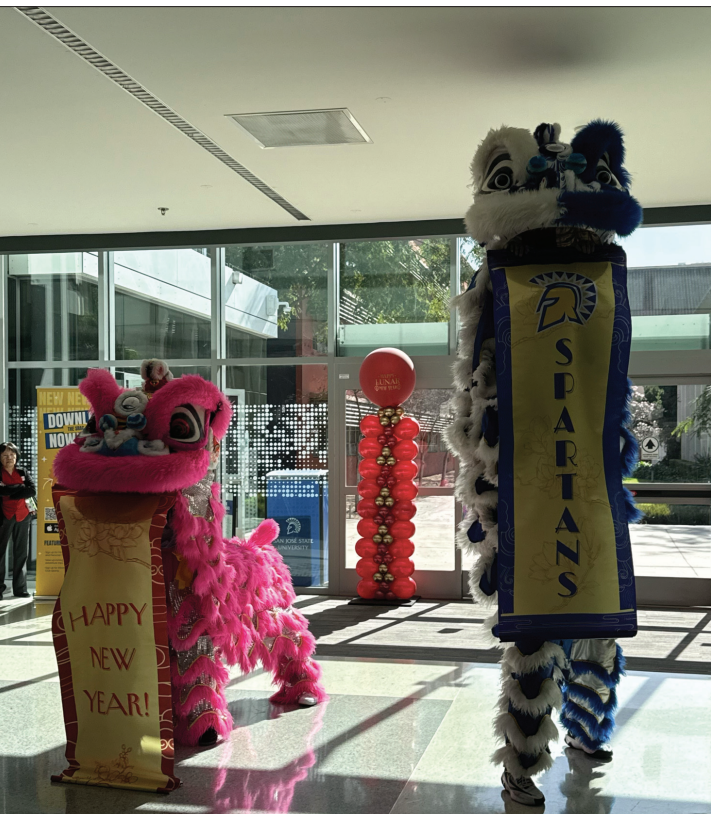
The lion costume was a large head with cloth attached to the end acting as the body. The dancers placed this on their upper bodies, only leaving their legs out as this would mimic the lion’s legs.
“Some of us have a wide range of experience, but we’ve been preparing for this performance and just this Lunar New Year’s season, the entire fall semester,” Tran said.
Each lion had the same patterns, but were distinguishable by color. The first lion was bright dark blue and white, hosting “San José State” on the back of its head in shiny gold lettering. The dancers inside it wore matching blue and white pants with ruffles.
The other lion was bright pink and silver, having more traditional designs on its head. The dancers wore pink and silver ruffled pants.
Isaac Li, a third-year business student, said he planned to watch the lion dance to support his friend in the Vietnamese Student Association.
“I didn’t expect there to be such a big crowd of people walking around, just stopping to watch it,” Li said. “I thought it was cool because everyone seemed to be very interested.”
Later on during the performance, the bottom half of the lion held the other dancer up on its shoulder, making it look as if the lion was standing on its hind legs.
Other stunts included in sync moving of the legs, head, tail and body, mimicking lion-like movements.
“I liked when they tossed the person in the front, like, really high up. It looked really cool,” Li said.
The Center for Asian Pacific Islander Student Empowerment gave away customary red envelopes to viewers with small gifts inside.
Red envelopes are associated with good luck and happiness because of its red coloring and gold lettering, according to the History website.
“I think the hardest part about planning and practicing for the performance is just the coordination between the head player and the tail player of the lion because they have to coordinate together to do these acrobatic stunts,” Tran said.
The Lion Dance Club could be seen practicing on Seventh Street on Tuesdays and Fridays from 5 to 7 p.m. on campus, according to the club’s Instagram account.