



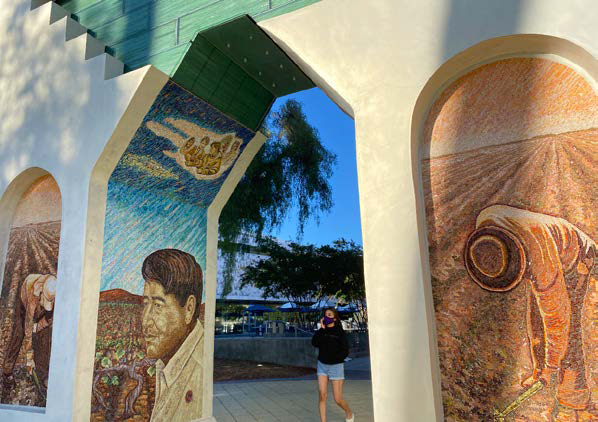
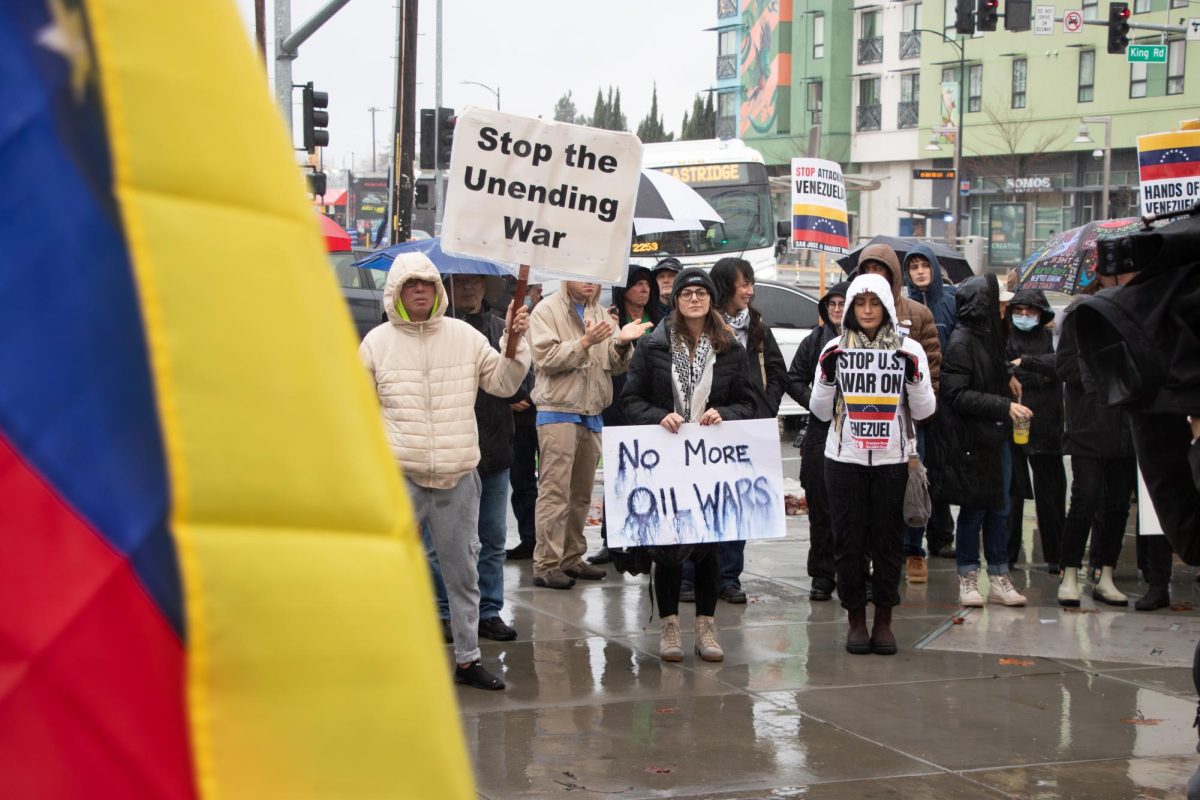
On a rainy Sunday afternoon, more than a hundred protesters marched down South King Road in East San José to protest the United States’ military campaign against Venezuela, including its latest capture of Venezuelan president Nicolás Maduro.
The emergency protest, which began with speeches and a rally outside of the Mexican Heritage Plaza, called for an end to U.S. military aggression against Venezuela in what organizers from San José Against War call a “war for oil.”
Drusie Kazanova, a member of San José Against War who emceed the rally, thanked protesters for showing up despite the weather and condemned the Trump administration’s attacks on Venezuela.
“We know what this is – it has nothing to do with drug trafficking,” Kazanova said. “We have seen this before with Iraq, with Afghanistan, with Libya, with Vietnam. The U.S. plunders other countries (and) kills millions of innocent people all for its own geopolitical aims and economic interests.”
Organizers led a procession of participants in chants of “No more blood for oil, U.S. off Venezuelan soil” as they made their way south to Story Road.
President Donald J. Trump said at a news conference Saturday that the U.S. government would “run” Venezuela and take control of its oil reserves, allowing the sale of Venezuelan oil to other countries, according to a Jan. 2 article by the Associated Press.
Richard Hobbs, an immigration attorney and founder of Human Agenda, described the move as “naked imperialism.”
“The contradictions are profound,” Hobbs said. “Claiming that the main reason (Trump) wants multinational oil companies to exploit the oil and the people of Venezuela is to help Venezuelans.”
Leading up to the capture of Maduro, the Trump administration carried out a series of airstrikes against foreign boats in the Caribbean on the pretext of countering alleged Venezuelan narco-terrorism and drug-trafficking, according to the same AP article.
The months-long bombing campaign has killed at least 115 people since September, according to a Dec. 31, 2025 article by NPR.
Donna Wallach, a member of San José Against War, said she cried in her car thinking about the human casualties caused by U.S. military interventions abroad.
“I am so outraged at all the suffering and the death and destruction that this government causes here and everywhere throughout the world,” Wallach said. “I’m going to use my anger to envision a world where every living being has liberty and justice and freedom and a life.”
U.S. forces abducted Maduro from a military complex in Caracas early Saturday morning and flew him to Manhattan, where he is facing conspiracy, drugs and weapons charges, according to a Jan. 3 news thread published by CNN. President Trump did not seek congressional approval for the operation, according to the same source.
John Duroyan, president of SJSU’s chapter of Students for a Democratic Society, led the procession from the back of a pickup truck, shouting chants through a megaphone. He said Trump’s capture of Maduro was bizarre.
“It was very much a criminal act,” Duroyan said. “I’m not really sure what Trump’s game plan is. What is certain is his end goal, which is to expropriate, steal Venezuela’s oil, sell it to Wall Street and turn a profit.”
Some Americans in Doral, Florida, the city with the largest concentration of Venezuelan people in the U.S., are celebrating Maduro’s capture, according to a Jan. 3 article by NBC News.
Ethan Pham, an SJSU nursing alumnus and home health nurse in San José, said he acknowledges the relief that some Venezuelan Americans may feel now that Maduro is ousted, but warned that foreign-led regime change won’t necessarily lead to a democracy.
“Whenever the United States comes in to take away the current president or dictator, we always replace it with someone who doesn’t have that country’s people’s interest in favor,” Pham said. “We always topple the regime and replace it with a regime that’s compliant with our interests, which will cause unneeded suffering, death and destruction all across the globe.”
In December, President Trump issued an executive order that designated fentanyl, a synthetic opioid, as a “weapon of mass destruction,” according to a White House webpage. The president justified the boat bombings as a means of stemming the flow of drugs into the country, according to a Jan. 4 article by PBS News.
“The production and sale of fentanyl by Foreign Terrorist Organizations and cartels fund these entities’ operations … and allow these entities to erode our domestic security and the well-being of our Nation,” Trump wrote in the order.
Top officials in Trump’s cabinet admitted there was no evidence of fentanyl coming out of Venezuela, but that the boats were carrying cocaine headed for Europe, according to a Dec. 17 article by The New Republic.
Karthika Sasikumar, a political science professor at SJSU, wrote in an email to the Spartan Daily that she believes the U.S.’s military action is unlikely to bring stability to the region or reduce overdose deaths at home.
“Taking the Venezuelan leader into custody will not prevent cocaine from entering the country,” Sasikumar wrote. “It is unrealistic to think that the huge profits that can be reaped by drug trafficking will be given up if one alleged network is disrupted.”
In 2003, President George W. Bush made similar claims of Iraq possessing weapons of mass destruction to justify his invasion of the country, according to a March 9, 2023 article by the Stockholm International Peace Research Institute. It is well established that there were no nuclear weapons efforts of any kind in Iraq at the time, according to the same source.
Duroyan said the large turnout at Sunday’s protest indicated Americans’ frustration with the Trump presidency.
“At the end of the day, Americans are exhausted,” Duroyan said. “We’ve had enough of these endless wars and we see these wars for what they are … they’re cynical, self serving wars that only benefit the rich elite.”