




















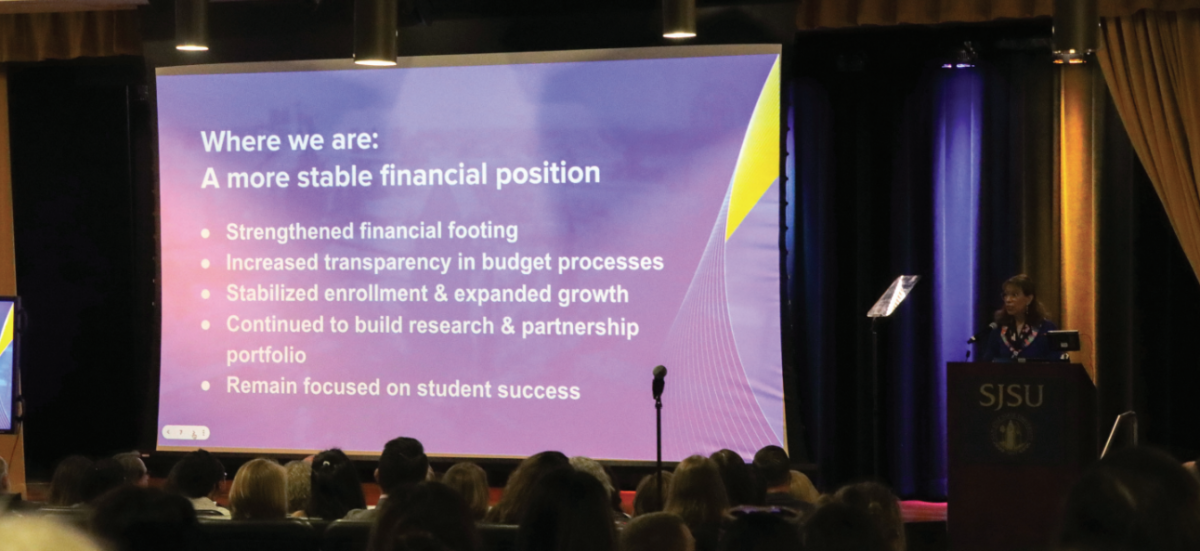
Faculty members and staff gathered at the Student Union Theater on Tuesday to listen to San José State administration discuss the university’s 2026-27 fiscal budget.
The budget town hall happens each semester to address financial updates and plans across departments.
The town hall meeting started with a discussion of the agenda and a land acknowledgement of the Muwekma Ohlone Tribe, followed by President Cynthia Teniente-Matson arriving at the podium.
Teniente-Matson said that throughout campus, efforts have strengthened the university’s financial standing compared to previous years, and she’s optimistic for the university’s financial state in the upcoming year.
“We are in a better position, and that is why I would describe our outlook as cautious optimism,” Teniente-Matson said.
After the introduction, Kathryn Kaoudis, vice president for administration and finance, gave an update on the 2025-26 budget and plans for the next academic year.
Kaoudis said the budget for the upcoming academic year is largely dependent on California Gov. Gavin Newsom’s budget proposal, which will be finalized in May, according to Kaoudis.
“This means that we’re budgeting according to our priorities, and this makes sense because educating our students is the heart of who we are at San José State,” Kaoudis said.
During the current academic year, 62% of the approximately $500 million total budget went to academic affairs, according to Kaoudis.
This was the highest allotment, followed by the second highest was admin and finance, which received 11.7%, also according to Kaoudis.
The Governor’s budget currently proposes providing the California State University (CSU) system $366 million, not including $201 million in revenue from student tuitions, which is a 7% increase in base funding for the 2026-27 year, according to the state’s legislative analyst’s office.
Mike Vizzusi, director for budget planning and financial management at SJSU, said the university has plans of a target for $25 million into funding reserves, with 5% of it from the $500 million operating fund per the Chancellor’s Office Policy.
“We are contributing $5 million to our reserves this year, which at the end of (the) year will lead to $7 million in campus reserves,” Vizzusi said. “These reserves are used to support campus operations during periods of uncertainty and importantly, we are making progress as part of next year’s budget plan.”
The Chancellor’s Office Policy is reserved for economic uncertainty that would be used to pay for operating costs, according to the town hall’s presentation.
The purpose of reserves is to ensure adequate financial management and have emergency funds available, according to San José State’s Campus Reserves Policy.
Provost and Senior Vice President for Academic Affairs Vincent J. Del Casino Jr. addressed how enrollment affects the university’s budget at the meeting.
“What I’m here to do is just briefly look at enrollment beyond the state budget,” Del Casino said.
Del Casino said that the Professional and Continuing Education program (PaCE) has generated significant enrollment and subsequently, revenue for SJSU.
PaCE offers online bachelor’s degrees able to be completed fully online, master’s level degree programs and high-level certifications, according to the academic affairs department website.
PaCE programs are not financially supported by the state’s general funding, according to a March 2024 campus communication by Del Casino.
By the end of 2024, PaCE had generated $72.4 million, a 18.9% increase from the previous year, according to SJSU’s 2024-25 annual budget plan.
Del Casino said SJSU has the largest continuing education program in the state.
“We make up 25% of all the professional and continuing education enrollment in the California State University,” Del Casino said. “So we are leading the way.”
Microphones were provided for public comment and questions in between each admin address.
Later, Chris Wessells, acting vice president of information technology (IT) and chief information officer, addressed Transformation 2030, the university’s long term plan for improvements by 2030.
Wessells said the IT department’s physical and cyber security plans in accordance with Transformation 2030, including replacing the campus camera infrastructure with 1,000 new video sensor cameras and continuing implementation of Artificial Intelligence (AI) for staff outside of teaching faculty.
Wessells said that currently the IT department is facilitating an AdoptAI initiative, to provide a base understanding of generative AI to non-teaching staff members.
“We’re excited about the growth of AI amongst the Spartan community, and we look forward to effective solutions that benefit everyone,” Wessells said.
Teniente-Matson closed by saying the purpose of budget town halls is to support campus and department communication about budgets.
“The types of questions that have emerged today, and the depth of the information presented is reflective of the building of our capacity, our institutional knowledge to be able to support each other in this sort of community where we can share all the information,” Teniente-Matson said.

