























“Stardew Valley” is a game that I always find a way back to, for the past three years.
Every spring break or quiet hour before bed, I’m quick to log on and become immersed in Pelican Town for a few blissful in-game days.
“Stardew Valley” is an open role-playing game created in 2016 by an independent videogame developer called ConcernedApe, according to the games website.
Everyone begins the game under the same circumstances: you leave your corporate job at Joja Cola and inherit your grandfather’s farm in Stardew Valley, where you start off with only a few farming tools and coins, according to the website.
When I log in, I can live a different experience than my reality.
I’m just a college student often stressed about my assignments and tired from working my 4 a.m. barista shifts.
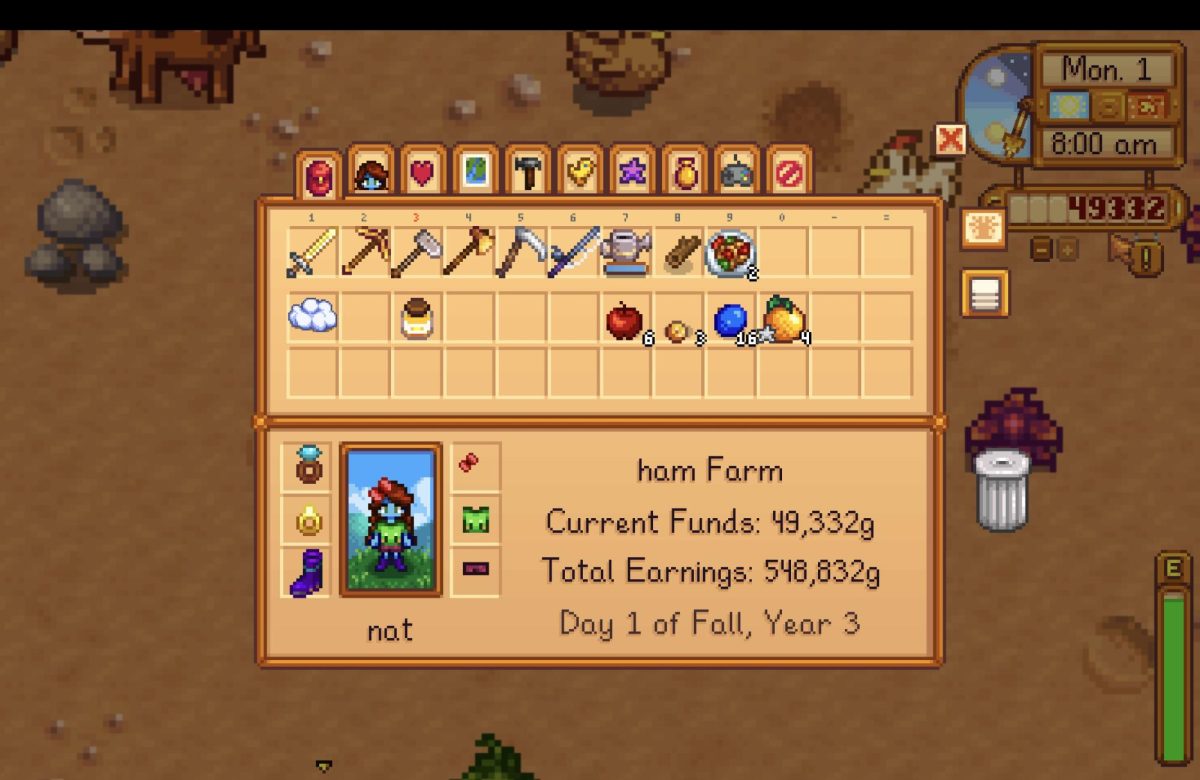
But in Stardew, I’m a millionaire farmer with dozens of animals who spend their days fishing.
I discovered the game by a friend’s recommendation, played for a few months and eventually forgot about it. Then this past summer, when cleaning old files from my laptop, I saw the game’s chicken logo and logged in.
This time I fell in love and everyday of that summer break I’d spend a few hours playing.
Near your farm is Pelican Town, with quirky townspeople, stores and even a bar (Stardrop Saloon) with arcade games.
You can date, get married and have children with a select few of the townspeople (non-player characters) who are considered bachelors and bachelorettes.
The player can gift all the non-person characters with assorted items to get hearts and cutscenes that reveal more about each character.
Bachelors include Alex, Elliot, Harvey, Sam, Sebastian and Shane, and bachelorettes include Abigail, Maru, Emily, Haley, Leah and Penny.
Each possible suitor has their own storyline and personality, often dealing with real world challenges.
As the player gains friendship hearts with Shane, he opens up about coping with his depression with alcoholism. At six hearts, the player finds Shane impaired and contemplating suicide and is tasked with affirming that he should continue living.
You can also fight monsters in the mines, fish, farm and unlock other places to visit like Calico Desert and Ginger Island.
Visually its a 2D pixelated game, its colorful yet low stimulation.
It was inspired by “Harvest Moon,” one of the pioneer farming simulation games, according to a Game Rant article.
What I love is the endless nature of “Stardew Valley,” many achievements can only be unlocked after a certain friendship level with a townsperson is reached or you complete a quest.
For example, when you complete the community center quest by gathering certain items, a character named Willy will ask you to help him repair his boat. Once completed you can travel to Ginger Island, an area I still await to access.
There is no rush in “Stardew Valley,” most activities will await your return.
It feels like the game grows with you, there is always more to do.
Many players try to reach perfection, which requires full completion of every skill and friendship. This can be tracked on one’s Steam account, but isn’t required.
I’ve tested several video games, but I wouldn’t truly connect with them, only playing with friends then putting it down.
Stardew is the only one I return to independently, it’s the only video game I could lose an entire day to.
According to my steam account, I have played 2,456 total hours and yet still I only have 37% of the in-game achievements completed.
This past spring break, I got to spend several uninterrupted hours on my virtual farm. It felt nostalgic to get so invested in a hobby without a pressing due date in the back of my mind.
I encourage gaming experts and novices to give “Stardew Valley” a try. In its simplicity, you can truly be free.
