




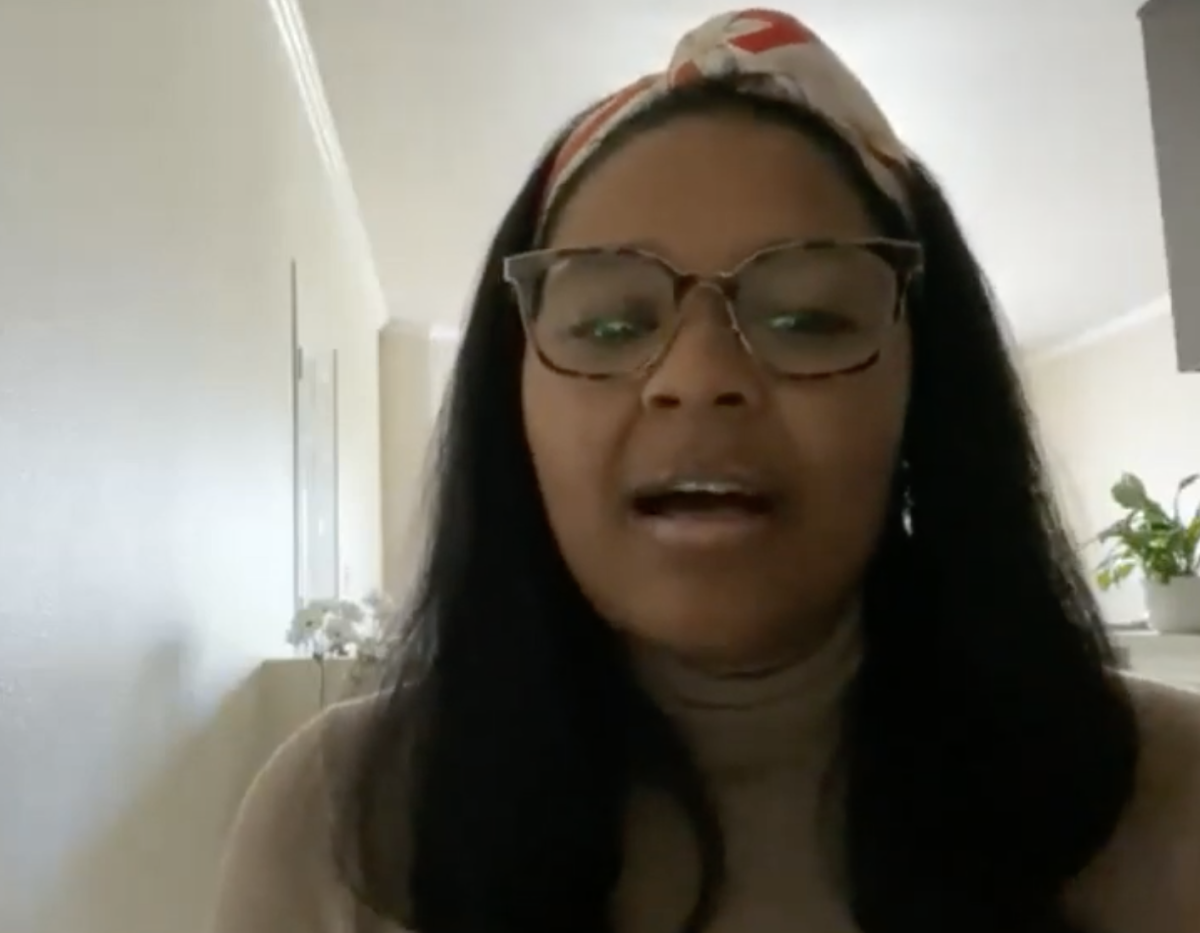
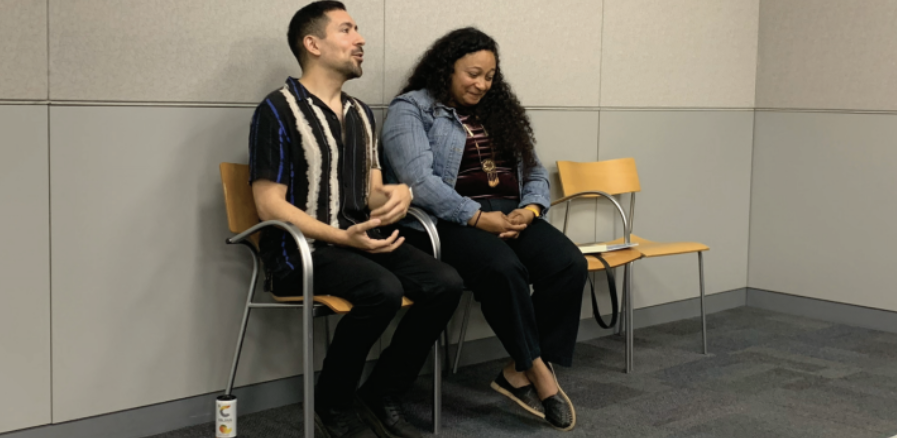
On Wednesday, California author and journalist Terria Smith, a member of the Torres Martinez Desert Cahuilla Indians, spoke at the Dr. Martin Luther King, Jr. Library about the experiences of Indigenous Californians and resistance.
Smith is an editor of the News from Native California magazine, the director of the Berkeley Roundhouse program at Heyday Books and has written three books, according to her author page on the Heyday website.
Heyday is an independent publication founded in Berkeley, Heyday’s Roundhouse program reports on California Native communities through books and its quarterly magazine, “News from Native California,” according to the publications website.
Smith said that the visibility of California Natives is important to her.
“It’s like my life’s work, I will always have a job if this keeps up,” Smith said.
Abel Gomez, an assistant professor of Native American and Indigenous Studies, brought his introduction level class to the event.
Gomez said he believes it’s important to educate students on Native American and Indigenous culture beyond a surface level.
“We hear the land acknowledgement all the time on campus, and I would invite students to be curious about what those words are, what they mean and to think about their relationship to this place and the original people of this place,” Gomez said.
Smith began her discussion by reading an excerpt from her 2023 book, “Know We Are Here: Voices of Native California Resistance,” published by Heyday Books.
Her book, comprising 25 short essays written by more than fifteen California Indian authors, focuses on the perspective of both elders and rising generations and confronting particular histories, challenges and life in Native California, according to Heyday Books.
Smith said California has a large Native American and Indigenous population with more tribes than any other state in the country.
There are about 660,000 Native people living in California, according to a 2022 U.S. Census.
Smith said that the recognition of Native communities in California is diminished due to chosen ignorance from the public, not from lack of presence.
“People claim their ignorance is unintentional, and actually, it’s a thin excuse to ignore the existence of tribal people in California,” Smith said. “It’s certainly a conscious act. I am convinced of that. Tribes in California state have a lot of physical visibility everywhere.”
Smith said that the public often thinks of Natives in southwestern states like Arizona and Nevada rather than California, due to representation in the media.
A 2024 study, the Native American Communication Project analyzed broadcast news trends in coverage of Native Americans. The study found coverage focuses on large well-known tribes in Western States surrounding California, according to an article by the Collaborative on Media and Messaging.
Smith said that during the Dakota Access Pipeline protests — also known as the 2016 Standing Rock protests — many questioned why the same attention wasn’t given when Native sites in California were developed in the year prior.
The Dakota Access Pipeline was constructed within half a mile of the Standing Rock Sioux tribe reservation, which poses a threat to pollute the water of the tribe and was met with protests, according to a Natural Resource Defence Council article.
In 2015, the Coyote Valley Band of Pomo Indians and Round Valley Indian Tribes filed a lawsuit against the California Department of Transportation, which claimed a 101 bypass in Mendocino destroyed cultural sites and blocked salmon passage used by the tribes for centuries, according to an article by the Santa Cruz Sentinel.
In 2017, a federal judge ruled in favor of the California Department of Transportation and construction of the 101 bypass was completed, according to an article by Courthouse News Service.
Smith said that as a Native reporter, coverage often fails to properly gather information from tribal members who have ultimate authority on Native issues.
“Maybe it’s you don’t want to relinquish any kind of superior authority onto people that actually know what they’re talking about,” Smith said.
Kerri J. Malloy, an assistant professor of Native American and Indigenous Studies and former board chair of the Yurok Indian Housing Authority, said that his approach to modern Native education was listening.
“A lot of our conversations have been with local tribes asking, ‘What is it they need from us?’ ” Malloy said. “Not in the sense of ‘what can we do for them,’ but ‘what do they need us to form our curriculum around?’ ”
The Native American Indigenous Student Success Center at San José State is located next to Tower Lawn and seeks to educate SJSU about indigenous communities, according to a university webpage.
The university has also offered a minor in Native American and Indigenous studies as a part of the schools’ Department of Sociology Interdisciplinary Social Sciences, according to an archived 2025 through 2026 SJSU course catalog.
Bernadette Quiroz, a Muwekma Ohlone tribal member and executive director of Muwekma Ohlone Archaeological Services, said Smith’s discussion on representation is important.
“It was beautiful, we need more of this. It combats the erasure that was not here, we actually are here,” Quiroz said.
