














Public distrust of license plate readers have led to updated policies in Silicon Valley, yet some cities remain committed.
On Feb. 24, the Santa Clara County Board of Supervisors voted 3-2 to improve its surveillance use policy, deactivating Flock cameras in Saratoga, Cupertino and Los Altos Hills.
The board referenced concerns about data breaches to national agencies including U.S. Immigration and Customs Enforcement (ICE).
In the updated policy, the Santa Clara County Sheriff’s Office can no longer utilize Flock Safety as a vendor for automatic license plate readers, and data can no longer be accessed, according to the Board of Supervisors meeting.
District Two County Supervisor Betty Duong said the county sheriff’s office would not partner with the vendor.
“With the following conditions, one that Flock is not used as a vendor or contractor for the ALPR technology systems, that the Sheriff operates on behalf of these cities,” Duong said.
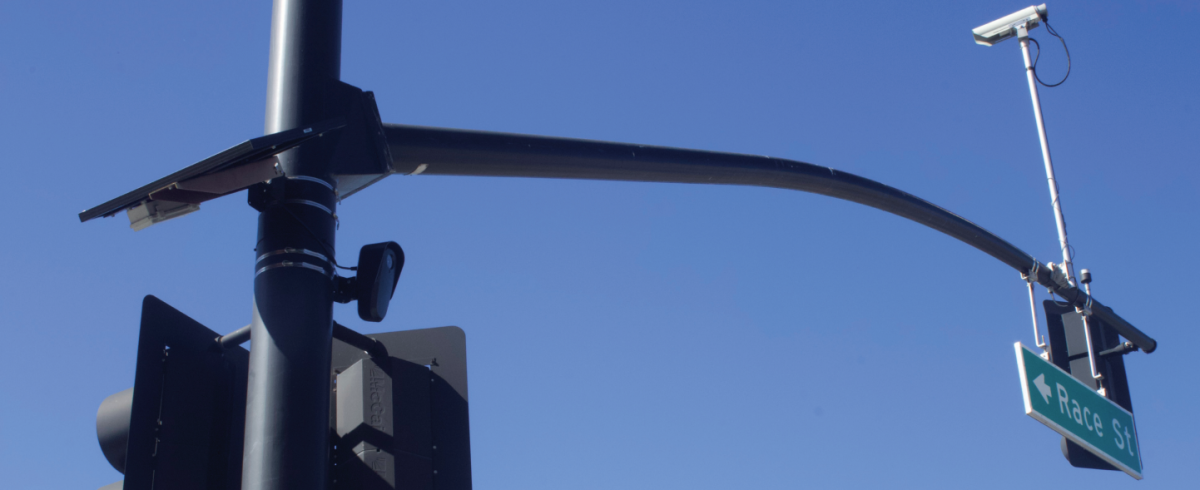
Flock Safety is a vendor of automatic license plate readers, which are small, often unnoticeable, computerized cameras attached to traffic signals that captures data from passing license plates including location, time and sometimes images of the vehicle’s passengers which are then uploaded to a central database, according to an article from the Electronic Frontier Foundation.
While the policy update includes Los Altos Hills, the Los Altos Hills City Council had previously disabled all Flock-operated license plate readers on Jan. 15, according to an announcement on the town of Los Altos Hills’ website.
During the board meeting, supervisors acknowledged the county’s record of tight security for surveillance tools.
The County received national recognition as the first county in the nation with transparency efforts for surveillance tools with the 2016 Surveillance Technology and Community Safety Ordinance.
Led by former District Five County Supervisor Joe Simitian, the ordinance mandated early public disclosure, accountability and ongoing oversight for all surveillance efforts, according to a June 7, 2016 news release by the American Civil Liberties Union of Northern California.
Duong recognized the county’s historic efforts to protect citizen privacy and said the resolution wasn’t criticism of the ordinance or the Sheriff’s Office, according to the board meeting.
“This is not an indictment of our sheriff’s office, this is not an indictment of our surveillance use policy,” Duong said. “What we have here is constructive notice of a bad vendor that all signs are telling us don’t get in bed with.”
The board’s vote wasn’t to approve any expenditure of the country budget on automated license plate readers, but to consider the current surveillance use policy and the trustworthiness of Flock in the county, according to Duong in the meeting.
Duong said she’s concerned by increased surveillance and believes county funds are better directed toward community efforts.
“Alleviating poverty and ensuring stable housing, sufficient nutrition, access to healthcare and education, clean and well-lit streets create more safety than surveillance cameras, even when used under the strictest use policies,” Duong wrote in an email to the Spartan Daily.
The deactivation of Flock in Saratoga and Cupertino occurred as several California jurisdictions reconsidered its contracts with the same vendor, including Mountain View and Santa Cruz.
The Mountain View City Council voted to terminate its contract with Flock Safety following a data breach in January, according to a Feb. 25 article by the San José Spotlight.
In January, Santa Cruz was the first California city to terminate its contract with Flock Safety, according to a Jan. 14 article by KQED.
However, some officials question the termination of license plate readers and support the use of the automated systems.
Paris Lewbel, public relations manager for Flock Safety, said Santa Clara County’s decision to end its contract was based on misinformation.
“While a small number of communities have chosen not to renew their contracts, largely amid misinformation, the number of new communities partnering with Flock has significantly outpaced those departures,” Lewbel said in an email to the Spartan Daily.
Santa Clara County Sheriff Robert Jonsen voiced his support for Flock’s license plate readers to solve and prevent violent crime in Saratoga and Cupertino.
“The primary reason I find value in it, is to prevent or apprehend individuals that have committed violent crime – serious crimes,” Jonsen said. “I think that’s where my concern comes from … I’m just very passionate about keeping this community safe and I think we are safe and I think there’s a place for technology to do that.”
A press release from the Santa Clara County Sheriff’s Office stated the agency has never shared its automated license plate reader data with ICE, and since 2022, the readers have aided in recovering over 50 stolen vehicles, making 66 arrests and helping in five missing person cases in the West Valley, according to the department’s website.
Adam Schwartz, a privacy litigation director for the Electronic Frontier Foundation, said automated license plate readers are not required to keep communities safe.
“If the claim is that the only thing standing between our society and the abyss is the plate reader, that’s just not actual history,” Schwartz said. “We have solved all kinds of crimes for a very long time.”
A November 2025 lawsuit was filed against the City of San José by the Electronic Frontier Foundation and the ACLU Foundation of Northern California representing two nonprofits, Services, Immigrant Rights & Education Network and the Council on American-Islamic Relations, California, on the basis of privacy concerns of its nearly 500 automated license plate readers, according to official documentation filed in the Superior Court of the State of California.
Schwartz said that even when county law enforcement is cautious with its license plate reader data, Flock as a vendor has aided ICE in finding immigrants and grants law enforcement access to share data.
“Flock is aware that police departments and officers across America are giving access to ICE,” Schwartz said. “It’s irrelevant that Flock is not itself, handing the data over. Flock has created a system that Flock knows is being used by police officers to hand the data over to ICE.”
The Flock network was accessed for 20 searches for “immigration violation” reasons from out-of-state police officers during the early months of 2025 in Los Altos, according to an article by the San José Spotlight.
This violates Senate Bill 34, which prevents the state’s license plate reader data from being shared with any out-of-state agency, according to the same source.
Tim MacKenzie, a member of the Silicon Valley chapter of the Democratic Socialists of America, said the license plate readers collect high amounts of data on innocent civilians in an email to the Spartan Daily.
“The overwhelming majority of data that is captured and searched is of everyday people like you and me going about our lives and has no impact on stopping crime,” MacKenzie wrote.
