


















San José is using artificial intelligence (AI) to improve transportation infrastructure and commuters are expected to experience increased travel speeds.
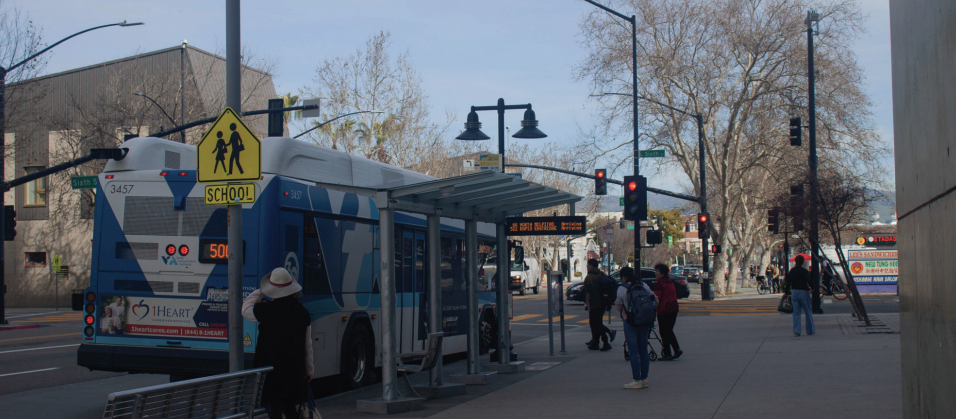
On Feb. 6, San José Mayor Matt Mahan announced the city’s public buses are operating 20% faster because of artificial intelligence (AI) implementation into the transportation system, according to the Mayor’s State of the City Address.
The initiative is a collaboration between the City of San José, the Santa Clara Valley Transportation Authority (VTA) and LYT.speed, an AI traffic technology software provided by the company LYT based in Santa Clara, according to a press release by the Office of Matt Mahan.
Chelsea Palacio, public information officer for the city of San José, said the LYT.speed program is unique and improves upon existing technology.
“The TSP (Transit Signal Priority) system uses existing tracking hardware already used in VTA buses,” Palacio said. “AI combines the location, direction and speed of the buses with traffic signal data to prioritize an extended green light or shortened red light as the bus approaches an intersection.”
As of October 2025, all bus routes in San José utilize AI-based technology at 671 intersections, including several that stop at San José State such as VTA Routes 64B and 522, according to the city’s website.
This announcement comes after years of testing, installation and analysis of AI-powered Transit Signal Priority systems, with testing beginning in 2019 at 17 intersections in East San José, according to a case study by LYT.
Since the implementation, LYT.speed’s AI Transit Signal Priority systems have saved the VTA around $1.4 million in bus equipment costs and around $255,000 in traffic signal installation cost, according to the same source.
According to VTA’s independent evaluation of LYT.speed’s Transit Signal Priority systems, bus speeds increased four to 16 mph, with a 15 to 20% increase on time performance during the pilot phase.
Matthew Domenichelli, a student at San José City College whose main method of transportation is the bus, said traveling on the bus requires additional time and planning.
“As a bus rider, I know that no matter what somehow it always takes an hour to get where I need to go,” Domenichelli said. “It’s like the holy trinity is the bus, the light rail and the BART.”
VTA said in an email to the Spartan Daily that there are two elements enabling AI transit signal priority systems to maintain accurate arrival times, both the technology that grants buses priority and policy regulated by the city that owns the traffic signals.
“Technology alone cannot significantly improve bus performance,” VTA said. “The effectiveness of TSP (Transit Signal Priority) ultimately comes from policy decisions, not just the technology itself.”
The Road Safety Conditions Pilot program is another AI-based transportation measure in San José that is currently in its second phase of evaluations and will involve attaching computerized cameras to the top of city vehicles to detect and report safety concerns on roads such as pot holes and fallen branches with a 97% accuracy, according to the March 20, 2025 Road Safety Conditions Pilot Status Report by the City of San José.
“The Road Safety Conditions Pilot uses computer vision, a technique that teaches computers to recognize images,” Palacio said. “The Transit Signal Priority system uses a specific type of machine learning called a regression model.”
A regression model is used to make predictions and estimate trends based on the relationship between entered information and the desired outcome, according to an article from geeksforgeeks.
Adam Cohen, a senior research associate at San José State’s Mineta Transportation Institute, said the use of AI in Transit Signal Priority systems makes public transit a more competitive option for travel.
“The goal of TSP (Transit Signal Priority) is to enable the buses to travel faster than regular car traffic,” Cohen said.
Cohen also said investing in efficient public transit is important because it lowers the obstacles those without cars face in everyday commuting.
“Those that depend on a bus, you know, you have to wait till the bus arrives and if it’s late they are really adversely impacted,” Cohen said. “Whereas someone who’s driving just gets in their car can go on their way.”
According to the VTA website, a monthly bus pass costs $90, making it a moderately-priced option compared to Santa Clara County’s average gas price of $4.65 per gallon, according to the American Automobile Association website.
Experts such as Cohen said that public transportation systems, like the county’s VTA, require several moving parts to operate instead of full reliance on a single system or AI implementation.
“TSP (Transit Signal Priority) is often employed with other types of infrastructure to make it more effective,” Cohen said.
