












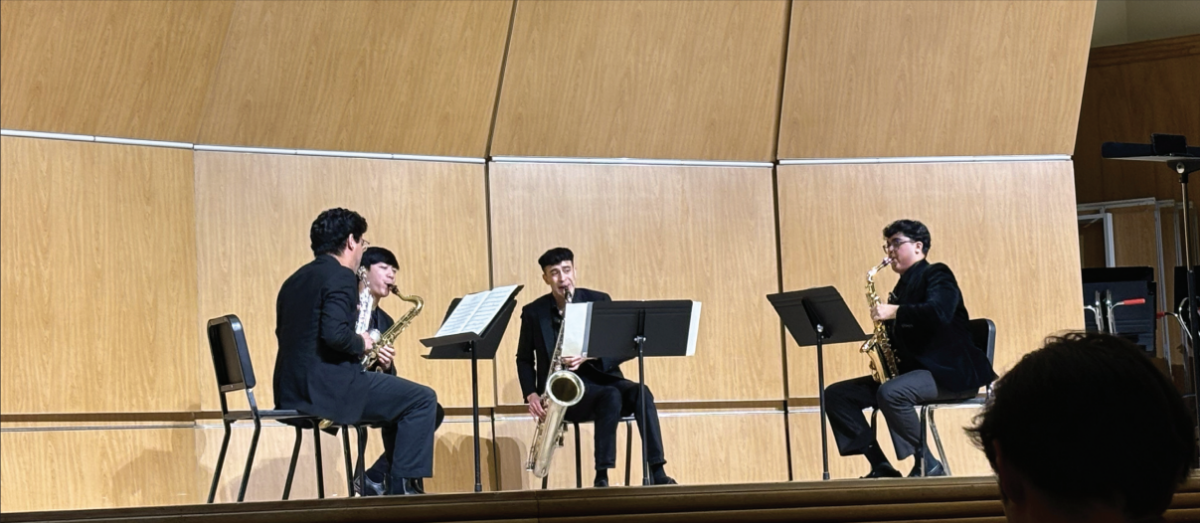
The blend of four saxophones filled San José State’s Concert Hall from the Zácha Quartet on Tuesday.
The SJSU School of Music and Dance introduced the jazz quartet during their kick off of the afternoon listening hour series, according to a Jan. 19 Facebook post from the school’s music and dance program.
The student quartet performed pieces by composers David Saleras, Sally Beamish and Aleksandr Glazunov, which highlighted the creativity and range of the saxophone quartet.
Listening Hour is a free series of performances by current students, faculty and guest artists hosted by the SJSU School of Music, located in the concert hall from 12:30 p.m. to 1:00 p.m. during the fall and spring semesters, according to the SJSU music webpage.
The ensemble consists of saxophone players studying under Michael Hernandez, a woodwind area coordinator.
“They are enrolled in my chamber class and they are the third competition quartet that I have formed in my tenure class,” Hernandez said.
A saxophone ensemble typically consists of four saxophone instruments that take on different tones such as soprano, tenor, alto and baritone, however the order may vary, according to a Bowling Green State University research paper.
According to the ensemble, they performed three pieces during the listening hour, which included “Tango Pour Une Princesse Désespérée,” “Constructions for Julie Mehretu” and “Saxophone Quartet, Op. 109.”
Hernandez said the performance served a dual purpose by sharing artistry with a live audience and filming for an upcoming competition.
“They are an eager young ensemble,” Hernandez said. “It’s exciting to watch their chemistry on stage and see them put all of the work together that took hours of individual practice, hours and hours of coaching and group rehearsals.”
Beginning saxophonists are recommended to practice at least two to three hours daily, according to the Taming the Saxophone website.
David Cortez, a graduate student majoring in music performance, said the group had mixed experiences when it came to playing in a quartet and wanted to create something different for the performance.
“We wanted to work as an ensemble to create a new musical experience for us all,” Cortez said. “We knew we could begin to create something special if we worked really hard together to play this music on the saxophone.”
Performing in a musical ensemble requires players to continuously adjust to one another’s actions through a real time coordination and social interaction to maintain timing, tuning and expressive cohesion, according to the National Library of Medicine study.
During the performance, Cortez said that their stage connection becomes visible during moments of contrast.
“We feel most connected in the most extreme moments,” Cortez said. “The quiet and fast sectionals feel like we have to hone in on each other very closely, but we are always aware of each other and our togetherness at all moments when playing.”
For students who came to sit down and listen to the sound of different saxophones, the dedication of the group gave the small audience a powerful experience.
Coltrane James, a third-year music performance student, said that the ending of the listening hour stood out to him the most.
“My favorite part was in the last movement of the Glazunov Saxophone Quartet,” James said. “It was an amazing ending to the whole program.”
According to the quartet, the inspiration behind the final piece of the program is a small trip through music history.
The Saxophone Quartet Op. 109 was one of Aleksandr Glazunov’s last works and he is known as a famous late Russian Romantic composer, according to Flicks Music webpage.
The audience that attended gave a positive applause, ending the afternoon performance on a high note.
“I hope the listeners have a moving musical experience and potentially learn something new about the saxophone,” Cortez said.
