











At San José State and across California State University campuses this week, skilled trade workers represented by Teamsters Local 2010 walked picket lines and argued that promised raises from previous fiscal years were never delivered.
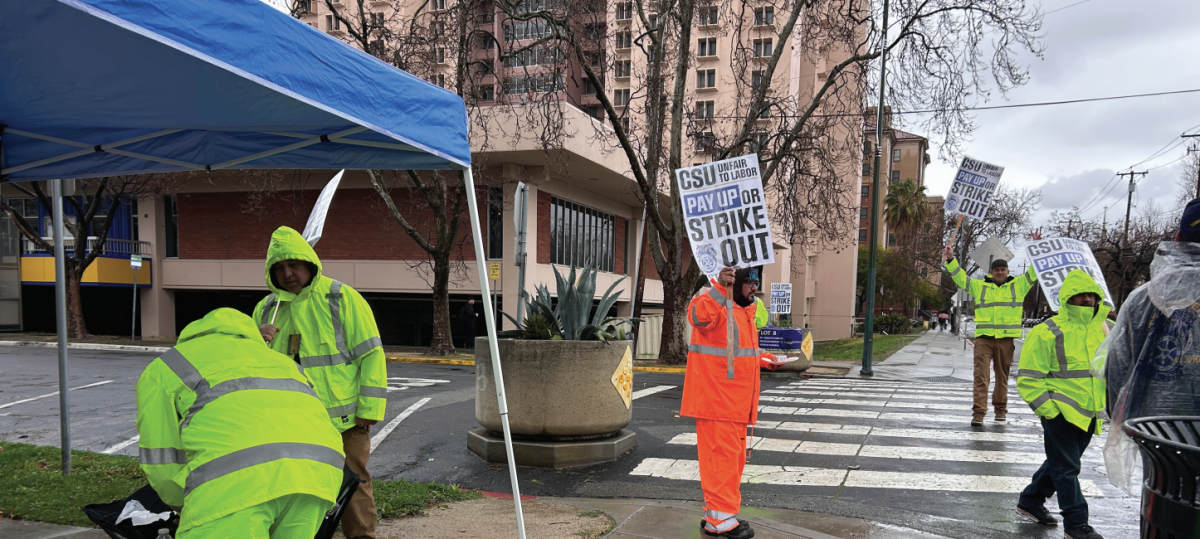
SJSU workers of the union went out with strike signs and reflective rain gear near Ninth and East San Fernando streets, as well as the Eighth and East San Salvador streets.
Joseph Fontana, Teamsters 2010 member and contracted plumber with SJSU, said he joined the picket line at 7:30 a.m. on Tuesday morning during rainy weather.
“I’m out here trying to get what I was promised,” Fontana said. “I like to support the campus and help students. That’s why I stayed.”
In California’s 2026-27 proposed budget, Gov. Gavin Newsom proposed $365 million in ongoing funding for the CSU system, according to a Jan. 9 Cal Matters.
Teamsters 2010 members launched a systemwide strike across all 22 CSU campuses including SJSU to occur from Feb. 17 to 20, according to a Feb. 14 message from the Teamsters Local 2010 website.
The four-day strike began on Tuesday and stems from a dispute over whether the university system is obligated to implement 2025-26 salary increases outlined in the union’s contract, according to the California Faculty Association.
Fontana, who has worked at SJSU for 20 years, said the issue is straightforward.
“We work for money,” Fontana said.
Despite the strike, campuses will remain open and operational, according to a campus-wide Feb. 11 email sent by SJSU President Cynthia Teniente-Matson.
In the same message, Teniente-Matson said that nobody should be pressured to take position on the strike or provide personal information to anyone participating.
After the strikes began on Tuesday, the CSU released a statement saying the Teamsters’ claims of unfair labor practices are inaccurate and the CSU remains open for continued negotiations.
“It is unfortunate that the Teamsters is advancing false claims to justify a strike, harming both their members and the broader university community,” reads the statement.
Robert Ovetz, a labor relations and political science lecturer at SJSU, said Teamsters 2010 argues that the CSU received sufficient state funding to trigger general salary increases and step raises for eligible workers.
“The system paid them what they agreed to pay them. That’s why they called off their strike two years ago,” Ovetz said. “They paid them for two years and then they stopped paying them last year. So it looks like the system is not living up to its legally contractual agreements with the different unions.”
Union leaders point to a $144 million zero-interest loan included in the 2025-26 state budget, which they say effectively restored the system’s funding level, according to a Feb. 10 article from Ed Source.
Vice Chancellor and Chief Human Resources Officer for CSU Frank Hurtarte wrote that the contract’s salary provisions were dependent on CSU receiving approximately $250 million in new, ongoing state funding, according to a Feb 10. CSU labor relations email.
Instead, the approved state budget reduced CSU’s ongoing base by $143.8 million.
Lawmakers approved a no-interest loan, where money is borrowed without any additional fees, to balance that reduction.
Additionally, CSU officials maintain that because the loan must be repaid and does not constitute permanent funding, it cannot support ongoing salary increases, according to a CSU labor relations email.
As a result, CSU proposed using the loan to fund one-time payments in the form of a 3% bonus rather than permanent raises, according to a Feb. 10 Ed Source article.
The Teamsters stated that CSU failed to provide contractual raises in July 2025 and objected to executive compensation increases approved by the CSU Board of Trustees, according to the Teamsters Local 2010 website.
“CSU was virtually the only public employer in California to give no raises to any workers in 2025 – except for huge increases to overpaid executives,” read the message.
Further disapproval from Teamsters came from the board of trustees approving of performance-based raises of 15% of base salary for several of the CSU presidents including SJSU president Cynthia Teniente-Matson in Nov. 2025, according to a documentation from the meeting.
Teniente-Matson’s current base salary is $474,840 and the proposed new base salary is $546,066, according to the same document.
Howard Hall, one of three stewards for the SJSU division of Teamsters 2010, said he felt disappointed President Cynthia Teniente-Matson approved the raise when others had their modest raises denied.
“She had a chance to be a hero to everybody,” Hall said. “If she had turned down her raise and told the Chancellor’s Office, ‘You know what, in good faith and conscience I can’t take (a) raise if the people under me aren’t getting raises.’ ”
The CSU system also planned to distribute one-time payments to nonunion employees, particularly those in management and executive classifications, while negotiations with unions were pending, according to the same source.
Confirmation of the Teamsters strike from Feb. 17 to 20 was confirmed via a 95% vote by members, according to a message on the Teamsters 2010 website.
The strike and picket line began Tuesday across all CSU campuses.
Sabrina Pinnell, chapter secretary at SJSU and member of CFA’s bargaining unit, said faculty members represented by the California Faculty Association (CFA) have shown solidarity with Teamsters 2010.
“I think the most important would be workload, salary, health and safety,” Pinnell said. “We have a number of faculty members of color that would be affected by the discrimination article. When we did a survey on this, by far the biggest concerns were salary, workload and health. Those were by far the biggest articles people were concerned about.”
Ovetz said the strike was a response to what union members view as an unfair labor practice.
“We have gone through a number of different claims about financial shortfalls and necessary investment in the facilities – that’s what the teamsters are managing,” Ovetz said. “They are the ones that keep the campuses running, so it’s a very hard job. It’s very important to make sure that institutions can deliver on its primary objective, which is educating students.”
Employees who participate in the four-day strike will see an approximate 18% reduction in pay for that pay period, according to Hurtarte’s previous email.
“We’re all dedicated to our job,” Fontana said. “We help students. We help staff. We stay on call. We come back after hours. We just want what we were promised.”
