


























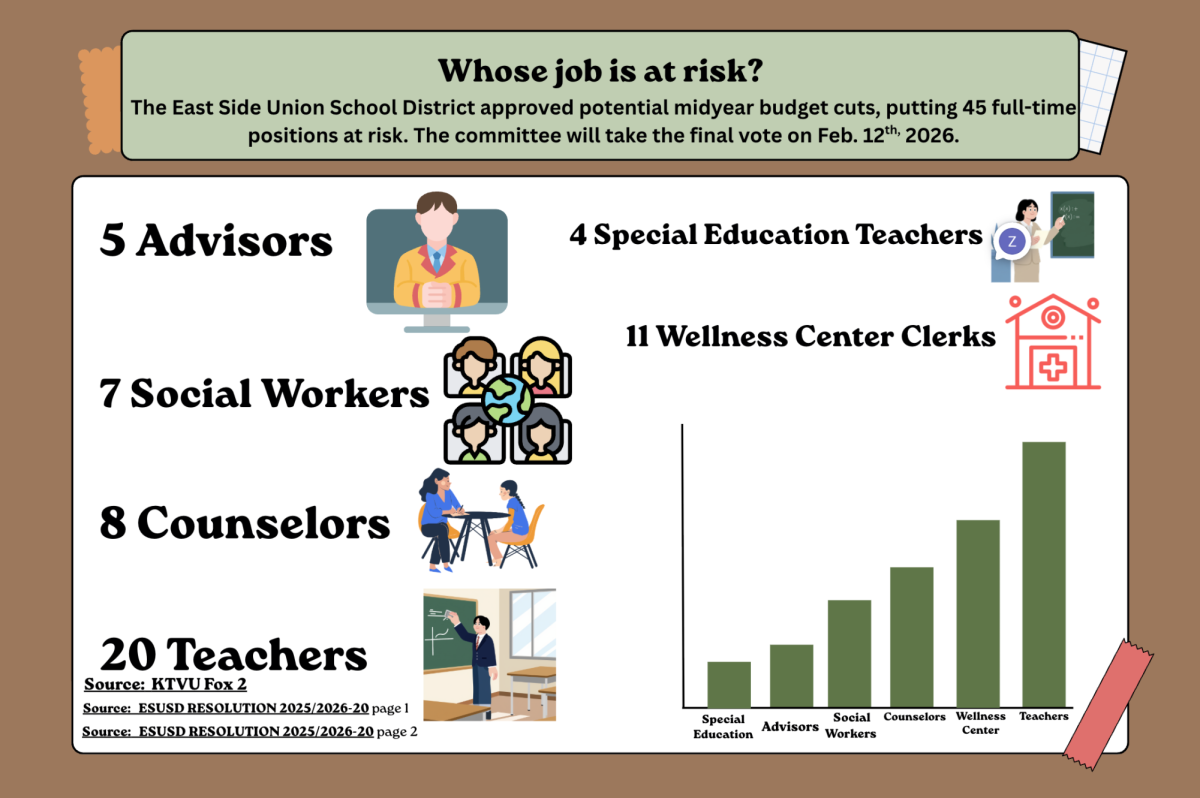
East Side Union High School District (ESUHSD) in San José is set to lose approximately 86 full time staff after layoffs were approved during a Jan. 22 board meeting, which will see jobs lost across multiple disciplines.
Seven social workers, eight counselors, four special education teachers and 11 wellness center clerks were laid off, according to an agenda item displayed during the board meeting.
The layoffs are in response to ESUHSD’s $16 million budget deficit, which per state law the district must address, according to the district’s agenda item presented to the public by the board of trustees.
The school district’s Superintendent Glenn Vander Zee said cutting staff was challenging as each service is important.
“As your superintendent that pains me and I want to make sure I look you all in the eye when I say that every service here is necessary,” Vander Zee said.
Vander Zee also referenced the district’s attempts to supplement the budget such as offering early retirement incentives to employees, which will save the district $11 million, approving a parcel tax generating $6 million per year for the next 5 years and increasing the unduplicated pupal percentage (UPP) in the district, according to Vander Zee during the board meeting.
UPP refers to a metric used in California’s funding formula for schools, according to the California Department of Education website.
It measures the amount of students who are English learners, receive free or reduced lunch, or are foster youth and allots districts with a high percentage additional funding, according to the same source.
“I encourage anybody to look across this area and find a district that’s done that much to reduce expenses and also generate new revenues,” Vander Zee said.
The ESUHSD UPP was at about 51% of students qualifying as UPP’s in 2024 according to the June 24, 2024 Proposed Budget Package.
The UPP is now at 69%, which after the district maintains this average for three years, it should receive an additional $12 million, according to Vander Zee.
Vander Zee said that the funding cuts are necessary.
“For us to meet all of our obligations, we have to make these cuts,” Vander Zee said.
Despite efforts by the district board to minimize losses to schools, some members of the district believe the cuts will harm students, including the East Side Teaching Association (ESTA), according to a press release by the organization.
“These proposed reductions represent a serious threat to classrooms, student well-being, and family support systems across the district,” the press release said.
Jack Hamner, President of the ESTA who has worked in the school district since 1997, said that East Side’s high percentage of UPP provides more of a reason to protect every provided program.
Hamner said in order for at-risk students to thrive in education they need to feel safe, be mentally well and have academic support.
“Our advisors are the ones who deal with safety, our social workers are the ones who deal with mental health and wellness, and then our counselors are the ones that primarily do the academic support,” Hamner said.
The ESTA believes reducing district administration instead of on-site employees would preserve more resources for students.
“The East Side Teachers Association does not call for the elimination of all district administration. However, we firmly believe that more can and should be cut at the district office level before classrooms and student services are sacrificed,” according to the same press release.
Hamner said the district office doesn’t need to retain additional employees during a budget crisis.
“Let’s say at the district office we have positions that we have two or three of them… we have multiple positions and you know, at some point when money is tight, there’s a financial crisis, then, maybe, we don’t need two of these,” Hamner said.
Jila Maleksalehi, lecturer for child and adolescent development at San José State, said budget cuts affect the ecosystem of education.
“As a result, more responsibility falls on educators, raising serious concerns about teacher burnout and the long-term impact of insufficient funding on both teachers and students,” Maleksalehi said.
In California, K-12 school districts are experiencing mass layoffs due to declining enrollment and no longer receiving the additional federal funding as they did during the COVID-19 pandemic, according to an article from K-12 DIVE.
Over 1,200 teachers were laid off across the state before the 2025-2026 school year, according to the same source.
The Spartan Daily reached out to members of ESUHSD board of trustees and the superintendent, but did not get a response in time for publication.
Hamner said he was surprised how many positions would be cut and questioned how schools could operate.
“It’s crazy to think that we’re gonna try to survive this way and I don’t know how it’s going to work,” Hamner said.
