























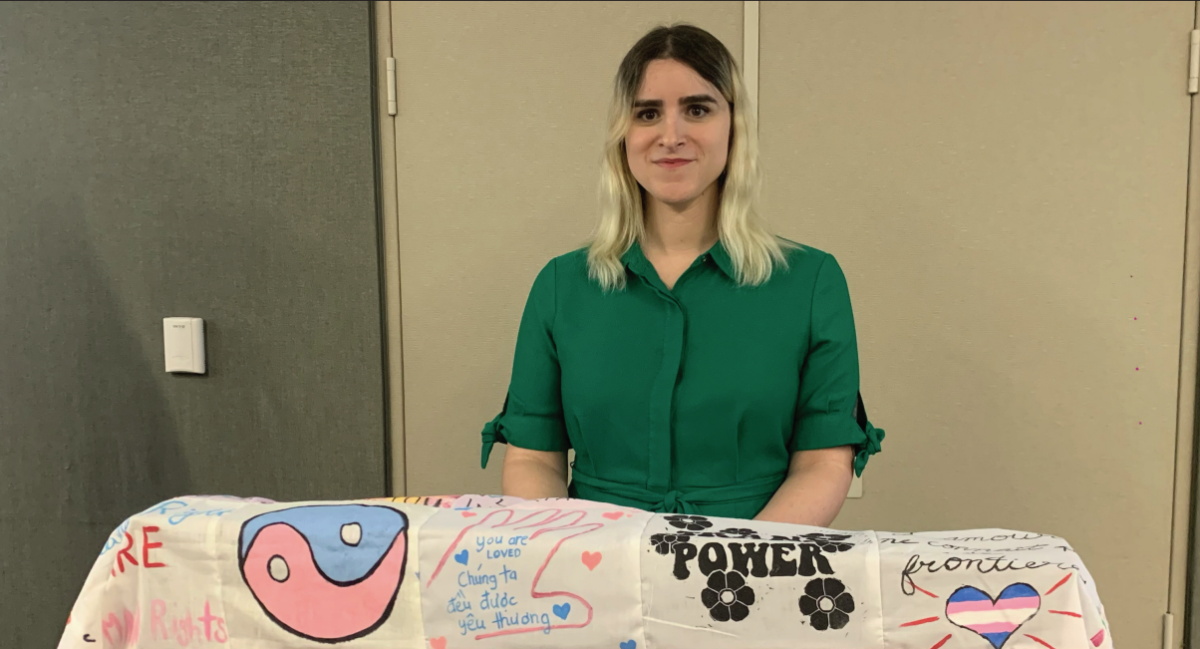
American journalist and trans activist Erin Reed spoke about resistance to the rainbow scare, the history of trans people and what it means to be trans today at the third annual San José State Transgender Teach-In on Wednesday in the Student Union.
The event was co-sponsored by the SJSU Pride Center, the College of Social Sciences and Women’s, Gender and Sexuality Studies.
Reed said the objective of the rainbow scare and targeted policies is to abolish trans people’s existence.
“The goal is to make sure we are outlawed. They’ve got a Supreme Court giving them all the tools to do so,” Reed said.
Rainbow scare was a term used by Reed, referring to increasing amounts of federal and statewide anti-LGBTQ policy that overwhelmingly targets the rights of trans Americans beginning in 2020 to present day.
In 2020, 100 anti-LGBTQ bills were proposed and in 2025, over 850 anti-LGBTQ bills were proposed, particularly against transgender individuals, according to an April 18, 2025 article by Reed.
“That’s more than any other subject in state houses, literally this is taking up more time than anything else in the country,” Reed said.
Several anti-trans legislation advocate against the existence of trans people.
Yesterday, the Kansas Senate voted 31-9 to approve Senate Bill 244 which not only bans trans people from using restrooms aligned with their gender identity, but reissues government identification to match their sex at birth, according to SB 244 text.
Reed said that much of recent anti-trans legislation compounded from controversy surrounding transgender inclusion in sports, however some policies that ban transgender athletes from competing don’t originate from concerns of biological advantage, but are simply transphobia.
“So we see bans in figure skating and even the incredibly gendered and muscle bound sport of chess,” Reed said.
In 2023, The International Chess Federation banned transgender women from competing in women’s competitions, despite chess being a fully intellectual game, according to an Aug. 18, 2023 article by NPR.
Reed said that when state lawmakers ban transgender athletes, it directly leads to the denial of the existence of transgender people.
“They continued to move that goalpost because the point of this is not just to touch this particular topic (transgender inclusion in sports), it’s to spread it everywhere, it’s to go as far as they can go,” Reed said.
On Jan. 20, 2025, the White House issued Executive Order 141698 no longer honoring customers’ requests for preferred sex markers on passports and only accepting ones assigned sex at birth, according to the United States Department of State website.
Passports for those 16-years-old or older are valid for 10 years, according to the United States Department of State FAQ webpage.
Reed said there is resistance to the erasure of trans Americans in the form of showing your humanity as a trans person.
Reed presented a video of her wife, Zooey Zephyr, Montana representative and the first trans woman to hold public office.
The video showed Zephyr asking 13 Republican state representatives to change their vote on House Bill 675, a 2025 proposal targeting drag and LGBTQ events in public spaces, according to a Mar. 7, 2025 Guardian article.
The bill was not approved, according to the same article.
“You can change minds if you show people your humanity and that is what every person here has,” Reed said.
After Reed’s keynote address, TransTalk at SJSU hosted a student panel to share their experiences as trans and genderqueer students while recommending resources to other students.
After the student panel, two students in leadership roles of TransTalk, President Iris Yip and Engagement Director Javier Ruiz were presented with the Trans Day of Remembrance plaque from the Santa Clara Office of LGBTQ Affairs.
The plaque was given to Louie McDonough, a TransTalk member and a social work graduate student at SJSU, in Nov. 2025 by District Four Representative Susan Ellenberg.
McDonough then presented it to Yip and Ruiz for their dedication to the organization during the teach-in and so the plaque can have permanent residence at the SJSU PRIDE Center.
Yip, a social work graduate student, said she is glad Santa Clara County visibly supports the trans community.
“It feels good to have institutional recognition and institutional support. We often see the limitations that institutions have with trans rights,” Yip said.
Yip said they’re grateful to be president of TransTalk and to welcome new students.
“Its both a great responsibility and a great blessing,” Yip said. ”I really ground myself in my work for the trans community.”
The event concluded with a zine workshop hosted by Danny Castillo, program director of the SJSU Queer Hope Institute.
The Queer Hope Institute is an organization that advocates for the mission to protect queer and trans youth and provide inclusive environments in the Bay Area, according to the institute’s website.
Castillo provided craft supplies such as construction paper, markers and a typewriter for students to create zines.
Zines are self-made pamphlets that act as creative mediums for communication and advocacy that often elevate awareness on social issues not published by larger distributors, according to an article from LGBTQ+ Cultural Heritage.
Zines hold historical significance for the LGBTQ+ community as they provide unedited depictions of queer existence and shared safety information about the AIDS epidemic, according to the same source.
Bonnie Sugiyama, director of the PRIDE Center, said the teach-in was an important space for transgender students, providing crucial representation.
“It’s almost like a coming home sensation, where you have a space of people who understand you,” Sugiyama said.
