












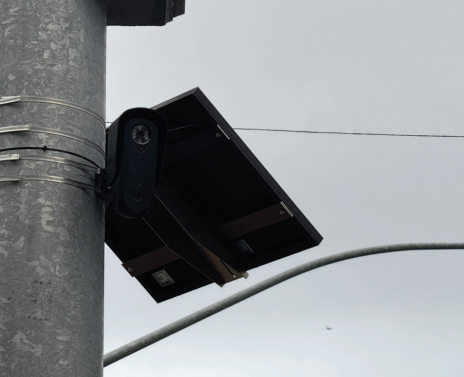
In the past four months, multiple Silicon Valley cities have paused or cut ties with Flock Safety, questioning if the heavy surveillance automated license plate readers provide is worth the risk.
At a Jan. 27 Santa Clara County Board of Supervisors meeting, officials approved District Two County Supervisor Betty Duong’s request to delay renewal of Flock cameras in Saratoga, Cupertino and Los Altos Hills until a full investigation of their use and privacy is completed, according to the board meeting.
Automated license plate readers are small surveillance cameras often on traffic lights that gather license plate data, “for the purpose of rapidly identifying and locating vehicles of legitimate interest to law enforcement,” according to a Northern California Regional Intelligence Center frequently asked questions document about license plate readers.
Duong said that the towns of Santa Cruz and Los Altos Hills had cut ties with the company because of privacy concerns.
“My request is that the (Santa Clara) County Council office and the administration work together to evaluate the issues with Flock and give us an overview of the investigation and an overview of the basis for the contract cancellations that have occurred in Los Altos Hills, with Santa Cruz and potentially any other jurisdictions,” Duong said during the meeting.
Flock cameras refer to Flock Safety, which is one of the largest vendors of these cameras, according to an article by Ars Technica.
Santa Clara County Sheriff Robert Jonsen said the cities of Saratoga, Cupertino and Los Altos Hills have independent contracts with Flock that the county administers.
“They are the purchasers of the equipment, so they contract independently with Flock,” Jonsen said. “Because we provide law enforcement services to those cities, we are the overseers of the automated license plate readers and the data.”
The Los Altos Hills City Council had already voted to terminate its contract with Flock on Jan. 15 and is in the process of removing all cameras, according to an announcement on the town of Los Altos Hills’ website.
Duong expressed concerns that Flock doesn’t abide by District two’s firm data security regulations.
“We do have the strictest (license plate reader) use policy,” Duong said. “What I’m hearing today is the concern that we may have a vendor that doesn’t follow policy.”
Other South Bay cities are experiencing public disapproval of the readers, including San José, according to official documentation filed in the Superior Court of the State of California.
In Nov. 2025, Services Immigrant Rights and Education Network and the Council on American-Islamic Relations California filed a lawsuit against the City of San José and Mayor Matt Mahan, claiming that nearly 500 cameras within San José violate citizens right to privacy, according to the same source.
It also claims the San José Police Department (SJPD) violated the California Constitution by allowing warrantless searches of license plate reader data, according to the same official court documents.
The lawsuit was filed by attorneys American Civil Liberties Union of Northern California and the Electronic Frontier Foundation, a nonprofit dedicated to protecting digital privacy, according to a press release on the foundation’s website.
Adam Schwartz, privacy litigation director for the Electronic Frontier Foundation, said SJPD having unchecked access to a high volume of data gathered from the 500 readers in the city is dangerous.
“A police department that collects and holds this data on such a vast level is playing with fire,” Schwartz said. “They may think they are keeping this data locked down, but over and over again we are seeing that data get lose.”
Schwartz said Immigrations and Customs Enforcement (ICE) can access sensitive data from cameras despite efforts from local governments because each police department can opt to share its data when it’s requested.
“There’s not many precautions in place to prevent ICE from accessing data, even though it says they aren’t supposed to,” Schwartz said. “They are able to access it pretty quickly.”
The Mountain View Police Department discovered a single automatic license plate reader programing allowed for national access to the data for approximately three months in 2024 and is a violation of state law, according to a Jan. 30 article by the Mountain View Voice.
Mountain View law enforcement was unaware the data was available nationally, with several federal agencies conducting searches using the city’s cameras, according to the same source.
All Mountain View’s automated plate readers have been disabled following the data breach, according to a Feb. 2 news release by Mountain View Police Chief Mike Canfield.
Hieu Nguyen, a fourth-year communications student at San José State, described these cameras as a necessary evil.
“It can be a good thing, you know, to track down criminals,” Nguyen said. “…There is like a double edged sword where it can be evil, where it can also hunt down immigrants.”
However, some law enforcement officials such as Jonsen claim license plate readers are beneficial in preventing crime.
“I do think there is value in their technology and I do think it’s something we shouldn’t just dismiss because of their vendor,” Jonsen said.
